Search AquaLots
Find fish, plants, invertebrates and equipment
Best Fish for a 20 Gallon Tank: Complete Stocking Guide for US Aquariums (2026)
22 April 2026
The 20-gallon aquarium is the sweet spot of the freshwater hobby. Big enough for a genuine community, stable enough that beginners have margin for error, small enough to fit in most rooms without dominating them. This guide covers everything that works in a 20-gallon — community combinations, species profiles, what to avoid, and how to build a tank that looks as good in six months as it does on setup day.
Contents
Why 20 gallons is the ideal starter size
The 10-gallon tank gets recommended to beginners constantly, but it's actually the harder tank to keep. Small water volume means parameters change quickly — an ammonia spike or temperature fluctuation that would be a minor blip in a 20-gallon can be fatal in a 10-gallon within hours. The 10-gallon also severely limits which fish you can keep and how many, meaning that the tank is usually overcrowded almost immediately.
The 20-gallon hits the sweet spot. It's large enough that water chemistry changes slowly, giving you time to identify and fix problems. It has enough volume to support a genuine community — schooling fish, a centerpiece, bottom dwellers, and invertebrates living together in layers. It fits on a standard furniture piece or dedicated stand. And when set up thoughtfully, it looks dramatically better than a 10-gallon: the additional depth and width create a sense of space that nano tanks simply can't replicate.
The 20-gallon also comes in two footprints that matter for stocking: the 20 Long (30" × 12" × 12") which provides more horizontal swimming space and surface area, and the standard 20 High (24" × 12" × 16") which provides more vertical depth. The 20 Long is generally preferred for most community fish because most species swim horizontally rather than vertically. The 20 High works better for species that use the full water column — angelfish, gouramis, tall-bodied fish generally.
Stocking rules for a 20-gallon
The old "one inch of fish per gallon" rule is outdated and actively misleading. A 6-inch fish produces far more waste than six 1-inch fish, and the rule says nothing about fish behavior, territory, or swim speed. Ignore it.
Better stocking principles for a 20-gallon:
Stock to adult size, not purchase size. That cute 1-inch common pleco in the store becomes a 12–18 inch fish requiring a tank six times bigger. Research adult sizes before buying.
Think in layers: a top-swimming fish, mid-water schoolers, a bottom dweller. Fish that occupy different zones can share the same water column without competition or conflict.
One centerpiece fish per tank. A centerpiece fish (betta, gourami, dwarf cichlid pair) establishes territory and personality. Multiple territorial centerpiece fish in a 20-gallon creates chronic stress and fighting.
School sizes matter. Neon tetras in a group of three school poorly, look unimpressive, and suffer from chronic stress. Neon tetras in a group of ten school naturally, look spectacular, and thrive. Budget for appropriate school sizes — minimum 6 for most schooling species, 8–12 for species that school tightly.
Understock rather than overstock. A 20-gallon with 15 fish in great health looks better than a 20-gallon with 25 fish in chronically stressed, slightly unwell condition.
Check your water first
Before choosing any fish, test your tap water for pH and hardness, or check your utility's water quality report. This single step prevents the most common source of fishkeeping failure — choosing fish that can't thrive in your specific water chemistry.
Soft water (below 8 dGH, pH below 7.5) — most of the Pacific Northwest, northern Florida, parts of New England and the Southeast — suits tetras, most barbs, South American dwarf cichlids, and many community fish without modification.
Hard water (above 12 dGH, pH above 7.5) — common in the Southwest, Texas, Midwest plains states, and southern Florida — suits livebearers, rainbowfish, most community fish sold in pet stores (which are farm-bred in moderate hardness water), and African cichlids. It's not ideal for wild-caught soft water species.
Most water between these extremes — moderate hardness at neutral to slightly alkaline pH — works for the widest range of community fish and is where the majority of US hobbyists find themselves.
Schooling fish for the mid-water
Schooling fish are the visual foundation of most community tanks — a tight-moving school of ten neon tetras or harlequin rasboras creates a living, dynamic display that no other category of fish matches. For a 20-gallon, choose schooling species that stay under 2 inches, school reliably, and are compatible with your water chemistry.
The best schooling options for a 20-gallon
Neon tetra (Paracheirodon innesi) — the iconic beginner fish, and for good reason. The electric blue and red stripe is one of the most dramatic color combinations in freshwater fishkeeping. At 1.5 inches, a school of 10–12 fits comfortably in a 20-gallon alongside bottom dwellers and a centerpiece. Farm-bred neons are reasonably adaptable to moderate hardness water; wild-caught specimens need soft, slightly acidic conditions. Parameters: 70–81°F, pH 6.0–7.5, GH 1–10 dGH.
Cardinal tetra (Paracheirodon axelrodi) — similar to neons but larger (up to 2 inches) and with more vivid coloration — the red stripe extends the full body length rather than just the rear half. More demanding about water chemistry than neons. Best in soft, slightly acidic water. A school of 8 in a well-planted 20-gallon is one of the most beautiful freshwater displays achievable. Parameters: 73–81°F, pH 5.5–7.0, GH 1–6 dGH.
Harlequin rasbora (Trigonostigma heteromorpha) — orange-copper body with a distinctive dark triangular patch. More adaptable to moderate hardness than tetras, peaceful, and excellent for community setups. At 1.75 inches, keep 8–10 in a 20-gallon. They school tightly and actively. Parameters: 72–77°F, pH 6.0–7.8, GH 2–10 dGH.
Chili rasbora (Boraras brigittae) — one of the most striking nano fish available. Vivid red body, tiny (0.75 inches), and spectacular in groups of 20+ against a planted background. Not for fish with large mouths — keep with similarly tiny companions. Parameters: 68–82°F, pH 4.0–7.0, GH 1–8 dGH. Prefers soft water.
Celestial pearl danio (Danio margaritatus) — small galaxy-patterned fish with vivid spots and red-orange fins. Excellent in planted tanks, peaceful, and unusual enough to stand out from the standard tetra options. Keep 10–12 in a 20-gallon. Parameters: 73–79°F, pH 6.5–7.5, GH 2–10 dGH.
Ember tetra (Hyphessobrycon amandae) — bright orange, tiny (0.8 inches), and spectacular in large groups against green or dark planting. Underrated compared to neons and cardinals but arguably more visually striking in a well-planted setup. Keep 15–20 in a 20-gallon for the best effect. Parameters: 73–84°F, pH 5.5–7.0, GH 1–10 dGH.
Cherry barb (Puntius titteya) — one of the most adaptable community fish available. Males develop vivid cherry-red coloration; females are golden-olive. Not nippy (unlike tiger barbs), peaceful, hardy, and tolerates a wide range of water parameters. At 2 inches, keep 8 in a 20-gallon. Parameters: 73–81°F, pH 6.0–8.0, GH 2–18 dGH. Genuinely hard-water adaptable.
White cloud mountain minnow (Tanichthys albonubes) — temperate fish that thrive at room temperature without heating (64–72°F). Red-tipped fins with iridescent silver stripe. Perfect for cool, unheated setups. Keep 10–12 in a 20-gallon. Parameters: 64–72°F, pH 6.0–8.0, GH 5–15 dGH.
Centerpiece fish options
The centerpiece fish anchors the tank visually and behaviorally. In a 20-gallon, this fish establishes its own territory and provides personality — often approaching the glass, recognizing its keeper, and displaying to tankmates. Choose one centerpiece species, kept as an individual or pair depending on the species.
Betta fish (Betta splendens) — the most dramatic centerpiece for a 20-gallon. Male bettas cannot be kept together, but a single male in a 20-gallon community with peaceful, short-finned tankmates is a spectacular setup. The betta uses the full tank, often develops a relationship with its keeper, and the variety of tail types and colors is extraordinary. Avoid fin-nipping species (tiger barbs, serpae tetras) as tankmates. Parameters: 76–82°F, pH 6.0–8.0, GH 3–15 dGH.
Honey gourami (Trichogaster chuna) — the most beginner-friendly gourami and one of the most underrated fish in the hobby. Golden-yellow body with pale orange fins; males become vivid in breeding condition. Peaceful, hardy, uses the upper water column. Keep a pair (one male, one female) or a single male. Parameters: 72–82°F, pH 6.0–7.5, GH 4–15 dGH.
Dwarf gourami (Trichogaster lalius) — vivid red and blue striping, slightly larger and more dramatically colored than honey gouramis. Males can be aggressive toward each other; keep one male in a 20-gallon. Susceptible to Dwarf Gourami Iridovirus (DGIV) — buy from reputable sources. Parameters: 72–82°F, pH 6.0–7.5, GH 4–10 dGH.
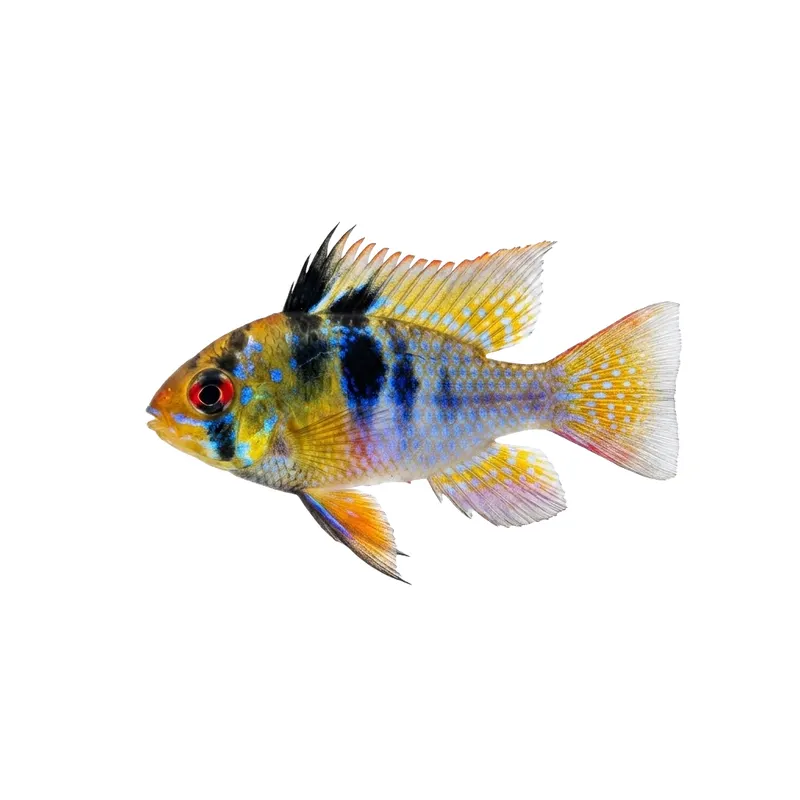
German blue ram (Mikrogeophagus ramirezi) — one of the most beautiful freshwater fish in the hobby. Vivid blue, yellow, and black with red eyes. Demanding about water chemistry (soft, warm water essential) but absolutely stunning when properly kept. Keep a pair. Parameters: 79–86°F, pH 5.0–7.0, GH 2–8 dGH. Not for hard water.
Bolivian ram (Mikrogeophagus altispinosus) — slightly larger and significantly hardier than the German blue ram. Less vivid but still attractive, and dramatically more forgiving about water conditions. Recommended for hobbyists who want a dwarf cichlid without the demanding water chemistry requirements. Parameters: 72–79°F, pH 6.0–7.5, GH 3–15 dGH.
Apistogramma cacatuoides (Cockatoo dwarf cichlid) — males develop spectacular elongated dorsal fin rays and vivid orange-red coloration. Keep one male with two females in a 20-gallon long. Prefer soft, slightly acidic water but farm-bred specimens are more adaptable than wild-caught. Parameters: 72–82°F, pH 6.0–7.5, GH 2–12 dGH.
Bottom dwellers and cleaners
Every community tank benefits from bottom dwellers — species that occupy the lowest water level, cleaning up leftover food, stirring the substrate, and adding activity to the part of the tank that would otherwise be empty.
Corydoras catfish — the foundation bottom dweller of the hobby. Peaceful, armored, active during the day, and available in dozens of species of various sizes. Keep in groups of 6 minimum — solitary corydoras are stressed and inactive. Small species for a 20-gallon include:
Pygmy cory (Corydoras pygmaeus) — 1 inch, schools in mid-water as well as the bottom. Keep 8–10.
Panda cory (Corydoras panda) — 2 inches, distinctive black and white markings. Keep 6.
Salt and pepper cory (Corydoras habrosus) — 1.5 inches, silver with dark spotting. Keep 6–8.
Sterbai cory (Corydoras sterbai) — 2.5 inches, orange pectoral fins, dark spots. Tolerates warmer water than most cories — compatible with discus and rams at 80°F+. Keep 6.
Always use sand or very fine gravel with corydoras. Their barbels (whiskers) are damaged by sharp substrate, which leads to infection and premature death. This is the most common preventable corydoras health issue.
Otocinclus catfish — tiny algae eaters (1.5 inches) that rasp green algae from tank glass and plant leaves without damaging the plants. More effective and less destructive than bristlenose plecos in a planted tank. Keep 4–6 in a 20-gallon. Sensitive to water quality — add only to established, fully cycled tanks. Parameters: 72–79°F, pH 6.0–7.5.
Bristlenose pleco (Ancistrus sp.) — the appropriate pleco for a 20-gallon. Reaches 4–5 inches, stays manageable, and does excellent algae control on glass and hardscape. Unlike the common pleco (which reaches 12–18 inches and is entirely inappropriate for a 20-gallon), the bristlenose stays a workable size. Keep one. Parameters: 60–80°F, pH 6.0–7.5, GH 2–20 dGH.
Kuhli loach (Pangio kuhlii) — eel-like bottom dwellers that burrrow into substrate and emerge at feeding time. Peaceful, interesting, unusual in appearance. Keep 4–6 as they're more active in groups. Fine sand substrate required. Parameters: 75–86°F, pH 5.5–7.0, GH 1–10 dGH.
Shrimp and snails
Invertebrates add cleanup function and visual interest without contributing meaningfully to the bioload. A cleaning crew of shrimp and snails maintains a planted tank in excellent condition.
Cherry shrimp (Neocaridina davidi) — vivid red, easy to breed, excellent algae eaters. Keep 10–20 in a 20-gallon. Compatible with small, peaceful fish — avoid bettas (will eat shrimp), large cichlids, or any fish that can fit a shrimp in its mouth. Parameters: 65–80°F, pH 6.5–8.0, GH 7–15 dGH. Prefer moderately hard water.
Amano shrimp (Caridina multidentata) — larger and more effective algae eaters than cherry shrimp. Translucent with dotted sides. Won't breed in freshwater, so no population management needed. Keep 5–10 in a 20-gallon. Compatible with most community fish except those large enough to eat them. Parameters: 65–80°F, pH 6.5–7.5.
Nerite snails — excellent algae eaters that won't breed in freshwater (eggs are laid but don't hatch without brackish conditions). Available in zebra, tiger, and other attractive patterns. Won't eat plants. Keep 2–4 in a 20-gallon. Parameters: wide tolerance, prefer moderately hard water for shell health.
Mystery snails — larger, more visually interesting snails available in gold, blue, purple, and other color morphs. Peaceful, interesting to watch, excellent scavengers. Do breed in freshwater — control population by removing eggs (laid above the waterline). Keep 2–3 in a 20-gallon. Parameters: wide, prefer moderate hardness.
Complete community build examples
Build 1: The Classic Community (Moderate hardness, any US region)
This works in most US tap water and is the most beginner-friendly setup:
10 harlequin rasboras (mid-water school)
1 honey gourami (centerpiece)
6 panda corydoras (bottom)
5 nerite snails (cleaners)
Parameters: 75–79°F, pH 6.5–7.5, moderate hardness.
Build 2: The Livebearer Community (Hard water — ideal for Southwest/Texas)
8 platies — mixed colors (mid-water)
6 endler's livebearers (upper water)
6 sterbai corydoras (bottom)
5 cherry shrimp (cleaners)
Parameters: 74–80°F, pH 7.0–8.0, hard water preferred. This setup thrives in Phoenix, Las Vegas, Dallas, and other hard water US cities without any water modification.
Build 3: The Planted Nano Community (Soft water — ideal for Pacific Northwest/Southeast)
15 ember tetras (mid-water school)
10 chili rasboras (upper mid-water)
8 pygmy corydoras (bottom/mid-water)
20 cherry shrimp (cleaners)
Parameters: 75–80°F, pH 6.5–7.2, soft to moderately soft. Looks spectacular in a densely planted 20-gallon long with dark substrate.
Build 4: The Betta Community
1 male betta (centerpiece)
8 harlequin rasboras (mid-water — compatible with bettas, short-finned)
6 pygmy corydoras (bottom)
10 cherry shrimp (some may be eaten — betta dependent)
Parameters: 78–82°F, pH 6.5–7.5. Note: some bettas tolerate shrimp, some hunt them. Introduce shrimp first and observe. Dense planting provides shrimp refuge.
Build 5: The Dwarf Cichlid Community (Soft water specialist)
1 male + 2 female Bolivian rams (centerpiece)
8 cardinal tetras (mid-water)
6 sterbai corydoras (bottom — tolerates the warmer temp needed)
Parameters: 78–82°F, pH 6.5–7.2, soft to moderate. The Bolivian ram is recommended over German blue ram for any hobbyist not in a naturally soft water area.
Species to avoid in a 20-gallon
These species are commonly sold in fish stores and frequently end up in 20-gallon tanks where they don't belong. Avoiding them saves you expense, frustration, and animal welfare problems.
Common pleco (Pterygoplichthys pardalis) — reaches 12–18 inches. Produces enormous amounts of waste. Will demolish plants. Not remotely appropriate for a 20-gallon. The fish being sold as "algae eaters" in most chain pet stores.
Goldfish of any variety — cold water fish that do not belong in tropical tanks. Produce extreme amounts of ammonia. Single-tailed goldfish (comets, shubunkins) reach 12+ inches. Fancy goldfish reach 6–8 inches and have chronic health problems in small tanks. Even fancy goldfish need 20 gallons per fish minimum, not a mixed community 20-gallon.
Oscars (Astronotus ocellatus) — reach 12–14 inches. Frequently sold as 2-inch juveniles in pet stores next to tetras and guppies. Will eat every other fish in a 20-gallon. Require 75+ gallons as adults.
Red-tailed sharks (Epalzeorhynchos bicolor) — territorial and aggressive toward their own species and often toward other fish. Reach 6 inches. Need 55+ gallons with territory space.
Tiger barbs in small groups — tiger barbs are vigorous fin nippers when kept in groups smaller than 8–10. Many hobbyists add 3–4 tiger barbs to a community and watch them destroy every long-finned fish in the tank. If you want tiger barbs, keep 10+ in a species-focused setup.
Bala sharks (Balantiocheilos melanopterus) — active open-water fish that reach 14 inches and need 120+ gallon tanks to school properly. Sold as 2-inch juveniles constantly in pet stores.
Discus (Symphysodon spp.) — reach 8–10 inches, require very soft warm water (82–86°F), are extremely sensitive to water quality, and are expensive to replace when conditions aren't right. Not a 20-gallon fish. Not a beginner fish.
Cycling before you stock
The single most important thing you can do before adding any fish to a 20-gallon is cycle the biological filter. The nitrogen cycle is the process by which beneficial bacteria establish in your filter media and convert toxic ammonia (from fish waste) into less toxic nitrite and then into relatively harmless nitrate.
A tank without an established nitrogen cycle will produce ammonia spikes that kill fish within days or weeks of addition. This is "new tank syndrome" and it's the primary cause of beginner fish deaths — not disease, not bad water, just the absence of the biological filter that takes 4–6 weeks to establish.
Fishless cycling is the most ethical and most effective approach: add an ammonia source (pure ammonia, fish food, or a small piece of raw shrimp) to a filled, filtered, heated tank and wait. Test ammonia, nitrite, and nitrate regularly. The cycle is complete when ammonia and nitrite both read zero within 24 hours of an ammonia dose. Only then add fish — slowly, in small groups, to avoid crashing the cycle with a sudden bioload increase.
Sourcing quality fish
The difference between fish from a reputable source and fish from a stressed, over-medicated big-box retailer is often visible immediately — better color, better body condition, no visible disease signs, more natural behavior. But even fish from good sources benefit from quarantine before introduction to a display tank.
AquaLots connects US buyers directly with dedicated breeders and hobbyists who maintain specific species and strains. Buying a school of harlequin rasboras from a hobbyist who has kept a breeding colony for three years, in similar water parameters to yours, is a fundamentally different proposition from buying fish from a chain store's holding tank of unknown origin, age, and health history.
For common species, local fish stores with visibly healthy tanks and knowledgeable staff are a reliable source. For specialist species, color morphs, quality strains of livebearers, or fish not available in your area — AquaLots and similar hobbyist marketplaces are where you'll find them.
More from the Blog
22 Apr 2026
Best Native North American Fish for Your Aquarium: The Complete Guide (2026)
22 Apr 2026
Aquarium Fish Laws in the USA: What You Can and Can't Keep by State (2026)
_400.webp)
22 Apr 2026
How to Sell Fish Online in the USA: Complete Guide for Home Breeders (2026)
22 Apr 2026
US Tap Water and Your Aquarium: A State-by-State Guide to pH and Water Hardness