Search AquaLots
Find fish, plants, invertebrates and equipment
Best Plecos for a Community Tank (And What Most Guides Get Wrong)
8 April 2026
The common pleco is sold in almost every fish shop. It also grows to 18 inches and will terrorise your tank. Here's how to actually pick the right pleco for a community setup.
In this guide
The common pleco problem
Walk into any fish shop and you'll usually find a tank of small, patterned catfish sold as "plecos" or "suckerfish." They look manageable — three or four inches long, browsing algae off the glass, minding their own business. The price tag is low. The temptation is high.
The problem is that most of those fish are Pterygoplichthys pardalis — the common pleco — and they will eventually hit 15 to 18 inches in length. What looks like a tidy algae eater at four months becomes a slow-moving wrecking ball at two years, uprooting plants, producing vast amounts of waste, and outcompeting everything else in the tank for space and oxygen.
This isn't a niche concern. It's one of the most common mistakes in the hobby, and it's almost entirely the result of poor labelling at the point of sale. Many shops don't know — or don't say — what species they're actually selling.
The good news is that the pleco family (Loricariidae) contains hundreds of species, and a good handful of them are genuinely excellent community fish. They stay small, they're peaceful, they're interesting to watch, and they do actually graze on algae. You just need to know which ones to look for.
What actually makes a pleco community-safe?
Before getting into specific species, it's worth understanding the criteria. A pleco that works in a community tank needs to tick most of the following boxes:
Adult size under 6 inches. Anything larger starts to create problems with bioload, territory, and compatibility with smaller tankmates.
Non-aggressive temperament. Most plecos are peaceful, but some species — particularly larger ones — can become territorial around caves and hiding spots, especially when breeding.
Manageable water requirements. If a species needs very specific temperature or pH ranges that conflict with your community fish, it's not a practical choice regardless of temperament.
Low to moderate bioload. Plecos are notoriously heavy waste producers relative to their size. Smaller species are far easier to manage in a mixed community setup.
Substrate and plant compatibility. Some plecos will devour broadleaf plants or constantly disturb the substrate. Good community plecos browse without bulldozing.
With those filters in mind, here are the species that consistently deliver.
Bristlenose pleco
Ancistrus sp. — Various species and hybrids
Stat Value Adult size4–5 inches Min. tank size30 gallons Temperature73–82°F pH range6.5–7.5 Community ratingExcellent
If you only ever keep one pleco in a community tank, make it a bristlenose. They're one of the few species that genuinely earns the "algae eater" label — they'll work through green spot algae, soft green algae, and biofilm with real enthusiasm, particularly on wood and glass surfaces.
Bristlenoses top out around four to five inches, which is large enough to hold their own but small enough to share a tank comfortably with tetras, rasboras, corydoras, and most livebearers. Males develop the characteristic bristle growth on their snout as they mature — females have smaller, less prominent bristles. The males can be territorial with each other, particularly if caves are scarce, but they rarely bother non-pleco tankmates.
The genus Ancistrus has been extensively tank-bred, and you'll find several colour variants in the hobby — albino, longfin, super red, and calico among others. All are equally suitable for community tanks; the breeding has been focused on colour and fin length rather than temperament.
One practical note: bristlenoses are prolific breeders. If you keep a male and female together, eggs are more or less inevitable. The male guards the eggs in a cave and fans them aggressively — this phase can make him temporarily defensive of that territory, not dangerous to other fish, but worth knowing about.
Feed them a varied diet. Algae in the tank helps, but supplement with blanched courgette, cucumber, algae wafers, and the occasional protein-rich food. Like all plecos, they benefit from access to wood — they rasp at it and it aids digestion.
Rubber lip pleco
Chaetostoma milesi / C. formosae
Stat Value Adult size4–5 inches Min. tank size30 gallons Temperature72–80°F pH range6.5–8.0 Community ratingExcellent
The rubber lip pleco is criminally underrated. It's not as striking as some of the L-number species and it doesn't have the same name recognition as the bristlenose, but for pure community tank performance it's hard to beat.
Chaetostoma species originate from fast-moving streams in Colombia and Venezuela, which means they appreciate good water movement and high oxygenation. They're also adapted to cooler water than many tropical plecos, which makes them a reasonable companion for goldfish in larger setups — though they're equally at home in a standard tropical community.
Their broad, fleshy mouths are highly effective raspers. They're particularly good at clearing green spot algae from glass — the harder variety that bristlenoses sometimes struggle with. They're also less boisterous feeders, which means they're less likely to disturb your substrate or uproot plants while foraging.
One caveat: rubber lips are generally less available than bristlenoses and can be harder to source from reputable breeders. When you do find them, they're worth picking up. They're not commonly bred in captivity at scale, so most specimens are wild-caught or F1 — acclimatisation and water quality matter more with this species than with a tank-bred bristlenose.
Clown pleco
Panaqolus maccus — L104 / L162
Stat Value Adult size3.5–4 inches Min. tank size20 gallons Temperature73–82°F pH range6.8–7.6 Community ratingVery good
Clown plecos are among the smallest commonly available pleco species, rarely exceeding four inches. Their dramatic black and orange striped pattern makes them one of the more visually arresting catfish in the hobby, and unlike many plecos that spend most of the day hidden, clowns are reasonably active and visible once settled.
The important nuance: clown plecos are wood eaters, not algae eaters. They belong to the Panaqolus genus, which specialises in digesting wood as a primary food source. They do graze on algae to some extent, but if you're adding a pleco specifically for algae management, a clown pleco will disappoint you. For a tank with a decent piece of driftwood and a varied diet, they're ideal.
Their small adult size means you can house one in a 20-gallon tank — one of the few pleco options for smaller community setups. They can be slightly territorial around their chosen piece of wood or cave, but they're not aggressive. Diet should be primarily wood-based, supplemented with algae wafers, vegetables, and occasional protein-rich foods.
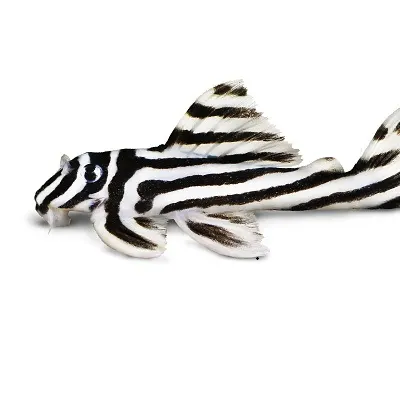
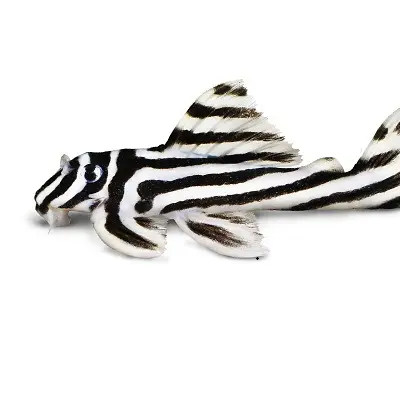
Zebra pleco (L046)
Hypancistrus zebra — L046
Stat Value Adult size3–4 inches Min. tank size20 gallons Temperature79–88°F pH range6.0–7.5 Community ratingGood (with caveats)
The zebra pleco is in a different category from everything else on this list. While the others are practical community fish first, the L046 is primarily a collector's fish that can work in a community setup under the right conditions.
Its bold black and white striped pattern is genuinely stunning, and it's been one of the most sought-after pleco species in the hobby since it was first exported from Brazil's Xingu River in the late 1980s. Today it's endangered in the wild and export is prohibited, which means all available specimens are captive-bred — a success story for responsible aquaculture, but also a driver of the higher price tag.
The community compatibility caveat is temperature. Zebra plecos need warmer water than many community species — 79°F minimum, with 82–86°F being the sweet spot. This rules out tankmates that prefer cooler water and means careful species selection. Good companions include cardinal tetras, discus, and other warm-water species.
They're carnivorous — unlike most plecos, they won't eat much algae at all. Feed them meaty foods: bloodworm, brine shrimp, high-protein wafers. They're shy and often hide during the day, so caves and crevices are essential.
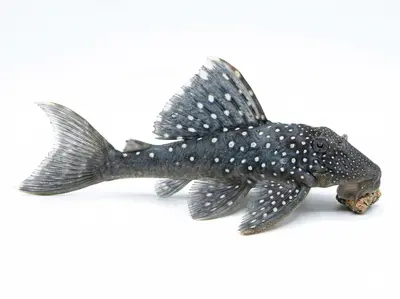
Blue phantom pleco (L128)
Hemiancistrus sp. — L128
Stat Value Adult size~7 inches Min. tank size55 gallons Temperature77–86°F pH range5.8–7.2 Community ratingGood in larger tanks
The blue phantom is the most visually dramatic pleco on this list. Its dark body covered in bright blue-white spots — more vivid in healthy, well-kept specimens — makes it a genuine centrepiece fish. At seven inches it pushes the size boundary for community plecos, but in a tank of 55 gallons or more it works well.
It's a peaceful fish with no interest in harassing other species, and unlike the zebra pleco it does actually graze on algae alongside a carnivorous diet. It originates from Venezuela's fast-flowing rivers, so strong water movement and high oxygenation are important — more so than most community setups provide by default.
Its colouration can fade in poor conditions. Keeping it in a tank with appropriate hiding spaces, good water quality, and a diet of both vegetable matter and protein-rich foods will maintain the vivid spotting that makes this species special. If you're building a larger South American community tank, the blue phantom is an excellent anchor for the bottom of the tank.
Quick comparison table
Species Adult size Min. tank Algae eater? Difficulty Bristlenose 4–5 in 30 gal Yes Beginner Rubber lip 4–5 in 30 gal Yes Beginner Clown pleco 3.5–4 in 20 gal Minimal Beginner Zebra pleco (L046) 3–4 in 20 gal No Intermediate Blue phantom (L128) ~7 in 55 gal Partial Intermediate
Species to avoid in community tanks
Just as important as knowing which plecos work is knowing which ones don't — and why. These species are regularly sold as suitable community fish. They're not.
Common pleco (Pterygoplichthys pardalis)
The most important one to avoid. Grows to 18 inches, produces enormous amounts of waste, and becomes aggressive about food and territory as it matures. Even if yours stays small for a couple of years, you're eventually going to have a problem. Don't buy it for a community tank.
Sailfin pleco (Pterygoplichthys gibbiceps)
Similarly sold as a manageable species, the sailfin can hit 20 inches. Its dramatic dorsal fin is genuinely beautiful and it's sometimes sold specifically as a display pleco — but at adult size it overwhelms any standard community setup. It belongs in a large species tank, not a community.
Royal pleco (Panaque nigrolineatus)
The royal pleco is a wood specialist that gets large — up to 17 inches — and requires very specific conditions to thrive. It's a fascinating species in the right setup but completely wrong for a mixed community tank.
Gold nugget pleco (L018)
This one surprises people. The gold nugget is beautiful, widely available, and not that large at around 8–9 inches. But it's notoriously difficult to keep in good health — sensitive to water quality, prone to stress, and less tolerant of the variable conditions that come with a community tank. It's a species for experienced keepers with stable, well-maintained setups rather than a starter community fish.
Setting up your tank for community plecos
Regardless of which species you choose, a few things make a real difference to how well any pleco settles into a community tank.
Hiding spaces
Plecos are primarily nocturnal and need somewhere dark to retreat during the day. Without adequate hiding spots they'll spend the day stressed and exposed, which suppresses their immune system and makes them more susceptible to disease. Caves, sections of PVC pipe, or clay pots all work. Driftwood with overhanging edges is particularly good because it doubles as a food source. Aim for at least one hiding space per pleco, plus one spare.
Water flow
Most pleco species come from rivers with moderate to strong flow. A standard aquarium filter often provides less movement than these fish prefer, particularly at the substrate level where plecos spend most of their time. Adding a powerhead or adjusting your filter outlet to increase surface agitation and mid-tank circulation will make your pleco more active and comfortable.
Wood
Even species that aren't strict wood eaters benefit from having driftwood in the tank. Plecos rasp at wood surfaces constantly — it helps their digestion and gives them something to do. Bogwood and Malaysian driftwood are the most commonly used types. The tannins released will also soften and slightly acidify your water, which suits most pleco species.
Feeding strategy
Don't assume your pleco is surviving on algae alone. Even in heavily algae-affected tanks, supplemental feeding matters. Blanched vegetables — courgette, cucumber, sweet potato, kale — are cheap and effective. Algae wafers or sinking pellets should be a regular staple. For carnivorous species like the zebra pleco, offer bloodworm, brine shrimp, or high-protein sinking wafers a few times a week. Feed at night when possible — most plecos only become truly active once the lights are off.
Tankmates
The best community tankmates for plecos are mid-water to upper-water fish that don't compete for the same space. Tetras, rasboras, danios, livebearers, and peaceful barbs all work well. Avoid aggressive cichlids that may harass a resting pleco, and be cautious with other bottom-dwellers — corydoras and plecos can coexist, but the tank needs to be large enough that they're not competing for the same feeding spots and hiding places.
The short version
For most community tanks, the bristlenose pleco is the answer. It stays small, eats real algae, is easy to find, and is genuinely peaceful. If you want something a little different — more interesting to look at, more of a specialist — the clown pleco or rubber lip are excellent alternatives. If you're building a more ambitious community setup and have the budget, the zebra pleco or blue phantom are genuinely spectacular fish that are entirely feasible with the right tankmates and conditions.
What you're avoiding is the word "pleco" on a shop label, because that label means almost nothing without a species name. Ask what it is. Look it up. The five minutes you spend doing that will save you from the most common — and most avoidable — mistake in the hobby.
_400.webp)