Search AquaLots
Find fish, plants, invertebrates and equipment
Flowerhorn Cichlid Care Guide: Setup, Feeding and Breeding
7 April 2026
Few fish inspire as much devotion — or as much misunderstanding — as the flowerhorn. This guide covers what it actually takes to keep one well, from tank setup through to breeding.
In this guide
What is a flowerhorn cichlid?
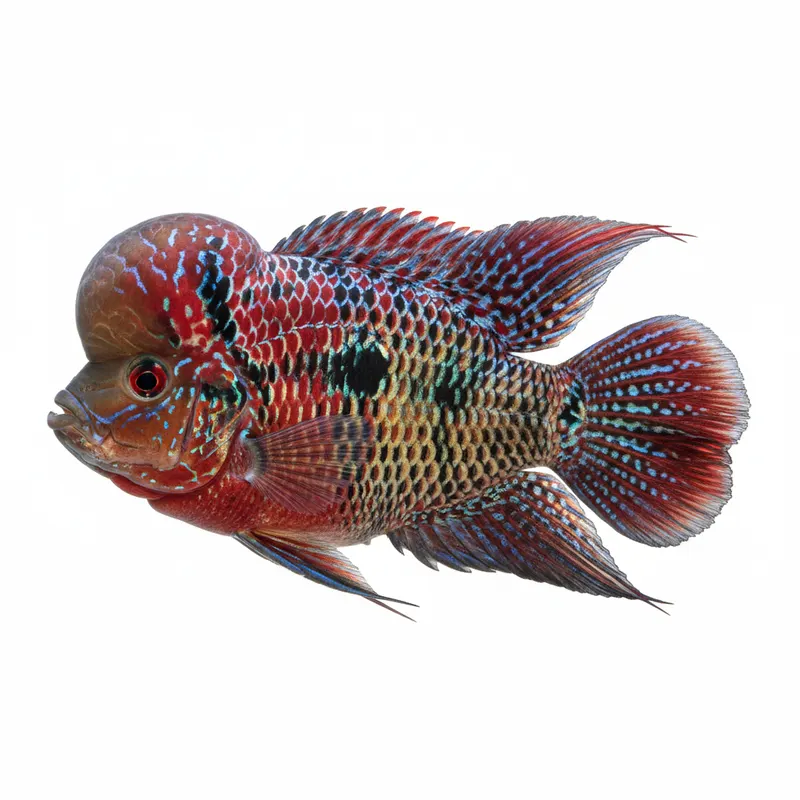
The flowerhorn is one of the most recognisable fish in the aquarium hobby — and one of the most misunderstood. Its oversized nuchal hump (the distinctive lump on the forehead, known in the hobby as the "kok"), vivid colouration, and large, expressive eyes give it an almost face-like quality that is unlike any other aquarium fish. Flowerhorn keepers frequently describe their fish as having genuine personality — recognising owners, responding to interaction, begging for food with obvious enthusiasm. For a fish, this level of perceived interactivity is unusual and it's a significant part of why the species has such a devoted following.
The flowerhorn is a hybrid cichlid, developed in Malaysia and Thailand in the 1990s through selective crossbreeding of various South and Central American cichlid species — most likely including Cichlasoma trimaculatum, Cichlasoma festae, and blood parrot cichlids among others. It has no wild population and exists entirely as an aquarium fish. This hybrid origin is worth understanding because it means flowerhorns don't have the natural habitat parameters you'd look up for a wild species — their requirements have been established empirically through decades of hobbyist and commercial keeping.
The flowerhorn's cultural significance is also worth noting. In parts of Southeast Asia, particularly Malaysia, Singapore, and China, flowerhorns are associated with good fortune and feng shui — the red colouration and prominent forehead are considered auspicious symbols. Premium specimens with particularly developed koks, vivid patterns, and symmetrical markings command extraordinary prices in these markets. The most prized examples have sold for thousands of dollars. This cultural context explains a lot about the breeding focus and the terminology (grades, bloodlines, show quality) that surrounds the fish.
Main varieties and what makes them different
The flowerhorn world has its own taxonomy of varieties, grades, and bloodlines that can seem impenetrable to newcomers. Here's a practical overview of the main categories.
Zhen Zhu (Pearl Scale)
One of the original and most popular varieties. Zhen Zhu flowerhorns are characterised by prominent pearling — the white or iridescent scales scattered across the body — combined with vivid red colouration and a well-developed kok. They're generally considered more beginner-friendly than some other varieties in terms of temperament, though "beginner-friendly" is relative — all flowerhorns are aggressive fish.
Kamfa
Kamfa flowerhorns have a squarer body profile, a more compact head shape, and typically larger koks than Zhen Zhu varieties. The eyes are often sunken-looking and white or yellow in coloration, which is considered desirable in this variety. Kamfas tend to be more aggressive than Zhen Zhus and are generally regarded as more of a specialist fish.
Thai Silk (Golden Monkey)
Thai Silk flowerhorns are among the most visually striking, characterised by a metallic, almost iridescent body colouration that gives the "silk" name its meaning. The golden or platinum variants — sometimes called Golden Monkey — have a pale body with vivid markings and are highly sought after. These are typically more expensive than standard varieties.
Faders
Faders are flowerhorns that go through a colour-loss phase during juvenile development — their bodies temporarily fade to a near-colourless white or grey before developing intense adult colouration. This process is nerve-wracking for first-time keepers who don't know it's coming, but the fish that come through a strong fade often develop the most vivid adult colours. The fade phase can last weeks to months.
Short Body (Ingot)
Short body flowerhorns have a compressed, round body profile compared to the standard elongated shape. This is a selectively bred trait that produces a fish with a very distinctive silhouette. Short body flowerhorns are popular in some markets, though the compressed body can be associated with some health complications in extreme examples.
Tank setup
Getting the tank right before the fish arrives is important with flowerhorns — they're large, active, waste-producing fish that need proper space and filtration from day one.
Tank size
A single adult flowerhorn needs a minimum of 75 gallons. This isn't a conservative estimate with wiggle room — it's the genuine minimum for a fish that reaches 12–16 inches and is highly territorial. A 55-gallon tank can house a juvenile flowerhorn comfortably, but you'll need to upgrade as it grows. Many experienced keepers recommend starting with the adult-sized tank from the beginning to avoid the stress and expense of multiple upgrades.
If you're keeping a pair for breeding, a larger tank is needed — 120 gallons or more — with a clear divider system that allows the fish to see each other without making contact until ready to breed.
Substrate
Flowerhorns are diggers. They will move substrate around the tank with considerable enthusiasm, particularly when breeding behaviour begins. Fine sand is the most practical choice — it's easy to shift (which they seem to enjoy), doesn't trap waste the way coarser gravel does, and is gentle on their undersides when they rest or dig. Avoid sharp-edged substrates.
Bare-bottom tanks are also a common choice for flowerhorn keepers, particularly for breeding setups. They're easier to clean, allow waste to be siphoned directly, and eliminate the digging behaviour that can uproot decorations. The aesthetic is more clinical but the maintenance is significantly easier.
Décor
Keep décor minimal and secure. Flowerhorns will rearrange anything they can move, and they can move more than you'd expect. Large, heavy rocks or purpose-made aquarium ornaments bolted or wedged in place work better than delicate arrangements. Avoid sharp edges that could injure the fish.
Live plants are generally impractical in a flowerhorn tank — they'll be dug up, eaten, or destroyed. Some keepers have success with very tough, robust species like Anubias attached to hardscape, but it's more effort than most flowerhorn setups justify.
Lighting
Standard aquarium lighting is fine. Some keepers use slightly enhanced lighting to bring out the fish's colours — the red and iridescent elements respond well to full-spectrum LED lighting. Avoid very bright lighting for extended periods as it can cause stress in some individuals.
Water parameters
ParameterTarget rangeTemperature78–84°FpH7.0–8.0Hardness (GH)9–20 dGHAmmonia0 ppmNitrite0 ppmNitrateBelow 20 ppm
Flowerhorns are robust fish by cichlid standards, tolerating a reasonable range of parameters. Their hybrid vigour — a genuine phenomenon in hybrid organisms — gives them more resilience than many wild-caught species. That said, consistently poor water quality will catch up with them. Nitrate accumulation is particularly problematic and is the most common long-term water quality issue in flowerhorn tanks.
The pH range is notably more alkaline than South American cichlids — flowerhorns are comfortable in the neutral to slightly hard water that reflects their mixed hybrid heritage. They don't need the very soft, acidic conditions that discus or Amazonian plecos require.
Temperature should be kept consistently warm. Fluctuations are more damaging than a stable temperature at either end of the acceptable range. Invest in a reliable heater — for a large tank, a heater with a capacity well above the minimum for that volume is worth the extra cost. Two smaller heaters running simultaneously is a common approach that provides redundancy if one fails.
Filtration
Flowerhorns are enormous waste producers. A single adult flowerhorn produces more biological waste than most hobbyists expect, and inadequate filtration is the most common cause of health problems in these fish.
The general rule is to filter a flowerhorn tank at three to four times the tank volume per hour, and to use filtration rated for a tank significantly larger than the one you actually have. A canister filter rated for a 200-gallon tank on a 75-gallon flowerhorn setup is not overcautious — it's appropriate. External canister filters are the most practical choice: they have large media capacity, are out of the tank (keeping things cleaner), and are easy to service.
Mechanical filtration should be cleaned regularly — every two to four weeks depending on feeding intensity. Biological media should be cleaned in old tank water, never tap water, to preserve the bacterial colony. Regular water changes of 30–50% per week are essential alongside filtration — no filter eliminates the need for water changes.
Feeding
Flowerhorns are enthusiastic, aggressive eaters. Overfeeding is a common problem because the fish will always appear hungry and actively beg for food. Resist the temptation to feed on demand — overfeeding leads to obesity, elevated nitrates, and associated health problems.
What to feed
A quality cichlid pellet should form the base of the diet. Look for pellets with high protein content (45%+), natural colour enhancers (astaxanthin, spirulina), and a formulation specifically designed for large cichlids. There are several premium flowerhorn-specific foods on the market that are genuinely worth using if you want to optimise colour development and kok growth.
Supplement the pellet diet with:
Bloodworm (frozen is safer than live for disease risk)
Krill and shrimp — excellent natural colour enhancers
Earthworms — highly nutritious and most flowerhorns go absolutely berserk for them
Prawns and mussel — good occasional treats
Feeder fish — controversial due to disease risk; not recommended as a staple
How much and how often
Feed twice daily, offering only what the fish will consume in two to three minutes. Fast the fish one day per week — this is good practice for all large cichlids and helps prevent digestive issues and organ stress. Remove any uneaten food promptly to avoid fouling the water.
Managing aggression
Flowerhorns are one of the most aggressive cichlids in the hobby. This is not a personality quirk that varies by individual — it is a fundamental characteristic of the species that you need to plan around from the start. A flowerhorn will attack and potentially kill most fish that share its tank.
Keeping flowerhorns alone
The simplest and most practical approach is to keep a flowerhorn as the sole occupant of its tank. This eliminates compatibility concerns entirely and lets the fish occupy its full territory without conflict. Most flowerhorn keepers who have kept them long-term end up at this position.
Tankmates — what's possible
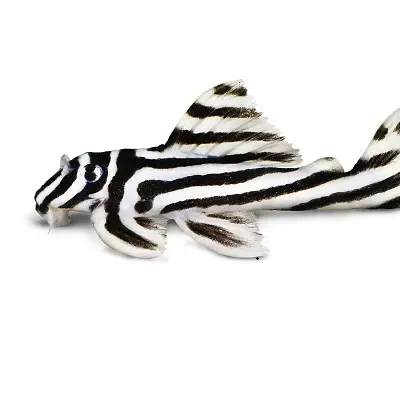
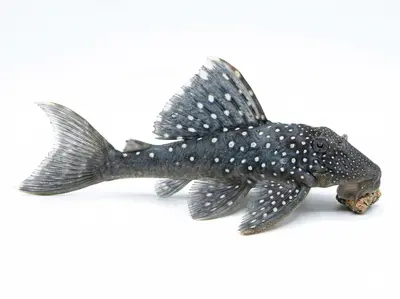
If you want tankmates, the options are limited. Large, robust fish that can hold their own have the best chance: large plecos (a big bristlenose or similar is often left alone because it's armoured and not interesting to attack), large catfish, or other large cichlids in genuinely large tanks with clear territorial divisions. Even with careful choices, aggression is always possible and you need to monitor closely and be prepared to separate fish quickly.
Avoid: any small fish, any long-finned fish, any slow-moving fish, and any fish that doesn't have the size or armour to absorb occasional attacks.
The mirror test
Flowerhorns, like many cichlids, will display and charge at their own reflection. Some keepers use this as enrichment — brief exposure to a mirror triggers natural territorial behaviour and exercise. Don't leave a mirror in permanent contact with the tank as this causes chronic stress.
Common health issues
Hole in the head disease (HITH)
Hexamita-related head and lateral line erosion is one of the most common health problems in large cichlids including flowerhorns. It presents as pitting or erosion around the head and lateral line. The exact cause is debated but poor water quality, dietary deficiencies (particularly vitamin C and mineral imbalance), and activated carbon use have all been implicated. Treatment involves metronidazole, water quality improvement, and dietary supplementation. Caught early, it responds well to treatment.
Ich (white spot)
White spot disease caused by Ichthyophthirius multifiliis is common in cichlids kept in temperature-variable conditions. Presenting as small white granules across the body and fins, it's highly treatable with heat (raising temperature to 86°F speeds up the parasite's lifecycle, making it more vulnerable) and proprietary ich treatments. Flowerhorns are not especially sensitive to standard ich medications.
Bloat
Abdominal swelling in flowerhorns can indicate bacterial infection, internal parasites, or organ problems from overfeeding. Mild cases sometimes respond to fasting and Epsom salt baths; more serious cases need antibiotic treatment. Prevention through appropriate feeding quantities is the best approach.
Kok deterioration
The kok can shrink or become misshapen during stress, illness, poor nutrition, or water quality decline. It's also naturally affected by age and breeding condition. Improving conditions usually results in gradual recovery in younger fish.
Breeding flowerhorns
Breeding flowerhorns is genuinely achievable for dedicated hobbyists, though it requires patience and careful management of fish that are by nature aggressive towards each other.
Sexing flowerhorns
Males develop larger koks, more vivid colouration, and longer ventral fins. Females are generally smaller, less intensely coloured, and have a rounder, fuller abdomen when in breeding condition. Reliable sexing is easier at six months or older. Younger fish are difficult to sex accurately.
Introduction and conditioning
Never place a male and female directly together in an unconditioned tank — the result will almost certainly be a severely injured or dead female. The standard approach is to divide the breeding tank with a transparent divider, allowing the fish to see and display to each other without making contact. This process can take weeks. Signs that the fish may be ready to meet include reduced aggression at the divider, the female showing a breeding tube (ovipositor), and colour intensification in both fish.
Spawning
When the divider is removed and conditions are right, spawning usually happens on a flat surface — a slate tile, a large smooth rock, or the bare glass bottom of the tank. The female deposits eggs and the male fertilises them. Both parents typically guard the eggs aggressively. Clutch sizes range from a few hundred to over a thousand eggs depending on the age and size of the female.
Fry care
Eggs hatch in two to three days at typical flowerhorn temperatures. The parents may move the wriggling larvae to small pits they've dug in the substrate. Free-swimming fry appear within a week and can be fed newly hatched brine shrimp and finely crushed cichlid fry food. Parent behaviour varies — some pairs are excellent guardians, others eat the eggs or fry. If predation occurs, remove the eggs to a separate hatching container.
What to look for when buying
Buying a flowerhorn is a long-term commitment — these fish live 10–12 years with proper care. Take the selection process seriously.
Active and alert. A healthy flowerhorn should be swimming actively, responding to your presence, and showing interest in food. Lethargic or hiding fish are a concern.
Clear eyes. Eyes should be bright and clear, not sunken, cloudy, or protruding.
Good body condition. The body should be symmetrical with no sunken areas, fin damage, or obvious lesions. Check the lateral line and head area for any early signs of HITH.
Strong fins. Fins should be intact and held upright. Clamped fins or ragged edges indicate stress or disease.
Eating. If at all possible, ask to see the fish eat before buying. A fish that refuses food in a shop may have underlying health issues.
Know what variety you're getting. If you're paying premium prices for a specific variety, buy from a seller who can clearly identify and verify what they're selling.
The flowerhorn is not the right fish for everyone. It needs space, it needs serious filtration, it cannot be kept with most other fish, and it demands attention to water quality that some setups can't provide. But for keepers who can meet those requirements, it offers something genuinely unusual in the freshwater hobby: a fish with presence, personality, and an appearance that commands attention from anyone who sees it.
_400.webp)