Search AquaLots
Find fish, plants, invertebrates and equipment
L-Number Plecos: Complete Species Guide with Rarity Ratings
8 April 2026
The L-number system unlocks one of the most diverse and fascinating groups of fish in the freshwater hobby. This guide covers what the numbers actually mean, which species are worth seeking out, and what it genuinely takes to keep them well.
In this guide
What are L-numbers?
If you've spent any time in the pleco hobby, you've come across the L-number system. L046, L200, L333 — strings of letters and numbers that get thrown around in forums, auction listings, and breeder profiles. To an outsider they look like part codes. To anyone who keeps plecos seriously, they're the most useful shorthand in the hobby.
The L stands for Loricariidae — the family of armoured catfish to which all plecos belong. The number is an informal catalogue reference assigned by the German aquarium magazine DATZ (Das Aquarium und Terrarium Zeitschrift) when a new or undescribed species appeared in the aquarium trade. Rather than waiting years for a formal scientific description and Latin name, hobbyists and the trade needed a way to refer to new fish consistently. The L-number system filled that gap.
The first L-numbers appeared in 1988. Since then, over 500 have been assigned, covering everything from common algae-grazing plecs to rare, specialist carnivores that sell for hundreds of pounds per fish. Some have since received formal scientific names. Many haven't. A few have been revised, split into multiple species, or reassigned — which is why you'll occasionally see the same fish listed under two different L-numbers depending on who you ask.
Understanding the system doesn't just make you sound more knowledgeable at a fish auction. It actually helps you buy the right fish, because a species name like "leopard pleco" could refer to a dozen different things, while L134 means exactly one fish.
How the numbering system works
Numbers were assigned roughly in the order species appeared in the German trade, which means they don't correlate to taxonomy, geography, or difficulty. L001 (a Pterygoplichthys) and L002 (a small Parancistrus) are completely unrelated fish that happened to be catalogued around the same time.
A few things worth knowing about how numbers are used in practice:
LDA numbers exist alongside L-numbers. LDA stands for Loricariidae Datz Aqualog and was used when the numbering continued in a sister publication. You'll see fish labelled LDA001, LDA033, and so on. These are the same system, just a different prefix — treat them identically.
Some fish have multiple numbers. If a species was described from different collection localities and initially thought to be separate fish, it may carry two or three numbers. L004 and L028 are both now known to be regional variants of the same species. When buying, check the fish itself, not just the number.
Not all plecos have L-numbers. Species that were formally described before 1988, or that entered the trade after the system became less actively updated, may only have a scientific name. The bristlenose pleco (Ancistrus sp.) is the most obvious example — it's one of the most commonly kept plecos in the world but doesn't carry an L-number because it was already well established in the trade before the system began.
Numbers don't imply quality or desirability. L001 is a large, relatively plain pleco. L046 is the zebra pleco, one of the most beautiful freshwater fish in existence. The number is a catalogue reference, not a ranking.
Beginner L-number species
These species are hardy, reasonably forgiving of water parameter variation, widely available, and well-documented. They're a sensible starting point for anyone new to the L-number world.
L144 — Albino bristlenose pleco
Ancistrus sp. — albino variant
StatValue Adult size4–5 inches Temperature73–82°F pH6.5–7.5 DietOmnivore — algae, vegetables, protein RarityCommon DifficultyBeginner
Technically an albino colour variant of the standard bristlenose rather than a distinct species, L144 is listed here because it's one of the most commonly traded L-numbered fish and a genuinely excellent beginner pleco. Everything that makes the standard bristlenose good applies here — it stays small, eats algae, breeds readily, and is peaceful in a community tank. The albino colouration (pale yellow-orange body, red eyes) makes it more visible than its darker counterpart, which is a bonus if you actually want to see your catfish.
Care is identical to the standard bristlenose. Provide caves for shelter, driftwood for grazing, and a varied diet including blanched vegetables and algae wafers. Males will guard eggs aggressively but are rarely a problem with other species.
L200 — Green phantom pleco
Hemiancistrus subviridis
StatValue Adult size5–6 inches Temperature77–86°F pH6.0–7.2 DietOmnivore — algae, vegetables, some protein RarityUncommon DifficultyBeginner–Intermediate
The green phantom is one of the most striking beginner-accessible L-numbers. Its olive-green body covered in yellow spots is immediately recognisable, and it grows to a manageable five to six inches. It's active enough to be seen during the day once settled, which puts it ahead of many other plecos that vanish the moment you approach the tank.
Like the blue phantom (L128), it's from Venezuela's fast-moving rivers and appreciates strong water flow and good oxygenation. It's an omnivore — it'll graze algae but also needs vegetable matter and some protein in its diet. It's generally peaceful and can work well in a community tank with fish that share its warm-water requirements.
Availability has improved significantly as more breeders work with this species. It's still not as common as the bristlenose, but a specialist seller should be able to source it without difficulty.
L181 — Snowball pleco
Hypancistrus inspector
StatValue Adult size5–6 inches Temperature79–86°F pH5.5–7.0 DietCarnivore-leaning — protein, some vegetables RarityUncommon DifficultyBeginner–Intermediate
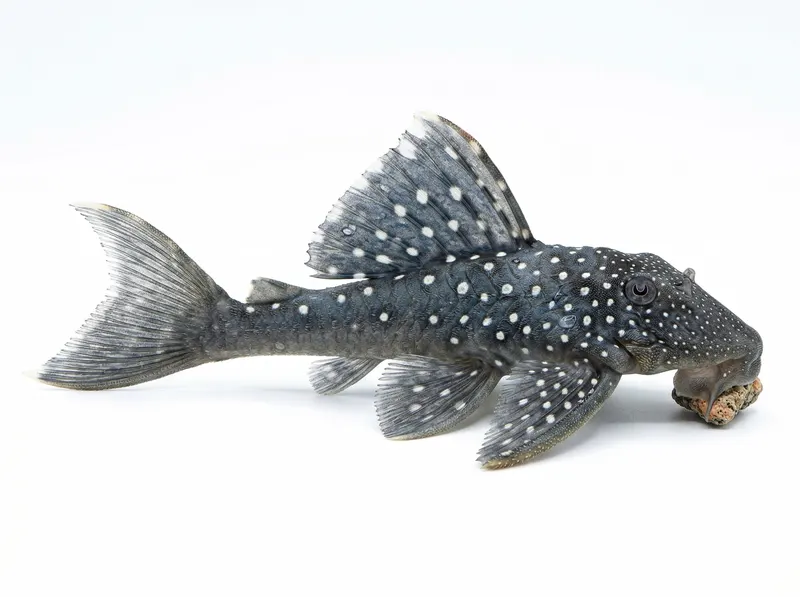
The snowball pleco takes its name from the large white spots on its dark body — a pattern that's visually similar to the zebra pleco but more approachable in terms of care and cost. It's a Hypancistrus, which means it leans carnivorous — don't expect it to clear your algae. Feed it primarily protein-rich foods with some vegetable matter mixed in.
It does well in warmer water, which places it naturally alongside discus, cardinal tetras, and other Amazonian warm-water species. It's cave-dependent and needs plenty of hiding spots to feel secure. Once settled it can become reasonably bold, particularly around feeding time.
Intermediate species
These species require more specific water conditions, more careful sourcing, or more attentive husbandry than the beginner group. They're not difficult fish, but they reward keepers who do their research.
L128 — Blue phantom pleco
Hemiancistrus sp.
StatValue Adult size6–7 inches Temperature77–86°F pH5.8–7.2 DietOmnivore — algae, vegetables, protein RarityUncommon DifficultyIntermediate
The blue phantom is one of the most visually spectacular plecos in the hobby. Its near-black body scattered with vivid blue-white spots catches light in a way that few freshwater fish can match, and the colouration intensifies significantly in a well-maintained tank. At six to seven inches it's one of the larger fish in this guide, but its peaceful temperament and genuine algae-grazing behaviour make it a viable option for a larger community setup.
It needs strong water movement — it originates from fast-flowing Venezuelan rivers — and high oxygenation. A standard hang-on-back filter is usually insufficient on its own. Add a powerhead or wave maker to create the flow this species needs. In stagnant or poorly oxygenated conditions it will become stressed and its colouration will fade noticeably.
Diet should include both algae-based foods (wafers, blanched vegetables) and protein (bloodworm, brine shrimp, quality sinking pellets). It's a genuinely active feeder once comfortable and will often be seen grazing during the day.
L333 — King tiger pleco
Hypancistrus sp.
StatValue Adult size4–5 inches Temperature79–86°F pH6.0–7.2 DietCarnivore-leaning — protein primary RarityUncommon DifficultyIntermediate
The king tiger is a bold, heavily patterned Hypancistrus with irregular black and white banding across its body and fins. It shares a lot of characteristics with the zebra pleco — warm water requirement, carnivorous diet, cave dependence — but is significantly more affordable and somewhat easier to source. For keepers who want a striking Hypancistrus without the zebra pleco price tag, the L333 is the natural starting point.
Like all Hypancistrus, it needs protein-rich food as the majority of its diet. Algae wafers alone won't cut it — feed bloodworm, brine shrimp, high-protein sinking pellets, and occasional live or frozen foods. It's a reasonably willing breeder in captivity given the right conditions: warm water, a tight cave, and good water quality.
L134 — Leopard frog pleco
Peckoltia compta
StatValue Adult size3.5–4.5 inches Temperature77–86°F pH6.0–7.5 DietOmnivore — varied RarityUncommon DifficultyIntermediate
The leopard frog pleco is one of the most charming small plecos in the hobby. Its cream and black tiger-striped pattern — more irregular and organic-looking than the zebra pleco's precise banding — earns it the frog comparison, and it stays compact at three and a half to four and a half inches. It's formally described as Peckoltia compta, making it one of the more scientifically well-documented L-numbers.
It's an omnivore with a good appetite, which makes feeding easier than the strict carnivores. It'll take algae wafers, vegetables, and protein equally well. It's also one of the more active L-numbers during daylight hours, particularly in a tank with good flow and plenty of structure. Compatible with a wide range of community fish given its manageable size and peaceful temperament.
L066 — King tiger pleco (different species)
Hypancistrus sp.
StatValue Adult size5–6 inches Temperature79–86°F pH6.0–7.0 DietCarnivore-leaning RarityUncommon DifficultyIntermediate
Confusingly, both L066 and L333 are commonly sold as "king tiger plecos" — they're related but distinct fish. L066 is slightly larger and has a different pattern, with more labyrinthine markings compared to the cleaner stripes of the L333. Both are worth keeping; just be clear when buying which one you're actually getting, because the names are used interchangeably in some parts of the trade.
Care requirements are near-identical to L333: warm water, protein-heavy diet, cave dependence, and strong flow. L066 is a competent breeder in captivity and has been established in the hobby long enough that captive-bred stock is fairly accessible from specialist sellers.
Advanced and collector species
These species are either genuinely difficult to keep, extremely expensive, very hard to source, or some combination of all three. They're not impossible — hobbyists breed and keep them successfully all over the world — but they require experience, specific setups, and a serious commitment.
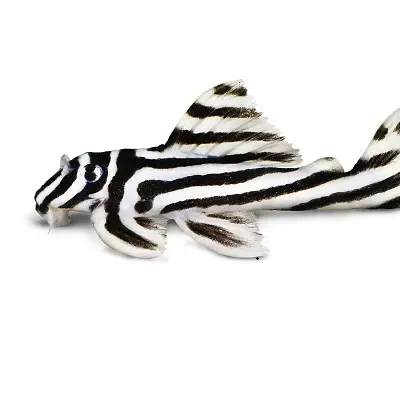
L046 — Zebra pleco
Hypancistrus zebra
StatValue Adult size3–4 inches Temperature82–88°F pH6.0–7.0 DietCarnivore — protein only RarityRare (captive-bred only) DifficultyAdvanced
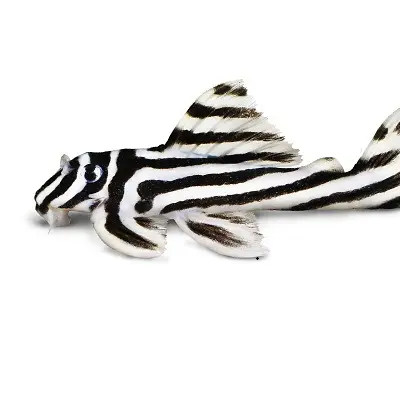
There is no other freshwater fish quite like the zebra pleco. Its stark black and white pattern — precise, high-contrast, almost geometric — sets it apart from everything else in the hobby, and it's been one of the most coveted aquarium fish in the world since it first appeared in the trade in the early 1990s.
Its status has changed significantly since then. Hypancistrus zebra is now listed as endangered in the wild, and Brazil prohibits its export. Every specimen available in the hobby today is captive-bred — a genuine conservation success story built on the work of dedicated breeders who have maintained and expanded the captive population for decades.
The care requirements are exacting. Water temperature needs to be consistently high — 82°F minimum, with 84–86°F being optimal for activity and breeding. The diet is strictly carnivorous: bloodworm, brine shrimp, high-protein wafers, Mysis shrimp. They won't touch algae and will decline on a vegetable-heavy diet. Water quality must be excellent — they're intolerant of elevated nitrates.
They're secretive fish, spending most of their time in caves or tight crevices. Don't expect to see them regularly during the day. Breeding requires closely matched pairs, tight cave entrances (the male guards the cavity), and consistent warm temperatures. It happens reliably in the right conditions but takes patience.
The price reflects all of this. Quality captive-bred zebra plecos from established lines are a significant investment, but the fish is genuinely extraordinary and the captive breeding community around it is one of the most knowledgeable and generous in the hobby.
L025 — Scarlet pleco
Pseudacanthicus pirarara
StatValue Adult size12–14 inches Temperature77–86°F pH5.5–7.0 DietCarnivore — meaty foods RarityRare DifficultyAdvanced
The scarlet pleco is one of the most dramatic large plecos in the hobby. Its orange-red fins against a dark, spotted body create a visual impact that few catfish can match. It's also large — up to 14 inches — and belongs to Pseudacanthicus, a genus of aggressive, predatory plecos that bear almost no resemblance in temperament to the gentle algae grazers most people picture when they think of plecos.
This is not a community fish. It's territorial, carnivorous, and needs a large tank to itself or with similarly sized, robust tankmates. It's included here because it represents an important category of L-number pleco — the large, specialist carnivore — and because it's regularly encountered in the trade and occasionally purchased by people who underestimate what it becomes.
For experienced keepers with the space and setup for a large, aggressive carnivore, the scarlet pleco is magnificent. For everyone else, it's one to admire from a distance.
L173 — Butterfly pleco
Dekeyseria brachyura
StatValue Adult size4–5 inches Temperature77–84°F pH5.5–7.0 DietOmnivore — algae, vegetables, protein RarityRare DifficultyAdvanced
The butterfly pleco is one of the most unusual-looking plecos in the hobby. Its broad, flattened body and wide pectoral fins give it an almost ray-like silhouette, and its complex patterning of spots and reticulations makes it unlike anything else in the Loricariidae. It's a genuine algae eater — one of the better ones at this level — which is a rarity among the more specialist L-numbers.
Its difficulty comes from availability and specific habitat requirements. It's a rock and fast-water dweller that needs very high oxygenation and strong current. It's also sensitive to deteriorating water conditions and doesn't travel or acclimate as easily as more established captive-bred species. When you find one from a trusted source, it's worth the effort — but this is not a fish to buy on impulse from a general fish shop.
Full rarity and care table
L-number Common name Adult size Diet type Rarity Difficulty L144 Albino bristlenose 4–5 in Omnivore Common Beginner L200 Green phantom 5–6 in Omnivore Uncommon Beginner–Int. L181 Snowball pleco 5–6 in Carnivore-leaning Uncommon Beginner–Int. L128 Blue phantom 6–7 in Omnivore Uncommon Intermediate L333 King tiger 4–5 in Carnivore-leaning Uncommon Intermediate L134 Leopard frog 3.5–4.5 in Omnivore Uncommon Intermediate L066 King tiger (alt.) 5–6 in Carnivore-leaning Uncommon Intermediate L046 Zebra pleco 3–4 in Carnivore Rare Advanced L025 Scarlet pleco 12–14 in Carnivore Rare Advanced L173 Butterfly pleco 4–5 in Omnivore Rare Advanced
Water conditions for L-number plecos
One of the most consistent mistakes people make with L-number plecos is applying tropical fishkeeping generalisations to fish that come from very specific environments. The Xingu River, where the zebra pleco originates, is not the same as a generic Amazonian tributary. Getting the water right matters more with these fish than with most.
Temperature
Most L-number plecos from Brazilian and Venezuelan river systems prefer warmer water than the standard tropical tank. While 76–78°F is comfortable for a community tank, many Hypancistrus species really thrive at 82–86°F. This affects tankmate choice significantly — you can't combine a zebra pleco with species that prefer cooler water.
pH and hardness
The majority of L-number plecos originate from soft, acidic water. A pH of 6.0–7.0 suits most species, with some preferring the lower end of that range. Hard, alkaline water won't kill most of them immediately, but it will suppress their immune systems, reduce activity, inhibit breeding, and shorten their lives. If your tap water is hard, consider using RO water blended to the target parameters.
Flow and oxygenation
Fast-water species — blue phantom, green phantom, butterfly pleco — need significantly more flow than a standard filter provides. These fish evolved in rivers where the current is strong enough to move gravel. In a tank with insufficient flow they become sluggish, lose colour, and are more susceptible to infection. A powerhead or additional circulation pump is not optional for these species — it's a basic care requirement.
Nitrates
All plecos are heavy waste producers, and L-numbers — particularly the carnivorous Hypancistrus — are no exception. Elevated nitrates are the single most common cause of long-term decline in these fish. Test regularly, keep nitrates below 20 ppm ideally, and don't overstock. Weekly water changes of 30–50% are standard practice for serious L-number keepers.
Feeding L-number plecos
The feeding requirements of L-number plecos vary enormously by genus, and getting this wrong is a genuine welfare issue, not just a performance problem.
Algae eaters
True algae-grazing species — including most Ancistrus, Hemiancistrus, and some Peckoltia — should receive a diet that's primarily vegetable-based. Blanched courgette, cucumber, sweet potato, spinach, and kale are all effective. Spirulina-based algae wafers should be a regular staple. These fish still need some protein, but it shouldn't dominate the diet.
Carnivores
Hypancistrus species — zebra, snowball, king tiger, and related fish — are primarily carnivorous and should be fed accordingly. Bloodworm (live or frozen), brine shrimp, Mysis shrimp, and high-protein sinking wafers form the core diet. Vegetables can be offered occasionally but shouldn't be the main food source. These fish will often ignore algae wafers entirely.
Omnivores
Most Peckoltia and some Hemiancistrus fall into a middle ground — they eat both plant and animal matter with equal enthusiasm. Variety is the key with these species. Rotate through different foods across the week rather than relying on a single staple.
Wood
Driftwood should be available to all pleco species regardless of diet type. Even strictly carnivorous species rasp at wood surfaces, and it contributes to gut health. For Panaqolus and Panaque species, wood is a primary food source and essential, not optional.
Feeding time
Feed in the evening when the lights go off or dim. Most L-number plecos are nocturnal and will ignore food dropped into a brightly lit tank during the day. Evening feeding dramatically increases the amount of food they actually consume and reduces waste rotting on the substrate overnight.
Where to source L-number plecos
Sourcing is one of the most important — and most underestimated — parts of keeping L-number plecos successfully. The difference between a fish bought from a general pet shop and one sourced from a specialist breeder is significant: better health on arrival, better genetic history, better acclimation to aquarium life, and a seller who actually knows what the fish is and what it needs.
General pet shops
Most general pet shops carry a small selection of the more common L-numbers — bristlenose variants, occasionally clown plecos or green phantoms. For anything more specialist, they're usually not the right source. Staff knowledge is variable, and fish are often kept in conditions that don't reflect their actual requirements. For common species it's fine. For anything from the intermediate or advanced category, look elsewhere.
Specialist aquatic shops
A good specialist aquatic retailer will carry a broader range and have staff who can answer specific questions about the fish they sell. These shops are worth seeking out and supporting — they're an important part of the hobby ecosystem. Stock varies significantly and you may need to ask about ordering specific species in.
Specialist breeders
For rare and intermediate species, buying directly from a specialist breeder is almost always the best option. Captive-bred fish are hardier, better adapted to aquarium life, have a known history, and don't contribute to wild collection pressure. The breeder can tell you exactly what conditions the fish has been raised in, what it's been fed, and what parameters it's used to — information that's genuinely useful when you're acclimating a new fish.
Aquatics marketplaces, specialist Facebook groups, and dedicated pleco forums are the main ways to find breeders. When buying, ask about the fish's age, what it's been fed, the water parameters it's been kept in, and whether the seller has bred from it before. A good breeder will answer all of these questions readily.
Auctions and fish sales
Aquatics auctions — both in-person club events and online platforms — are one of the best places to find unusual L-numbers at fair prices. The fish at these events often come directly from hobbyist breeders who keep large colonies of specific species. Quality is generally high and prices are often better than retail. It's worth getting connected with local aquatics clubs and online groups if you're serious about the L-number hobby.
Final thoughts
The L-number system opened up a corner of the aquarium hobby that was previously inaccessible to most people. Without a reliable way to refer to undescribed species, the remarkable diversity within Loricariidae would have been much harder to catalogue, trade, and appreciate. The fact that the zebra pleco is now entirely sustained by captive breeding — with no wild collection — is partly a consequence of that accessibility: hobbyists could identify, acquire, and breed a specific fish, rather than purchasing an anonymous "pleco" and hoping for the best.
Starting with L-numbers doesn't require going straight to the rare and expensive end of the spectrum. The green phantom, snowball, and leopard frog pleco are all genuinely interesting, well-patterned fish that are manageable for a keeper with some tropical fishkeeping experience. They'll give you a feel for what this group of fish needs — warm water, strong flow, varied diet, quality hiding spaces — before you commit to something more demanding.
When you're ready to go further, the Hypancistrus world in particular has an outstanding community of breeders and enthusiasts who are extraordinarily generous with advice. The zebra pleco, for all its requirements, has been bred successfully by hobbyists for over three decades. The knowledge is there — you just need to find the people who have it.
_400.webp)