Search AquaLots
Find fish, plants, invertebrates and equipment
Aquarium Equipment Guide: What You Actually Need (And What You Don't)
5 April 2026
Walk into any aquarium shop and you'll find shelves of equipment ranging from genuinely essential to completely unnecessary. This guide cuts through the marketing and tells you what actually matters.
In this guide
The tank itself
The tank is the foundation of everything and the most consequential purchasing decision you'll make. Getting the size right from the beginning matters more than most beginners appreciate — the most common regret in fishkeeping is starting too small.
Size: bigger is better, within reason
Larger tanks are more stable than smaller ones — temperature fluctuations are slower, parameter swings from partial water changes are less dramatic, and there's more margin for error in everything from stocking to feeding. A 40-gallon tank is significantly easier to maintain than a 10-gallon tank in almost every dimension that matters.
The trade-off is cost, space, and the weight of water (approximately 10 pounds per gallon, plus the tank itself). A 40-gallon tank full of water, substrate, and rock weighs several hundred pounds — it needs to sit on a surface rated for that load, ideally with weight distributed over the full tank footprint.
For a first tropical tank, 30–55 gallons is the practical sweet spot for most people — big enough to be stable and to stock reasonably, small enough to be manageable in a typical room. If space genuinely limits you to a smaller tank, a 20-gallon is workable. Anything smaller than 10 gallons is expert territory — nano tanks are harder, not easier, despite their size.
Shape
Standard rectangular tanks are the most practical shape. They provide the maximum surface area for gas exchange relative to volume, the most usable swimming space, and the easiest maintenance access. Tall, narrow tanks sacrifice surface area for visual height — not ideal for most fish species. Bowfront and corner tanks look attractive but complicate cleaning and limit viewing angles.
Glass vs acrylic
Glass tanks are more scratch-resistant, don't yellow with age, and are typically less expensive. Acrylic tanks are lighter, optically clearer at wider viewing angles, and can be formed into shapes that glass can't. For most hobbyists, glass is the better choice.
Complete setups vs component buying
Starter kits — tank, filter, heater, and sometimes lighting sold together — are often good value for beginners. The included equipment is rarely the best quality available but is typically adequate to get started. As you gain experience, you'll replace components with better alternatives based on what actually matters for your specific setup.
Filtration
Filtration is the most important equipment decision after the tank itself. The filter is the biological engine of the aquarium — it maintains the bacterial colonies that process toxic ammonia and nitrite into the less toxic nitrate. Without adequate filtration, fish die. It's that straightforward.
Filter types
Hang-on-back (HOB) filters hang on the back of the tank, drawing water up through an intake tube, passing it through filter media, and returning it over the back edge. They're practical, easy to maintain, and effective in the right size range. They're exposed to temperature changes (the exposed pump can overheat in warm rooms, or slow in cold), and they're best suited to tanks up to 55 gallons. Most are rated for tanks smaller than their stated maximum — size up.
Canister filters sit below the tank in a cabinet, drawing water down through an intake, through the filter canister, and pumping it back up and into the tank through a return. They have larger media capacity than HOBs, are quieter when maintained, and are better suited to larger tanks or setups requiring high flow. They're more expensive, harder to prime after maintenance, and require more space. For tanks of 40 gallons and above, a canister filter is usually the better long-term choice.
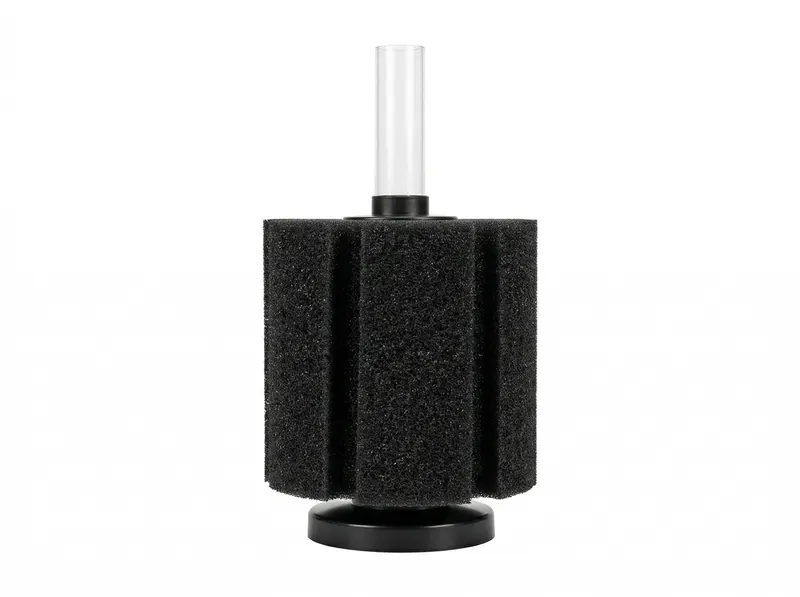
Sponge filters are powered by an airline and airpump. They provide biological filtration through the colonised sponge surface and gentle mechanical filtration. They're inexpensive, safe for fry and shrimp (no intake risk), easy to maintain, and extremely reliable. They're not adequate as the sole filtration for heavily stocked tanks or species that produce a lot of waste, but they're excellent in breeding tanks, quarantine tanks, and lightly stocked setups.
Internal filters submerged in the tank, typically with a small impeller and sponge media. Adequate for smaller tanks and as supplemental filtration. Not the most efficient use of tank space, and maintenance requires putting hands in the tank.
How much filtration?
The general rule is to filter at four to six times the tank volume per hour. A 40-gallon tank needs a filter rated for 160–240 gallons per hour at minimum. For heavily stocked tanks or species that produce significant waste (cichlids, goldfish, large catfish), size up further. Running two smaller filters rather than one large one provides redundancy — if one fails, the other maintains biological filtration until you can fix or replace it.
Filter media
Filter media is what lives inside the filter. It falls into three categories: mechanical (traps solid waste — foam, filter floss), biological (provides surface area for beneficial bacteria — ceramic rings, bio-balls, sintered glass), and chemical (removes dissolved compounds — activated carbon, zeolite). Mechanical and biological media are essential. Chemical media is optional and its use is situational — activated carbon is useful for removing medication residue or tannins, but it also removes trace elements and needs replacing monthly to remain effective.
Heating
Most tropical fish require water temperatures of 75–82°F — well above typical room temperature in most climates. A reliable heater is not optional for tropical fishkeeping.
Heater sizing
The general rule is 3–5 watts per gallon. A 40-gallon tank in a normal room temperature environment needs a 150–200 watt heater. In colder rooms or for tanks requiring higher temperatures (zebra plecos, discus), size up. Running two smaller heaters — each rated for slightly more than the required total — provides redundancy that's worth the extra cost. If one heater fails, the other maintains a survivable temperature until you can replace it.
Heater types
Submersible glass heaters are the standard. They sit inside the tank, attached to the glass with suction cups. Modern versions with reliable thermostats are safe and accurate. Position them horizontally or at a diagonal near the substrate in an area of good water flow — this ensures the thermostat reads the actual tank temperature rather than its immediate surroundings.
Inline heaters attach to the output line of a canister filter, heating the water as it returns to the tank. They're neat, effective, and keep the heater out of the display tank. Requires a canister filter to use and is more expensive than standard heaters.
Heater controllers are separate thermostat controllers into which you plug a basic heater. The controller manages temperature independently of the heater's built-in thermostat, providing much more precise temperature control. Useful for species requiring precise temperatures (zebra plecos, discus) and for monitoring — many controllers have audible alarms for temperature deviation.
What can go wrong
Heater failure comes in two forms: failure to heat (the fish get cold) and failure to stop heating (the fish cook). The second is less common but more immediately fatal. Using a controller eliminates the risk of a stuck-on heater by cutting power independently of the heater's internal thermostat. Monitor tank temperature daily — a cheap thermometer is worth having as a cross-check against the heater's thermostat.
Lighting
Lighting requirements depend heavily on what you're keeping. For fish-only tanks with artificial décor, almost any light that makes the fish visible is adequate. For planted tanks, light intensity and spectrum matter significantly.
LED lights
LED lighting has replaced fluorescent as the standard in modern aquarium equipment. LEDs are more energy-efficient, last longer, run cooler, and are available in a wide range of intensities and spectrums. Quality varies considerably — a branded aquarium LED suitable for plant growth is meaningfully better than a cheap generic option, even at the same nominal wattage.
Light intensity
For non-planted or low-tech planted tanks (the species in the beginner plant guide), modest lighting is adequate — 20–40 PAR (photosynthetically active radiation) at the substrate is sufficient. For high-tech planted tanks with CO2 injection and demanding stem plants, 50–80+ PAR is needed. Most branded aquarium LEDs designed for planted use provide adequate intensity at appropriate depths.
Light duration
Run the aquarium light for eight to ten hours per day on a consistent schedule. More than ten hours increases algae risk without proportionate plant growth benefit. Use a timer — consistent photoperiods support both plant growth rhythms and fish behaviour patterns. Inconsistent lighting causes chronic low-level stress in fish.
Testing equipment
You cannot maintain water quality by sight. Water that looks crystal clear can have lethal ammonia or nitrite levels. Testing is the only way to know what's actually happening in your tank.
Liquid test kits
Liquid test kits (the most widely used is the API Freshwater Master Test Kit) are the reliable standard for aquarium water testing. They test ammonia, nitrite, nitrate, and pH at minimum. Follow the instructions exactly — shake reagent bottles, time the colour development correctly, read in natural light. Liquid tests are accurate enough to make meaningful husbandry decisions.
Test strips
Test strips are faster but significantly less accurate than liquid tests, particularly at the low concentrations that matter most — the difference between 0 and 0.25 ppm ammonia is critical, and most strips can't reliably distinguish these values. Use strips for quick spot-checks if you wish, but confirm with liquid tests for important decisions.
Digital meters
TDS (total dissolved solids) meters and pH meters are inexpensive and useful. A TDS meter is practically essential if you're keeping shrimp or using RO water. A calibrated pH meter is more accurate than liquid tests for pH, though liquid tests are adequate for most purposes. Calibrate meters regularly with reference solution.
What to test and when
During cycling: ammonia and nitrite every 2–3 days
First month after adding fish: ammonia and nitrite weekly
Established tank: ammonia and nitrite monthly (or when fish appear stressed)
Nitrate: weekly to inform water change frequency
pH: monthly or when adding new fish from different water conditions
Substrate
Substrate choice affects aesthetics, plant growth, fish behaviour, and water chemistry. The options range from inert (doesn't affect water parameters) to active (buffers pH and provides nutrients).
Plain sand
Inexpensive, easy to clean, gentle on bottom-dwelling fish, and available in various colours. Pool filter sand or play sand (rinsed thoroughly before use) is an economical option. Fine aquarium sand is more expensive but cleaner. Sand suits most freshwater tropical fish and is particularly good for cichlids, corydoras, and plecos.
Gravel
The traditional aquarium substrate. Coarser than sand, which means it traps debris between particles — more cleaning required. Fine gravel (2–3mm) is more practical than coarse. Coloured gravels are purely aesthetic; natural tones look better long-term.
Plant substrates
Nutrient-rich substrates (ADA Aqua Soil, Fluval Stratum, Seachem Flourite) contain minerals that feed plant roots and in the case of active substrates, buffer pH downward. Significantly more expensive than sand or gravel. Worth the investment for high-tech planted tanks; unnecessary for low-tech setups with root tabs.
Circulation and flow
For most community tanks, the flow from the filter provides adequate circulation. For specific applications, additional circulation equipment is useful or necessary.
Powerheads — submersible pumps that move water without filtering it — are used to increase flow in tanks with species that require strong current (river-dwelling plecos, hillstream loaches) or to create circulation patterns that the filter outlet alone doesn't produce. Essential for zebra plecos, blue phantom plecos, and hillstream species.
Wave makers — powerheads with an alternating flow pattern — create more natural wave-like circulation than constant directional flow. Used in larger tanks and reef systems; occasionally useful in freshwater for species from highly variable-flow environments.
Useful optional equipment
These items aren't essential for basic fish keeping but are genuinely useful and worth considering.
Timer — for consistent lighting duration. Inexpensive and eliminates the inconsistency of manual switching. Worth buying for any planted tank.
Gravel vacuum / siphon — essential for substrate cleaning during water changes. The standard Python-style siphon started by suction is effective; auto-start versions are more convenient.
Magnetic algae scraper — keeps the glass clean without putting your arm in the tank. The Flipper brand is widely recommended for its longevity and effectiveness.
Protein skimmer (freshwater) — not relevant; protein skimmers are marine equipment.
UV steriliser — kills free-floating pathogens and algae spores in the water column. Useful for outbreak control and disease prevention in heavily stocked tanks. Not essential for most setups.
CO2 system — for high-tech planted tanks. Pressurised CO2 injection significantly accelerates plant growth and unlocks more demanding plant species. Not necessary for the beginner plants in this guide but worth considering if you advance into planted tank keeping.
Automatic water changer — connects to a tap and drain to automate water changes. Expensive but eliminates the labour of manual water changes in large or multiple tank setups.
Equipment you can skip
The aquarium equipment market contains a lot of products that make impressive claims but deliver limited practical benefit. These are the most commonly recommended items that experienced hobbyists typically either don't bother with or actively advise against.
Undergravel filters — a technology from decades past that's been superseded by modern filtration. Difficult to clean, inefficient, and problematic in planted tanks. Don't bother.
Airstone and air pump as primary filtration — an airstone adds oxygenation but doesn't filter. It's not a filtration solution. Fine as supplemental oxygenation; not a substitute for actual filtration.
Chemical filter additives added routinely — products claiming to instantly improve water quality, neutralise all toxins, or eliminate the need for water changes are typically effective for very short-term emergency situations and not as ongoing maintenance products. Regular water changes and good filtration achieve what these products can't.
Colour-enhancing foods as a substitute for good conditions — fish colour reflects health and conditions first, diet second. Colour-enhancing foods are a supplement to good husbandry, not a replacement for it.
Overpriced "aquarium salt" for freshwater — where aquarium salt genuinely helps (mollies, some cichlids, disease treatment), it's effective. It's not a universal water conditioner or necessary addition to every freshwater tank, and plain non-iodised table salt is chemically identical to branded aquarium salt at a fraction of the price.
Practical starter equipment list
For a 40-gallon tropical freshwater community tank:
40-gallon glass tank with lid or cover
Canister filter rated for 80+ gallons, or HOB filter rated for 80+ gallons
200-watt submersible heater (two 100-watt heaters for redundancy is better)
Thermometer (separate from heater)
LED light appropriate for tank size (8+ hours via timer)
Plug-in timer for lights
Fine sand or gravel substrate
API Freshwater Master Test Kit
Dechlorinator (Seachem Prime is widely recommended — it also temporarily detoxifies ammonia and nitrite)
Gravel vacuum / siphon
Buckets dedicated to the aquarium (not used for cleaning products)
Magnetic glass cleaner
Driftwood and/or rocks for décor and hiding
This setup provides everything you genuinely need to run a healthy, stable tropical freshwater tank. Additions like CO2 systems, specialist substrates, additional powerheads, and UV sterilisers are worth considering as your experience develops and your keeping goals become more specific. Start with the essentials, learn what your particular tank needs, and add equipment in response to real requirements rather than marketing.