Search AquaLots
Find fish, plants, invertebrates and equipment
Aquarium Snails UK: The Complete Guide to Species, Care and Where to Buy
31 March 2026
Why Aquarium Snails Are Having a Moment
Aquarium snails have gone from being the thing hobbyists try to get rid of to one of the most actively traded livestock categories in the UK hobby. Search interest for snail species is climbing year on year. Dedicated breeders are selling out of mystery snail clutches before they have even hatched. Assassin snails — once a niche pest-control solution — are now a staple of planted tank setups across the country.
Part of this is the planted tank and aquascaping boom. As more hobbyists move towards heavily planted setups, snails have become essential — algae cleaners, substrate turners, and in many cases genuinely beautiful animals in their own right. Part of it is simply that people have discovered snails are interesting, easy to keep, and far more varied than the brown pond snails lurking uninvited in most community tanks.
This guide covers everything you need to know about keeping aquarium snails in the UK — which species are worth keeping, how to care for them, the legal situation around one of the most popular species, and where to find quality stock. Whether you want algae control, pest management, a breeding project, or just something a bit different in your tank, there is a snail for you.
The Mystery Snail Story — Why One of the UK's Most Popular Snails Was Banned (and Is Back)
Before getting into care guides, it is worth covering a piece of UK aquatic legislation that affected hobbyists for nearly a decade and still confuses many people today.
Mystery snails — the large, colourful apple snails sold in the hobby under the Pomacea genus — were banned from sale across the EU in 2012. The reason was agricultural risk: apple snails are an invasive pest in rice paddies across Asia and parts of Europe, and the EU classified the whole Pomacea genus as a prohibited invasive species to prevent accidental release into waterways.
For UK hobbyists, this meant nearly nine years without access to one of the hobby's most popular and beginner-friendly snail species. The ban covered import, sale, keeping, and breeding — a blanket prohibition that frustrated aquarists and cost the industry significant trade.
Then Brexit changed things. Following the UK's departure from the EU single market, Great Britain was no longer bound by EU invasive species regulations. In early 2021, the Ornamental Aquatic Trade Association successfully lobbied DEFRA to assess mystery snails independently, and the result was that Pomacea bridgesii — the mystery snail species most commonly sold in the hobby — was cleared for sale in England, Scotland and Wales.
There is an important caveat: Northern Ireland remains subject to the NI Protocol and EU regulations, meaning mystery snails still cannot be legally sold or kept there. If you are in Northern Ireland, this species is still off the table.
For the rest of the UK, mystery snails are back — and demand has been strong ever since. If you have not kept them before, they are an excellent choice, and we will cover exactly how to keep them well below.
Nerite Snails — The Best Algae Cleaner in Freshwater
If you only add one snail species to your tank, make it a nerite. No other freshwater snail comes close to their algae-eating ability. A single nerite snail will visibly clean a glass panel overnight. A group of four or five in a planted tank will keep algae growth in check on glass, hardscape, and plant leaves more effectively than almost any other method.
Species Available in the UK
Several nerite varieties are available to UK hobbyists, each with slightly different markings. Zebra nerites — black and yellow striped — are the most common and the easiest to find. Tracked nerites (also called tiger nerites) have a similar pattern with slightly more variation. Olive nerites are plainer but hardy and effective. Horned nerites are a smaller, spikier variant that works particularly well in tanks with fine substrate and low-profile hardscape.
All nerite species eat algae in broadly the same way and have the same care requirements. The choice is largely aesthetic.
Care Requirements
Nerites are adaptable but do best in established, stable tanks. They need calcium in the water to maintain healthy shells — very soft, low-mineral water leads to shell pitting and erosion over time. In most UK tap water this is not a problem, as our water tends towards moderate to hard. If you are running an RO or very soft water setup, add a small amount of mineral supplement to support shell health.
Temperature range is broad — 18°C to 28°C suits them fine, making them compatible with both tropical and coldwater setups. pH should be neutral to slightly alkaline, ideally 7.0 to 8.0. They are sensitive to ammonia and nitrite like all invertebrates, so only add them to a fully cycled tank.
Nerites eat algae almost exclusively. They will also consume biofilm and the occasional algae wafer, but if your tank has genuine algae growth they will not need supplemental feeding. If your tank is very clean, drop an algae wafer near them a few times per week.
The Breeding Situation
Here is the key fact about nerites that makes them uniquely useful: they cannot breed in freshwater. They lay eggs — small, white, sesame-seed-shaped capsules stuck to surfaces — but those eggs require brackish or marine water to hatch. In a freshwater tank, the eggs are laid but never develop. This means nerites will not overpopulate your tank, which is a genuine problem with some other snail species.
The eggs are the one downside. They stick firmly to glass, hardscape and equipment and are difficult to remove without scraping. In a tank with a lot of natural hardscape, they are barely noticeable. In a minimalist setup, they can be a mild annoyance.
Stocking Numbers
One nerite per 10 litres is a reasonable starting point in a tank with moderate algae growth. In a heavily planted tank with strong lighting and good nutrient levels — conditions that produce significant algae — you can stock more generously. They are peaceful with all fish and invertebrates and will not bother even the smallest nano fish or shrimp.
Nerite snails are one of the most consistently available species on AquaLots, listed by hobbyist sellers and small breeders across the UK. Buying from a hobbyist source gives you snails that have been kept in freshwater conditions and acclimatised to aquarium life, which is preferable to shop-bought specimens that may have come through a brackish wholesale chain.
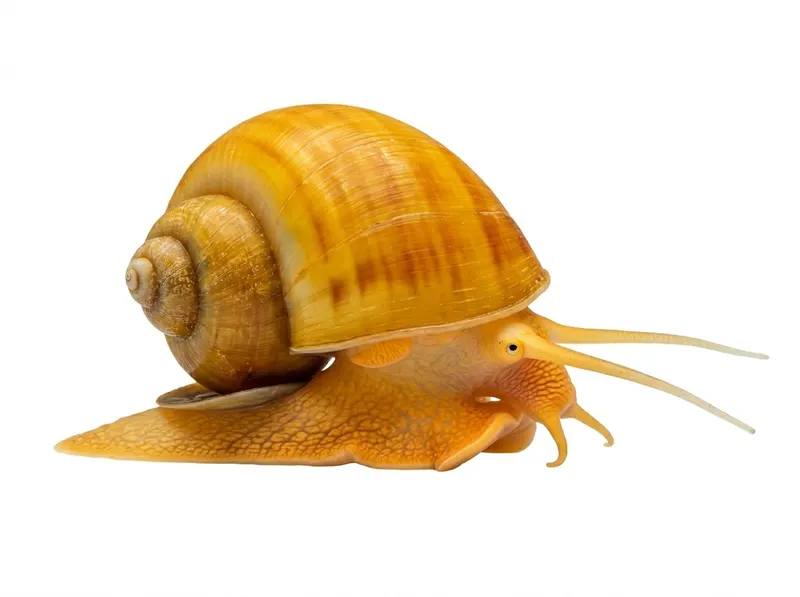
Mystery Snails — Colourful, Characterful, and Back on the Shelves
Mystery snails are the labrador retrievers of the snail world — big, friendly, curious, and immediately likeable. They are active during the day, which sets them apart from many nocturnal snail species. They explore the tank visibly, hang from the surface to breathe (they have a siphon tube for atmospheric oxygen), and show enough individual behaviour that many keepers end up genuinely fond of them.
Colours and Variants
One of the main attractions of mystery snails is their variety. Shell and body colour come in multiple combinations — gold shells with gold bodies, ivory shells with purple bodies, blue-grey shells with dark bodies, wild-type brown, and various stripe patterns. Selective breeding in recent years has produced increasingly vivid colour combinations that look genuinely striking in a planted tank.
The colour of the snail you buy is the colour it will keep. Unlike fish, which can change colour with diet and stress, mystery snails are what they are. When buying from AquaLots, the listing photos will show you the actual snails or the parent stock — always worth checking before purchasing if colour is important to you.
Care Requirements
Mystery snails are large — adults reach golf ball size in good conditions — so they need adequate space. A single snail in a tank under 30 litres will be fine, but a group of three or four needs at least 60 litres to avoid competing for food and space. They produce a moderate bioload for a snail, so factor that into your filtration.
Like nerites, they need calcium for healthy shells. Hard to moderately hard water is ideal. Temperature should be between 18°C and 28°C. They are peaceful and compatible with most community fish, though any fish that nips fins — some tetras, tiger barbs, cichlids — will also nip at their tentacles and siphon tube, causing stress and injury.
Mystery snails eat algae, plant matter, and decaying organic material. They will graze on soft-leaved live plants if underfed, so supplement with blanched vegetables (cucumber, courgette, spinach) and algae wafers. A well-fed mystery snail leaves healthy plants alone.
Breeding Mystery Snails
Unlike nerites, mystery snails breed readily in freshwater — and this is where they become genuinely interesting as a project. Females lay clutches of eggs above the waterline, in a firm, pink-to-cream mass attached to the tank hood or the glass just above the water surface. A clutch can contain 50 to 200 eggs depending on the size and age of the female.
Eggs take two to four weeks to hatch at tropical temperatures. The hatchlings drop into the water and immediately begin feeding. They are surprisingly robust from birth and grow quickly with good feeding.
Mystery snail breeding is one of the more popular small-scale breeding projects for hobbyists looking to generate some income from their tanks. Clutches of young mystery snails in desirable colour combinations sell consistently on AquaLots. A batch of 10 juvenile mystery snails in a sought-after colour sells for £15 to £30 depending on grade and colour rarity. With a productive colony, a hobbyist can produce multiple clutches per month.
Assassin Snails — The Best Solution to a Snail Infestation
If you have an unwanted snail population — ramshorns multiplying faster than you can remove them, bladder snails appearing from nowhere, Malaysian trumpet snails carpeting your substrate — assassin snails are the most elegant solution available. They eat other snails. That is essentially their entire diet, supplemented occasionally with meaty foods when snail prey is scarce.
How They Work
Assassin snails (Clea helena) are predatory. They track down other snails using chemoreception, surround them with their muscular foot, and consume them. In a tank with a genuine snail infestation, a group of six to eight assassin snails will visibly reduce the pest population within a few weeks. In a tank with only a light snail presence, they will still pick them off over time.
They are not a magic instant solution — the process takes weeks, not days — but they are far more effective and far less work than manual removal, chemical treatments (which also harm plants and other invertebrates), or traps.
Will They Eat Your Other Snails?
Yes. If you keep nerites, mystery snails or any other snail species alongside assassin snails, the assassins will eventually target them, particularly smaller specimens. Assassin snails are not selective — any snail is potential prey. If you want to keep decorative snails alongside an assassin population, choose larger species (adult mystery snails are usually too large to be easily consumed) and monitor carefully.
Care and Breeding
Assassin snails are easy to keep. They need a soft substrate they can bury into during rest periods — fine sand or a sand-soil mix is ideal. Temperature 24°C to 28°C, pH 7.0 to 8.0, moderately hard water. They are slow breeders — pairs lay small batches of single eggs attached to surfaces, and development is slow. You will not get an assassin snail explosion in your tank.
This slow breeding rate also makes them consistently worth selling. Unlike pest snails that reproduce exponentially, assassin snail populations grow slowly. Hobbyists with an established colony have a steady, modest supply of young snails to sell. On AquaLots, assassin snails sell reliably at £2 to £4 each, with groups of five or ten listed regularly and selling quickly.
Ramshorn Snails — Pest or Pet?
Ramshorn snails occupy a unique position in the hobby — for some keepers they are an uninvited nuisance, for others a deliberately kept and selectively bred species of genuine beauty. The answer to "pest or pet?" depends entirely on which ramshorns you are talking about.
Common Brown Ramshorns
The small, brown ramshorn snails that appear uninvited in most community tanks — usually hitchhiking on plants or hardscape — are the pest variety. They reproduce rapidly in nutrient-rich water and can reach plague numbers if left unchecked. They are not harmful to fish or plants directly, but large populations indicate excess nutrients and the sheer number becomes an eyesore.
If you have these, an assassin snail or two will manage the population effectively. Alternatively, reducing feeding and maintaining excellent water quality reduces their reproduction rate significantly. They will never disappear entirely, but they can be kept at low, manageable numbers.
Coloured Ramshorns — A Different Proposition Entirely
Selectively bred ramshorn snails in vivid red, blue-grey, and pink are a completely different thing. These are larger than the common brown variety, visually striking, and actively sought by planted tank hobbyists for their appearance and their utility as algae cleaners and detritivores.
Red ramshorns — which get their colour from haemoglobin rather than pigment — are the most common and widely available. Blue ramshorns are rarer and more sought after. Pink variants are a relatively recent development and command higher prices from collectors.
Coloured ramshorns breed readily and produce large numbers of offspring, which makes them one of the easier species to breed for selling. A bag of 10 red ramshorns sells for £3 to £6 on AquaLots. Blue ramshorns command more — £8 to £15 for a small group. They are a low-effort, beginner-friendly breeding project with a consistent buyer market.
Rabbit Snails — The Premium Snail for Serious Keepers
Rabbit snails (Tylomelania) are a growing niche in UK aquatics and one of the most underrated snail species available. They are large — adults reach 8 to 10 centimetres — slow moving, long lived, and genuinely beautiful in the right setup. Their elongated, conical shells and velvet-textured bodies in combinations of yellow, orange, chocolate brown and white make them stand out in any aquarium.
Care Requirements
Rabbit snails come from the Sulawesi lakes in Indonesia, which means they have specific water requirements. They prefer warm water — 26°C to 30°C — and moderately hard, neutral to slightly alkaline conditions. They are more sensitive than the species above, and a tank that fluctuates in parameters will stress them.
They eat algae, biofilm, and decaying plant matter. Like mystery snails, supplemental feeding with blanched vegetables and algae wafers keeps them healthy and reduces grazing on live plants. They are slow and peaceful, compatible with nano fish and shrimp, and unlikely to cause any trouble in a well-stocked planted tank.
Breeding
Rabbit snails are live bearers — they produce a single, fully formed juvenile every four to eight weeks. This makes them the slowest-breeding snail species in the hobby, but it also means their populations never get out of hand and juveniles are always in demand. A young rabbit snail in a desirable colour sells for £5 to £8 on AquaLots. Established breeding pairs are worth more. For hobbyists with the right setup and patience, rabbit snails are a premium, low-volume breeding project with strong returns.
Setting Up a Tank for Aquarium Snails
Most snail species thrive in conditions that suit a standard planted or community tank, which makes adding snails to an existing setup straightforward. There are a few things worth getting right.
Substrate
A soft substrate is beneficial for most snail species. Sharp gravel can damage the foot of snails that dig or burrow — particularly assassin snails and Malaysian trumpet snails. Fine sand or a soft-grain aqua soil provides better conditions and looks more natural alongside most snail species. Hardscape snails like nerites are less bothered by substrate type since they spend most of their time on hard surfaces.
Calcium and Shell Health
Calcium is essential for healthy shells across all species. Moderately hard water (150 to 300 ppm GH) covers most snail needs without any supplementation. In softer water, add a piece of cuttlefish bone to the tank — it dissolves slowly, releasing calcium without significantly impacting pH. Crushed coral in the filter achieves the same result more gradually. Shell pitting, thinning or cracking are signs of calcium deficiency and should be addressed promptly.
Copper — the Silent Killer
Copper is lethal to all invertebrates, including snails. Many fish medications contain copper as an active ingredient — always check before treating a tank that contains snails. Even trace amounts of copper from old pipework can affect sensitive species. If you are treating fish for disease, remove snails and shrimp to a separate tank before dosing. Do not return them until the medication has been fully filtered out and tested clear.
Avoiding Overpopulation
Some snail species reproduce rapidly in favourable conditions. Mystery snails, ramshorns and Malaysian trumpet snails can all reach very high numbers if food is plentiful and parameters are stable. The most effective control is reducing feeding — snail populations track food availability closely. If numbers are already high, manual removal combined with reduced feeding brings them back to manageable levels quickly. Assassin snails provide a more permanent solution.
Breeding Aquarium Snails — Is It Worth It?
For hobbyists looking to generate some income from their tanks, snails are one of the most accessible starting points. The barriers are low — a 30 litre tank, basic filtration, and a starter colony — and the market on AquaLots is active and consistent.
Mystery snails are the most popular breeding project. Colourful variants sell quickly, clutch sizes are large, and the buyer demand is consistent year-round. A productive colony in a 60 litre tank with good feeding and stable parameters produces multiple clutches per month. Even at modest prices, this adds up.
Assassin snails and rabbit snails are slower breeding but command higher per-unit prices. Coloured ramshorns are the highest volume, lowest effort option — they breed continuously with minimal intervention and require almost no specialist knowledge.
Importantly, breeding and selling invertebrates in the UK does not require an Animal Activities Licence — that requirement applies to vertebrate animals. Selling snails as a hobbyist, even regularly, does not trigger the licensing rules that apply to fish selling. The £1,000 HMRC trading allowance still applies for tax purposes, but the licensing threshold that complicates fish selling does not apply here. It is genuinely one of the cleanest entry points into selling aquatic life.
AquaLots has a growing and active snail listing section. Buyers range from hobbyists adding algae control to established keepers looking for breeding stock and collectors seeking unusual colour variants. If you have a productive colony, listing on AquaLots puts your stock in front of the right buyers without the hassle of social media groups, local classifieds, or the unreliable nature of selling through forums.
Where to Buy Aquarium Snails in the UK
Pet shops stock nerites occasionally and mystery snails less reliably since the post-ban period. Stock varies enormously by area and by shop, and availability is inconsistent. For hobbyists who want specific species, particular colour variants, or assurance that their snails have been kept in freshwater conditions by someone who knows what they are doing, buying from a fellow hobbyist is almost always the better option.
AquaLots has a dedicated invertebrates and snail category with listings from hobbyist breeders and small-scale keepers across the UK. You can find nerites, mystery snails in multiple colours, assassin snails, coloured ramshorns, and rabbit snails listed by sellers with feedback histories and detailed descriptions of their keeping conditions. Most sellers include water parameter information, size details, and photos of the actual animals — information you will rarely get from a pet shop.
Buying through AquaLots also means your purchase is protected. Secure checkout through Stripe, buyer messaging, and the platform's dispute process give you recourse if something goes wrong — something no social media group or classified listing can offer. For live animals particularly, that protection matters.
If you are new to buying live invertebrates online, check the seller's feedback before purchasing, read their delivery policy, and make sure you are available to receive the parcel on the day it arrives. Most sellers ship Monday to Wednesday to avoid weekend transit delays. Have your tank ready before you order — acclimatising snails promptly after arrival gives them the best start.
Quick Species Reference
Nerite snails — Best for: algae control. Cannot breed in freshwater. Compatible with all fish and shrimp. Price on AquaLots: £2–£4 each.
Mystery snails — Best for: personality, colour, beginner keeping. Breeds readily in freshwater. Needs moderate hardness. Legal in England, Scotland and Wales only. Price on AquaLots: £3–£6 each, more for rare colours.
Assassin snails — Best for: pest snail control. Will eat other snail species. Breeds slowly. Price on AquaLots: £2–£4 each.
Ramshorn snails (coloured) — Best for: planted tanks, algae grazing, breeding projects. Reproduces readily. Price on AquaLots: £3–£6 per group of 10 for red; higher for blue.
Rabbit snails — Best for: experienced keepers, warm Sulawesi-style setups. Live bearer, very slow reproduction. Price on AquaLots: £5–£10 each depending on colour.