Search AquaLots
Find fish, plants, invertebrates and equipment
Axolotl Care Guide UK: Tank Setup, Feeding, Water Temperature and More
1 April 2026
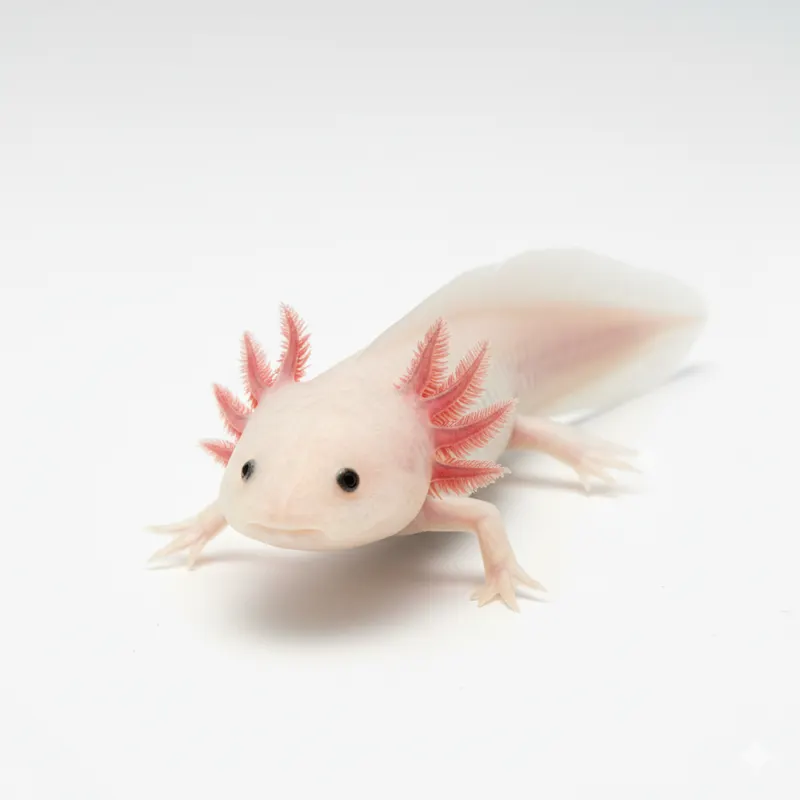
Axolotls are unlike anything else you can keep in an aquarium. They are not fish, not standard reptiles — they are fully aquatic salamanders with feathery external gills, extraordinary regenerative abilities, and a face that appears, improbably, to be permanently smiling. They are also more demanding to keep correctly than most people expect. This guide covers everything you need to know before, and after, getting one.
In this guide
What is an axolotl?
The axolotl (Ambystoma mexicanum) is a fully aquatic salamander native to the lake system of Xochimilco near Mexico City. Unlike most other amphibians, it never undergoes metamorphosis — the process by which larval amphibians lose their gills and transition to semi-terrestrial life. The axolotl retains its juvenile characteristics throughout its entire lifespan, including large feathery external gills, a broad flattened head, and a continuous dorsal fin running from behind the neck to the tail tip. This condition is called neoteny, and it is one of the things that makes axolotls so immediately distinctive.
In the wild, axolotls are critically endangered. The lakes they inhabit have been drastically reduced by urban development and water management changes around Mexico City, and what remains is heavily polluted and invaded by non-native fish species. The IUCN lists wild axolotls as critically endangered, and they are listed under CITES Appendix II. The species now depends almost entirely on captive populations — in research facilities, zoos, and the hands of dedicated hobbyist breeders — for its survival as a viable gene pool.
In captivity, axolotls can live 10 to 15 years with proper care, and some individuals exceed 20 years. They reach adult sizes of 20 to 30cm, with exceptional animals growing slightly larger. They are carnivorous, predominantly nocturnal, and spend the vast majority of their time on or near the tank bottom. They cannot be handled in any meaningful sense, they do not interact with owners the way dogs or even many reptiles do, and they have specific environmental requirements — particularly around temperature — that make them considerably more demanding than a standard tropical fish setup.
Are axolotls legal in the UK?
Yes — axolotls are legal to keep as pets in the UK without a licence. There is no prohibition on ownership comparable to restrictions in some US states such as California, Maine, and New Jersey where axolotl ownership is banned outright.
However, legal UK ownership comes with clear obligations. All axolotls must be captive-bred — the species is listed under CITES Appendix II, which prohibits wild-caught specimens from entering the commercial pet trade. Every axolotl available in the UK hobby should be captive-bred, and you should ask for confirmation of this when purchasing. Releasing axolotls into UK waterways is illegal under the Wildlife and Countryside Act 1981 and Invasive Alien Species regulations — if you can no longer keep your axolotl, rehome it responsibly through a specialist community, not into the wild under any circumstances.
Is an axolotl right for you?
Be honest with yourself about the following before committing to one.
They are a 10 to 15 year commitment. An axolotl is not a short-term pet. Consider carefully whether your living situation over the next decade or more can accommodate a tank animal with specific environmental demands.
Temperature management is genuinely difficult in UK summers. This is the most consistently underestimated challenge for UK keepers. Axolotls need cool water — ideally 16 to 18 degrees C — and become stressed above 20 degrees, with serious health risk above 22 degrees. UK homes in summer regularly reach 22 to 25 degrees or higher. Maintaining safe water temperatures during warm weather requires either an aquarium chiller (typically £150 to £350), a consistently cool room, or intensive fan-based management. This is not a minor inconvenience — it is a fundamental care requirement with a real cost.
They cannot be handled. Axolotls have extremely delicate permeable skin and gills that are easily damaged by handling. They are observation animals, not interaction animals.
They are not suitable for community tanks. Axolotls will eat fish and invertebrates that share their tank. Fish will nip at their gills. Housing with other species almost always ends badly. They are best kept alone or with other same-size axolotls.
They are rewarding for the right keeper. Set up the environment correctly from the start and axolotls are robust, long-lived, and endlessly fascinating to observe. The challenges are all addressable with preparation — but the preparation has to happen before the animal arrives.
Tank setup
Tank size
A single adult axolotl requires a minimum of 80 litres. Many experienced keepers recommend starting with 120 litres or more — larger water volumes are more thermally stable, which is significant for UK summer temperature management, and they dilute waste more effectively. Add a minimum of 40 litres per additional axolotl.
Shape matters significantly. Axolotls are bottom-dwellers that use floor space, not water depth. A long, shallow tank is far more appropriate than a tall, narrow one. For a single adult, aim for a tank at least 75 to 90cm in length. The tank must have a secure lid — axolotls occasionally jump, particularly at night, and will not survive on the floor for long. The lid should allow adequate ventilation, which is also necessary if using clip-on fans for cooling.
Equipment checklist
Appropriately sized tank with secure, ventilated lid
Filter with adjustable or baffled flow
Accurate digital thermometer
Liquid water test kit (not strips)
Aquarium chiller or cooling fan for UK summers
Aloe-free water conditioner
At least two hiding places per axolotl
Fine sand or tile substrate
Siphon for waste removal
Temperature — the most critical factor
Temperature is the single most important aspect of axolotl husbandry and the variable most likely to cause serious problems for UK keepers. Axolotls evolved in high-altitude cold lakes fed by glacial runoff. Their physiology is calibrated to cool water.
TemperatureStatus15 to 18 degrees COptimal — aim here consistently18 to 20 degrees CAcceptable short-term — monitor carefully20 to 22 degrees CStress begins — take cooling steps immediatelyAbove 22 degrees CSerious health risk — urgent intervention requiredAbove 24 degrees CLife-threatening with sustained exposure
During warmer months — typically May through September in the UK, sometimes longer — active cooling intervention is necessary for most households. Your main options:
Aquarium chiller is the most reliable solution. Chillers connect to the filter outlet and cool water to a set temperature regardless of ambient room conditions. Cost is the main barrier at £150 to £350 for a unit appropriate for 100 to 200 litres. For anyone committed to long-term axolotl keeping, a chiller is the correct investment.
Clip-on fan directed across the water surface causes evaporative cooling and can reduce temperature by 2 to 4 degrees C in typical UK conditions. Adequate for mild weather, insufficient during heatwaves. Inexpensive at £15 to £30 and worth having as supplemental cooling alongside other methods. The lid must be ventilated for a fan to work — a sealed lid prevents evaporation and defeats the approach.
Room placement in the coolest part of the house — a north-facing room, away from windows and radiators — reduces baseline temperature and the load on active cooling. This should inform where the tank goes before purchase.
Frozen water bottles floated in the tank provide temporary emergency temperature reduction. Not a substitute for reliable cooling equipment, and the temperature fluctuations from repeated bottle additions are themselves a stress factor. Use only as emergency management while sourcing proper cooling.
Axolotls do not require a heater under normal UK conditions. If your home regularly drops below 10 degrees C for extended periods, a heater with a thermostat set to 14 degrees C provides a safety floor without risking overheating.
Water parameters and cycling
ParameterTargetTemperature15 to 18 degrees CpH7.4 to 7.6Ammonia0 ppmNitrite0 ppmNitrateBelow 20 ppm (below 10 ppm preferred)GH7 to 14 dGHKH3 to 8 dKH
Axolotls are highly sensitive to water quality — considerably more so than most tropical fish. Ammonia and nitrite must be consistently zero. Elevated nitrates cause chronic stress and immune suppression; keep them below 20 ppm with weekly water changes, with below 10 ppm being the preferred target.
The tank must be fully cycled before any axolotl is introduced. Do not add an axolotl to an uncycled tank. The nitrogen cycle takes four to eight weeks from scratch, or significantly less with established filter media seeded from an existing cycled tank. Cycle at the target temperature, not room temperature — bacterial activity varies with temperature and a cycle established at 24 degrees may need to re-stabilise at cooler axolotl conditions.
One critical note on water conditioners: avoid any product containing aloe vera. Aloe is an irritant to axolotls and is commonly added to fish water conditioners marketed as natural or containing slime coat additives. Seachem Prime is widely recommended in the UK axolotl community as a reliable aloe-free conditioner. Perform 20 to 30 percent water changes weekly, siphoning waste from the substrate each time. Ensure replacement water is temperature-matched before adding to avoid thermal shock.
Filtration and flow
Axolotls produce substantial biological waste and need strong biological filtration. They are simultaneously sensitive to strong water flow. This tension — high filtration capacity with low current velocity at tank level — needs to be actively managed.
Canister filters are the most practical choice. Large media capacity for biological filtration, with an outlet that can be positioned to spread flow along the surface or through a spray bar rather than directing a current down at the axolotl. Sponge filters work well in smaller setups and produce gentle diffuse flow. Internal filters can work if the outlet is baffled — directed along the glass surface rather than into open water.
Signs that flow is excessive: the axolotl's gills are pressed backward, or the animal is constantly repositioning against the current. Baffle a strong outlet by attaching a spray bar or deflector plate, directing flow along the tank walls or surface. The axolotl should be able to rest anywhere in the tank without fighting the current.
Substrate
Substrate choice is one of the most consequential decisions in axolotl care, and using the wrong substrate is among the most common causes of preventable death in captive axolotls.
Do not use standard aquarium gravel. Axolotls feed by gulping — a sudden suction motion that ingests prey and anything nearby. Gravel particles in the mid-range (roughly 3 to 20mm) cannot pass through the digestive system and cause intestinal impaction, which is frequently fatal. This is not a remote risk — it is a common cause of axolotl death.
Fine sand under 1mm particle size is the most widely recommended substrate for adults. Particles this fine pass safely through the digestive system if ingested. Use play sand or aquarium fine sand without additives or sharp-edged particles.
Bare bottom is the safest option, particularly for juveniles under 15cm. Easier to clean and eliminates impaction risk entirely. The main downside is that smooth glass provides poor grip — axolotls can struggle to move confidently on bare glass.
Smooth slate or ceramic tile laid flat on the tank bottom provides grip without impaction risk and is a popular practical compromise — safe, easy to clean, and more aesthetically complete than bare glass.
Decor, hiding spots and lighting
Hiding spots are essential. Axolotls need places to retreat from light and feel secure. Provide at least one solid hide per axolotl — PVC pipe sections, smooth ceramic caves, terracotta pots on their side, or purpose-made aquarium caves. Ensure all edges are smooth and that the hide is large enough for the axolotl to enter fully. Axolotl gills are fragile and easily torn on sharp decor edges.
Live plants are possible in an axolotl tank. Axolotls do not eat plants but do clamber over and disrupt delicate plantings. Robust low-light cold-water species work best: Anubias attached to hardscape, Java fern, Java moss, Elodea, and Marimo moss balls. Avoid plants requiring bright lighting or tropical temperatures.
Axolotls have no eyelids and are sensitive to bright light. They do not require UVB lighting. Standard low-intensity aquarium lighting on a natural day-night cycle of 8 to 10 hours is adequate. High-intensity lighting causes stress and drives axolotls into hiding continuously. Dimmer lighting with good hiding spots produces a more visible, active animal than trying to illuminate a brightly lit display tank.
Feeding
Axolotls are obligate carnivores. They detect food primarily through smell and water movement sensitivity — their eyesight is poor. Feed in the evening when they are naturally most active.
Earthworms are as close to a perfect axolotl food as exists. Nutritionally comprehensive, readily accepted, available year-round from garden centres or fishing suppliers. Use worms only from pesticide-free soil. Nightcrawlers are ideal for adults; smaller worms or worm sections for juveniles.
Frozen bloodworm is a convenient and universally accepted food. Available from any aquatic shop. Less nutritionally complete than earthworms as a sole diet — use in rotation with other foods. Thaw before feeding; frozen bloodworm fed directly can cause digestive upset.
Axolotl-specific sinking pellets formulated for the species are a practical dietary component. Look for high protein content with no plant-based primary ingredients. Most axolotls accept pellets readily once introduced.
Brine shrimp (frozen) are a useful supplemental food especially for juveniles, but not nutritionally complete enough as a sole adult diet.
Live river shrimp sourced from fish-free water provide excellent enrichment — they survive in the tank for days while the axolotl hunts them, stimulating natural foraging behaviour.
Do not feed feeder fish (disease risk and digestive problems from hard scales and bones), processed meats, wild-caught tubifex (disease risk), or waxworms as a staple (too high in fat).
Feed adults every two to three days — one to two large earthworms or equivalent per feeding. Juveniles under 15cm: every day or every other day with smaller food items. Remove uneaten food within 30 to 60 minutes. Decomposing food fouls the water rapidly and significantly increases ammonia load.
Handling
Handle as infrequently as possible. Axolotl skin is extremely delicate and their gills are fragile structures easily damaged by contact. Human hands are warmer than ideal water temperature and introduce oils and potential contaminants. Dry hands are particularly harmful to permeable amphibian skin.
When you must move an axolotl — for tank maintenance or transfer — use a soft fine-mesh net or cup it briefly in wet hands. Never lift by the tail or gills. Support the full body. Keep any out-of-water time to seconds, not minutes. Axolotls are observation animals. For keepers who find watching them explore, feed, and rest deeply satisfying, they are excellent pets. For those wanting a tactile relationship, a different animal is a better fit.
Colour morphs
Selective captive breeding has produced a range of colour morphs. All share identical care requirements — morph selection is purely personal preference and budget. Common UK-available morphs include:
Wild type — dark olive-brown or near-black body with gold iridescence and pale belly. The natural colouration.
Leucistic — pale white or pinkish body with dark eyes. One of the most recognisable and popular morphs.
Albino (golden) — yellow or gold body with red eyes. True albino — lacks all melanin.
White albino — white body with red eyes. Similar appearance to leucistic but genetically distinct.
Melanoid — very dark near-black body with no iridescence. Striking, less commonly available.
Axanthic (silver dalmatian) — grey or silver body with dark spots. Rarer, commands higher prices.
Mosaic — irregular patches of mixed pigmentation occurring spontaneously during development. Cannot be reliably bred; each is unique.
Health and common problems
Heat stress is the most common health emergency in UK axolotl keeping. Signs: lethargy, loss of appetite, floating near the surface, gills curling forward or losing feathery texture, mucus sloughing from the skin. Cool the water immediately — do not add ice directly to the tank (causes thermal shock). Float sealed ice packs while increasing ventilation. If water has been above 22 degrees for more than a day, monitor closely for fungal infection which commonly follows heat stress.
Fungal infection presents as white fluffy growth on gills, skin, or limbs. Usually follows heat stress, injury, or poor water quality. Mild cases may respond to salt baths (non-iodised aquarium salt, 1 to 2g per litre, for 10 to 15 minutes) and improved water quality. Severe infections need antifungal treatment — methylene blue or proprietary antifungal products. Consult an exotic vet for persistent or extensive infections.
Gill curl and gill shrinkage indicate stress. Healthy gills are full, feathery, and spread outward. Curling forward, sparse texture, or visible reduction points to poor water quality, high temperature, or excessive flow. Address the environmental cause and gills typically recover over several weeks.
Impaction from ingested gravel or oversized substrate is often fatal by the time it presents clearly. Signs are loss of appetite, bloating, and inability to pass waste. Prevention through correct substrate choice is the only reliable solution. If suspected, contact an exotic vet immediately.
Ammonia or nitrite toxicity — rapid gill movement, floating, lethargy, reddening of skin or gill bases — requires immediate emergency water change of 30 to 50 percent with dechlorinated, temperature-matched water, followed by root cause investigation.
Where to buy an axolotl in the UK
The most important thing you can do when buying an axolotl is buy from someone who actually knows how to keep them. A specialist breeder who can confirm captive-bred status, tell you the animal's current water temperature, what it's been eating, and how old it is — that's the starting point. Standard morphs from reputable breeders typically cost £30 to £80. Significantly cheaper animals from unverifiable sources are not a bargain. They are higher risk.
AquaLots is a good place to start your search. The axolotl listings on AquaLots come from verified UK sellers — hobbyist breeders and specialists who list with photos, descriptions, and their own feedback history. You can see exactly what morph is available, message the seller before purchasing, and buy with buyer protection in place. It's a meaningfully safer route than picking up an animal from a Facebook group with no accountability, or from a general pet shop that's keeping axolotls in a tropical fish tank at the wrong temperature.
If you do buy from a general aquatic retailer, pay attention to how they're keeping the animals before committing. Axolotls housed in warm water alongside tropical fish, or in tanks with strong current and gravel substrate, are being kept incorrectly — and a retailer that doesn't know the basics of axolotl care is not a source you want to rely on for advice or aftercare.
Wherever you buy from, check the following before the animal changes hands: gills should be full, feathery, and spread outward with no fungal growth or sparse patches; the axolotl should be alert and responsive to movement; body condition should be full with no visible spine, pinched flanks, or lesions; all four limbs should be present and intact; eyes should be clear. Ask the seller what temperature the animal has been kept at and what it has been eating — you'll need both for safe acclimation.
And above all: set up and fully cycle your tank before you buy. Verify stable water parameters. The axolotl should enter a ready, tested environment — not a work in progress. That single discipline, tank first and animal second, prevents the majority of first-week losses that new axolotl keepers experience.