Search AquaLots
Find fish, plants, invertebrates and equipment
Best Aquarium Plants for Beginners: 10 Species That Actually Survive
5 April 2026
Most aquarium plant guides recommend species that need CO2 injection, high-powered lighting, and regular fertilisation. This one doesn't. These are the plants that thrive under normal conditions.
In this guide
Why live plants matter
Live plants do more for an aquarium than plastic alternatives ever can. They compete with algae for nutrients — a well-planted tank is measurably harder for algae to colonise than a bare or artificially decorated one. They produce oxygen during daylight hours. They provide cover and security for fish, reducing stress and encouraging natural behaviour. They process ammonia and nitrate as fertilisers, contributing — modestly but genuinely — to water quality. And they look better.
The common objection to live plants is difficulty. People buy delicate stem plants, put them under standard lighting without CO2, and watch them melt and die within two weeks. This creates the impression that planted tanks are inherently specialist. They're not — but species selection matters enormously. The species in this guide have all been selected because they genuinely thrive in normal aquarium conditions: standard LED lighting, no CO2 injection, moderate fertilisation, and a range of water parameters.
Anubias
Anubias barteri and related species
StatValueLight requirementLow to moderateCO2Not requiredGrowth rateSlowPropagationRhizome divisionSubstrateAttaches to hardscape — do not plant in substrate
Anubias is the first plant recommended to almost every new planted tank keeper, and it earns that recommendation. It grows slowly, tolerates low light, doesn't require CO2, and is practically indestructible under normal aquarium conditions. Its broad, waxy leaves are also unappealing to most plant-eating fish — it's one of the few plants that holds up in a tank with cichlids or goldfish.
The critical care point: do not bury the rhizome (the horizontal stem from which leaves and roots grow) in substrate. Anubias is an epiphyte — it grows attached to surfaces, not rooted in substrate. Burying the rhizome causes it to rot. Attach it to wood or rock with thread, fishing line, or aquarium-safe glue, and it will gradually attach itself with roots. The roots can then penetrate substrate or continue growing along the hardscape surface.
It grows slowly enough that you won't see obvious changes week to week, but new leaves emerge steadily over months, and a mature Anubias plant on a good piece of driftwood is one of the most satisfying sights in a planted aquarium. Available in multiple species and varieties: A. barteri is the standard; A. nana is the compact version; A. gigantea grows considerably larger and suits big tanks.
Java fern
Microsorum pteropus
StatValueLight requirementLow to moderateCO2Not requiredGrowth rateSlow to moderatePropagationRhizome division, adventitious plantlets on leavesSubstrateAttaches to hardscape — do not plant in substrate
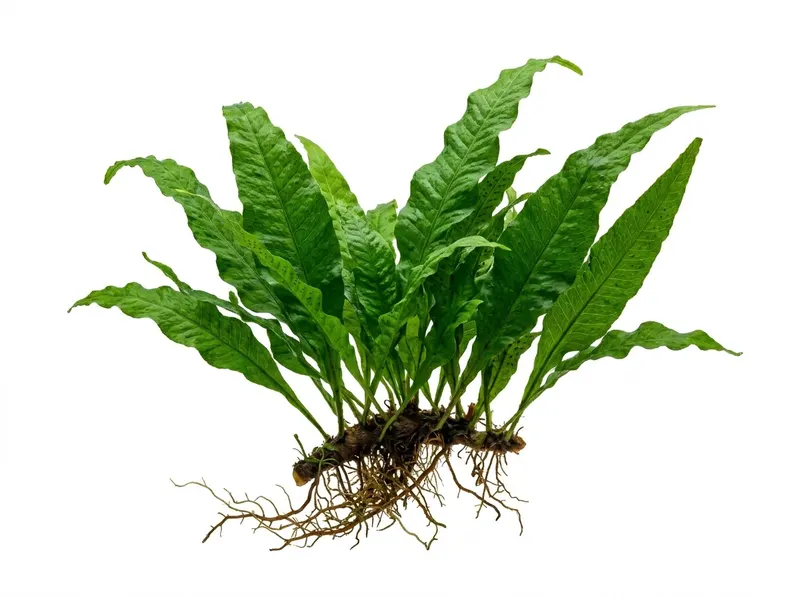
Java fern is the other near-universally recommended beginner plant. Like Anubias, it's an epiphyte that should be attached to hardscape rather than planted in substrate. It tolerates a very wide range of light conditions — it'll survive in dimly lit tanks where little else would — and doesn't require CO2 or significant fertilisation.
The leaves of java fern reproduce asexually — small plantlets develop from the leaf surface, eventually detaching and growing into new plants. This makes propagation essentially automatic and passive; over time a single java fern plant becomes multiple as the plantlets mature and attach themselves to new surfaces.
Several varieties exist beyond the standard: M. pteropus 'Narrow' has thinner, more elegant leaves; 'Windeløv' has heavily branched, lace-like leaf tips; 'Trident' has deeply lobed leaves that create an almost feathery texture. All varieties share the same care requirements and combine well in a planted layout.
Java moss
Taxiphyllum barbieri
StatValueLight requirementLow to high (adaptable)CO2Not requiredGrowth rateModerate to fastPropagationDivisionSubstrateAttaches to any surface
Java moss is the most versatile plant in the beginner list. It attaches to virtually any surface — rock, wood, substrate, even equipment — and grows in almost any light condition. It doesn't need substrate, doesn't need CO2, and propagates simply by tearing off pieces and attaching them elsewhere.
Its primary role in most tanks is either as ground cover (tied or glued to flat slate to form a moss carpet), as a textural element on hardscape, or as a spawning medium — many egg-scattering fish use moss as a breeding substrate, and java moss is the most practical option for this purpose. It also provides excellent cover for fry and small invertebrates.
The main maintenance consideration with java moss is controlling its spread — in good conditions it grows quickly and will gradually colonise adjacent surfaces if not trimmed. Monthly trimming to maintain shape is typical.
Hornwort
Ceratophyllum demersum
StatValueLight requirementModerateCO2Not requiredGrowth rateFastPropagationStem cuttingsSubstrateCan float or be loosely anchored
Hornwort is one of the fastest-growing aquarium plants available and one of the most effective at competing with algae for nutrients. Its rapid growth means it processes nitrate and phosphate quickly, which has a direct water quality benefit in tanks with high nutrient levels from fish waste.
It can be floated at the surface (where it gets the most light and grows fastest) or loosely anchored to the substrate — it doesn't root in the traditional sense and doesn't require burial. In a floating configuration it provides cover and shade for fish below, which suits many species that appreciate overhead cover.
The main downside of hornwort is needle drop — when stressed or moved, it sheds its fine leaf structures, which can create a cleaning burden. Once established and stable, shedding reduces significantly. It's also a plant that benefits from moderate trimming to prevent it from dominating a tank's visual space.
Vallisneria
Vallisneria spiralis and related species
StatValueLight requirementModerateCO2Not requiredGrowth rateModerate to fastPropagationRunnersSubstratePlanted in substrate
Vallisneria — commonly called val or eel grass — is the classic background plant for freshwater aquariums. Its long, ribbon-like leaves grow upward from the substrate and, in a tall tank with adequate light, reach the surface and spread horizontally, creating a grass-like canopy. It reproduces rapidly through runners — horizontal stems sent out along the substrate from which new plants emerge — which means a small initial planting will eventually fill a background section.
Unlike Anubias and java fern, val is planted in substrate — roots go into the gravel or sand, and the leaves grow upward. It benefits from root tabs (small fertiliser capsules pushed into the substrate near the roots) in inert substrates like sand or plain gravel.
One caveat: val and liquid CO2 supplements (particularly glutaraldehyde-based products like Excel) are incompatible — val is sensitive to these products and will melt. If you're not using liquid CO2, val is straightforward; if you are, avoid it.
Crypts (Cryptocoryne)
Cryptocoryne wendtii, C. beckettii, C. lutea and others
StatValueLight requirementLow to moderateCO2Not requiredGrowth rateSlowPropagationRunners and divisionSubstratePlanted in substrate
Cryptocoryne species — universally called crypts in the hobby — are among the best low-light foreground and midground plants available. They grow slowly, don't need CO2, and are available in a wide variety of leaf shapes, colours, and sizes — from the compact C. parva (suitable for foreground planting) to the larger C. wendtii and C. balansae that work as midground specimens.
New crypt keepers should be warned about crypt melt — the frustrating phenomenon where crypts respond to environmental changes (new tank, changed parameters, different light) by losing all their leaves. This looks like the plant has died. It hasn't — as long as the roots are intact and conditions are stable, new leaves will grow from the established root system within two to four weeks. The trick is patience and not uprooting the plant when melt occurs.
Once established and stable, crypts are virtually indestructible. They propagate through runners and gradually colonise the substrate area around them, creating dense, natural-looking patches over months.
Amazon sword
Echinodorus grisebachii / E. bleheri
StatValueLight requirementModerateCO2Not requiredGrowth rateModeratePropagationAdventitious plantlets on flower stemsSubstratePlanted in substrate
The Amazon sword is the archetypal large aquarium centrepiece plant. Its broad, lance-shaped leaves grow from a central rosette and can reach 18–24 inches in good conditions, making it a background or centrepiece specimen for tanks of 30 gallons and larger. It's been in the hobby for decades and its combination of size, ease of care, and natural appearance makes it one of the most used plants in freshwater aquascaping.
Amazon swords are heavy root feeders — they extract the majority of their nutrients from the substrate rather than the water column. In nutrient-poor substrates (plain sand or gravel), they benefit significantly from root tabs. In nutrient-rich substrates (specialist plant substrates), they typically thrive without additional fertilisation.
Propagation occurs when the plant flowers — an adventitious plantlet develops on the flower stem, which can be detached and planted once it has developed several leaves and visible roots. A mature Amazon sword will produce multiple flower stems and multiple plantlets, making propagation essentially free once you have an established plant.
Floating plants
Salvinia natans, Pistia stratiotes, Limnobium laevigatum and others
StatValueLight requirementModerate to highCO2Not requiredGrowth rateFast to very fastPropagationNatural spreadSubstrateNone — floating
Floating plants are often overlooked in favour of rooted aquascape plants, but they offer several genuine advantages. They grow fast, which means they process nutrients quickly — useful in tanks with high bioload. Their roots hang down into the water column, providing cover for fry and small fish. They shade the tank below, reducing algae growth on surfaces and providing a sense of security to fish that prefer overhead cover.
Salvinia is one of the easiest — small, fast-growing, and controllable. Water lettuce (Pistia) and frogbit (Limnobium) are slightly larger and create more substantial surface cover. Amazon frogbit in particular is popular for its long dangling roots that fish fry use as both cover and feeding ground.
The main maintenance consideration is controlling spread — floating plants in good light grow very fast and can cover the entire surface, blocking light to submerged plants below. Regular removal of excess plant material is necessary. Also check local regulations — some floating plant species are considered invasive in certain regions and must not be released into natural waterways.
Water wisteria
Hygrophila difformis
StatValueLight requirementModerateCO2Not requiredGrowth rateFastPropagationStem cuttingsSubstratePlanted in substrate
Water wisteria is an excellent fast-growing background plant that grows well without CO2 and produces attractive, deeply lobed leaves that have a feathery, delicate appearance despite the plant being very robust. It grows quickly under moderate light and can be used to fill background areas rapidly in new planted tanks — a useful characteristic when you're waiting for slower-growing species to fill in.
Propagation is simple: trim stems and replant the cuttings. Each cutting will root and continue growing within a week or two. This makes it easy to propagate and share, and a single purchased stem can become a full background section within a few months through regular trimming and replanting of cuttings.
Marimo moss ball
Aegagropila linnaei
StatValueLight requirementLow to moderateCO2Not requiredGrowth rateVery slowPropagationDivisionSubstrateRests on substrate — no planting required
Marimo moss balls are technically a form of algae (Cladophora) rather than a true plant, but they function as a beginner-friendly living decoration that's genuinely different from anything else in the aquarium plant world. The spherical form develops naturally as the ball rolls around the substrate in its native lake environment in Japan — in the aquarium, you occasionally need to rotate them to maintain their shape.
They grow extraordinarily slowly — a few millimetres per year — which means they never need trimming and never outgrow their space. They absorb nutrients from the water, contribute modest oxygen, and are essentially indestructible under normal aquarium conditions. Fish occasionally pick at them but rarely damage them. They can be divided by tearing apart and reforming the pieces into smaller balls.
Not the most impactful plant in an aquascape, but useful as accent elements, interesting for younger hobbyists, and one of the very few aquarium decorations that grows without any special care.
General planting tips
Fertilisation
Even easy plants benefit from regular fertilisation. Liquid fertilisers added weekly provide macronutrients (nitrogen, phosphorus, potassium) and micronutrients (iron and trace elements). Root tabs pushed into the substrate benefit heavy root feeders like Amazon swords and crypts. In a heavily stocked tank, fish waste may provide adequate nutrients on its own; in lightly stocked tanks with regular water changes, supplemental fertilisation makes a visible difference to plant growth and health.
Lighting duration
Standard aquarium LED lighting run for eight to ten hours per day is adequate for all the species in this list. More than ten hours per day increases algae risk without proportionately benefiting plant growth. A timer is worth the small investment — consistent lighting periods support plant growth cycles and help prevent algae blooms from inconsistent light exposure.
Algae management
Planted tanks with appropriate light duration, adequate fertilisation, and sufficient plant density are significantly more resistant to algae than unplanted tanks. Where algae does appear, addressing the cause (usually excess light, elevated nutrients, or CO2 fluctuations in more advanced setups) is more effective than purely reactive cleaning.
Planting density
Start with more plant mass than you think you need. A densely planted tank from day one competes more effectively with algae and looks better sooner than a sparsely planted tank that you intend to fill over time. Plants are living organisms — they establish more quickly when in a competitive environment with other plants than when isolated in a largely empty tank.