Search AquaLots
Find fish, plants, invertebrates and equipment
Betta Fish Care Guide UK: Tank Setup, Water Parameters and Common Mistakes
27 March 2026
Betta fish are the most purchased aquarium fish in UK pet shops — and among the most frequently kept in conditions that shorten their lives. This guide covers what bettas actually need, not what the packaging on a 5-litre starter kit suggests.
In this guide
What is a betta fish?
The betta (Betta splendens), also known as the Siamese fighting fish, is a labyrinth fish native to Southeast Asia — primarily Thailand, Cambodia, Laos, and Vietnam. It evolved in warm, shallow, slow-moving water: flooded rice paddies, irrigation ditches, and roadside ponds. Its labyrinth organ — a supplementary breathing structure unique to labyrinth fish — allows it to breathe air directly from the surface, which is why it can survive in water with very low dissolved oxygen. This is the biological basis for the bowl-keeping myth, and it's one of the most misunderstood facts in fishkeeping.
Yes, bettas can breathe air. No, this does not mean they thrive in a half-litre vase. Their native habitat, while shallow, is expansive — rice paddies cover entire fields. A betta in nature has essentially unlimited horizontal territory. The air-breathing adaptation evolved to cope with seasonal oxygen depletion, not to enable life in a jam jar.
In captivity, bettas can live four to five years with good care. The average lifespan of a pet shop betta in the UK is far shorter — largely due to inadequate tank size, cold water, and absence of filtration. Getting the basics right adds years to their lives.
The bowl myth — why it persists and why it's wrong
Bettas are sold in UK pet shops in small containers, sometimes in individual cups, and almost always alongside small bowls and nano kits marketed specifically for them. This creates an impression that small, unfiltered water volumes are appropriate housing — because that's what the point of sale suggests.
The reality is that small, unfiltered water volumes cause rapid ammonia and nitrite accumulation. Ammonia from fish waste in a 2-litre bowl with no filtration becomes toxic within 24–48 hours of being established. The fish doesn't die immediately — bettas are hardy — but they live in a state of chronic low-level ammonia poisoning that suppresses immune function, causes fin damage, and shortens their life significantly.
Bettas in bowls also get cold. UK room temperature, particularly in autumn and winter, regularly drops below the minimum acceptable temperature for bettas (24°C). A betta in a bowl on a windowsill in January in a UK home may be living in water of 16–18°C — well below what causes lasting health damage. Without a heater, temperature management is impossible.
The Anabantoid Association of Great Britain (AAGB) in conjunction with aquatic veterinarians has published formal care guidelines recommending a minimum of 20 litres for a single betta, with a heater and appropriate filtration. This is the baseline for responsible UK betta keeping.
Tank size — what you actually need
The UK aquatics community has largely settled on these minimum tank sizes for bettas, expressed in litres rather than the US gallons that dominate American care guides:
SetupMinimumRecommendedSingle male betta20 litres30–40 litresBetta in community tank60 litres80+ litresFemale sorority80 litres120+ litresGiant betta40 litres60+ litres
The 30–40 litre range is the sweet spot for most UK betta keepers. It's large enough to maintain stable water parameters and temperature, manageable in terms of space and cost, and gives the betta meaningful territory to explore. A longer, shallower tank is preferable to a tall, narrow one — bettas spend time at all water levels and benefit from horizontal swimming space.
Why does more volume help? Water quality stability is the primary reason. In a 10-litre tank, a missed water change or a slightly overfeeding incident causes ammonia to spike quickly and significantly. In a 30-litre tank, the same event has a much smaller proportional impact. More water is a buffer against the inevitable small mistakes in day-to-day maintenance, and it means the fish spends less time in compromised water quality.
A lid is essential. Bettas jump, particularly when startled or stressed. A betta found on the floor is a betta that's likely beyond help. All betta tanks need a lid, and the lid needs to fit well with no gaps the fish can squeeze through.
Water parameters
ParameterTarget rangeTemperature24–28°CpH6.5–7.5GH (hardness)5–20 dGHKH (alkalinity)2–8 dKHAmmonia0 ppmNitrite0 ppmNitrateBelow 20 ppm
Bettas are more adaptable than many fishkeeping guides suggest in terms of pH and hardness — they're less sensitive to these parameters than species like discus or neocaridina shrimp. The parameters that matter most are temperature (they're very sensitive to cold), and the absolute requirement for zero ammonia and nitrite (which requires a cycled tank with proper filtration).
UK tap water and bettas
Good news for UK betta keepers: most UK tap water is entirely suitable for bettas without any modification beyond dechlorination. Unlike species that require soft, acidic water (discus, most L-number plecos, neocaridina at the high-grade end), bettas are adaptable across a broad pH and hardness range.
The one thing you must always do is dechlorinate tap water before adding it to the tank. Chlorine and chloramines — used in UK water treatment — are harmful to fish and to the beneficial bacteria in your filter. Use a standard aquarium dechlorinator (Seachem Prime, Tetra AquaSafe, Interpret TapSafe, and similar products are all effective) every time you add new water.
If you're in a particularly hard water area (above 20 dGH), bettas will still survive and thrive, though very hard water at the upper extreme is slightly less ideal. There's no need to invest in RO equipment for bettas — the hard water that causes problems for shrimp and soft water species is fine for bettas.
Temperature and heating
Temperature is the most important environmental factor for betta health, and the most commonly wrong one in UK setups. The acceptable range is 24–28°C. Below 22°C, bettas become lethargic, eat poorly, and their immune system is significantly suppressed — they become susceptible to infections they'd otherwise resist. Below 18°C, permanent damage and death become real risks within days.
UK room temperature, without heating assistance, ranges from around 16°C in winter to 25°C+ in summer heatwaves. This means:
A heater is always required for betta tanks in the UK, regardless of the season. Even summer nights in most UK homes drop below 24°C. A heater set to 26°C maintains a stable, appropriate temperature year-round without any adjustment.
A thermometer is essential — not just to set the heater correctly but to verify it's working. Heaters fail. A digital probe thermometer (available for a few pounds) lets you check the actual water temperature daily rather than relying on the heater's thermostat display.
Stable temperature matters more than hitting the exact number. A consistent 25°C is better than water that swings between 22°C and 28°C daily. Fluctuations stress bettas and suppress immunity — a common trigger for ich outbreaks.
In small tanks, two smaller heaters running simultaneously rather than one provides redundancy — if one fails, the other maintains a survivable temperature until you can replace it. This is particularly worth considering for 20-litre setups where a single heater failure can crash the temperature rapidly.
Filtration — gentle flow matters
Bettas need filtration — a cycled filter with an established biological colony that processes ammonia into nitrite and nitrite into nitrate. Without filtration, ammonia accumulates and water quality deteriorates rapidly, regardless of how often you change the water.
The specific requirement for bettas is that the flow from the filter must be gentle. Bettas evolved in slow or still water, and their elaborate finnage makes them poor swimmers in strong current. A male betta with a large flowing tail in a tank with a powerful filter outlet will be constantly fighting the current — exhausting, stressful, and damaging to fin condition.
Solutions for gentle filtration in betta tanks:
Sponge filters — the most betta-friendly option. They provide biological filtration through a sponge medium without any significant water movement. The gentle bubbling is harmless and even provides mild surface agitation. Sponge filters are inexpensive, easy to maintain, and appropriate for tanks up to about 40 litres.
Small hang-on-back filters with baffled output — directing the filter output against the glass wall rather than into open water reduces flow significantly. Some keepers attach a section of sponge or a small piece of plastic bottle to the outlet to spread the water flow.
Internal filters on low settings — many internal filters have adjustable flow; turn them down to their minimum setting and position the outlet to flow along the surface rather than down into the water column.
The practical test: can you float a small piece of tissue paper in the tank without it being pushed significantly in any direction? If yes, the flow is appropriate for a betta. If the tissue races across the surface, the flow is too strong.
Décor, plants and hiding spots
Bettas are intelligent fish that explore their environment, establish territory, and — critically — rest. They rest by perching on leaves, resting at the bottom, or hovering near the surface in sheltered spots. A tank with nowhere to rest and no visual complexity is stressful for them.
Plants are the most important decor element in a betta tank. Live plants are better than artificial — they improve water quality through nutrient uptake, provide natural surfaces to rest on, and create the shaded, sheltered environment bettas prefer. Good options for betta tanks include java fern, Anubias, java moss, floating plants (frogbit, amazon frogbit), and hornwort. Hardy, low-maintenance species suit the stable, low-flow betta environment.
Floating plants are particularly valuable — they provide surface cover that makes bettas feel secure, shade the water below, and bettas will often build bubble nests in and around floating plants.
A betta leaf hammock — a silk or live leaf positioned near the surface — gives bettas a resting spot they actively use. Many bettas spend significant time resting on their hammock, and keepers who add one for the first time are sometimes alarmed to find the fish lying motionless on it — this is normal resting behaviour, not illness.
Hiding spots — caves, hollow logs, pots — are used by bettas when they feel exposed or startled. A tank with zero hiding spots is a more stressful environment than one with a few sheltered areas. You don't need to cram in decoration, but some structure is important.
Sharp edges are dangerous. Betta fins, particularly in long-finned varieties, snag and tear on sharp or rough surfaces. Before adding any decoration, run your hand over all surfaces. If it scratches your skin even slightly, it will damage betta fins. Silk plants are safer than cheap plastic plants with hard leaf edges; smooth ornaments are safer than rough ones.
Feeding
Bettas are obligate carnivores. In the wild they eat primarily insects and small invertebrates. Their digestive system is not designed for the plant-based filler content in many generic tropical fish flakes, and a flake-only diet is genuinely inadequate.
Best foods for bettas
Quality betta pellets — specifically formulated with high protein content and no excessive plant-based filler. Hikari Betta Bio-Gold, Fluval Bug Bites Betta, and Northfin Betta Bits are widely used by UK betta keepers. Feed 3–5 pellets per meal, twice daily.
Frozen bloodworm — the go-to treat and conditioning food. Accepted eagerly by virtually all bettas. Feed two to three times per week as a supplement to pellets.
Frozen daphnia — excellent for digestive health and variety. Bettas that are prone to constipation benefit noticeably from regular daphnia in the diet.
Frozen brine shrimp — nutritious and accepted readily, though less protein-dense than bloodworm.
Live foods — live daphnia, mosquito larvae, and small earthworm pieces are accepted enthusiastically and provide behavioural enrichment. Source live foods from disease-free cultures rather than the wild.
Feeding notes
Bettas have small stomachs and can overeat. Overfeeding is the most common cause of swim bladder problems in bettas — the swim bladder becomes compressed by an overfull digestive tract, causing the fish to float or sink incorrectly. Feed small amounts twice daily rather than one large feeding. Fast the fish one day per week — this is good practice and helps prevent the constipation issues that affect bettas on pellet-heavy diets.
Remove uneaten food within a few hours. Uneaten food fouls water chemistry rapidly in smaller betta tanks.
Tail and fin types
The variety of betta fin types available in the UK is extraordinary — from the wild-type short-finned form to elaborate show strains with tails covering more surface area than the rest of the fish combined. Understanding the main types helps when buying and selecting tankmates.
Veil tail — the most common type in pet shops. Long, flowing, asymmetric tail that droops slightly. Hardy, resilient finnage. Good beginner type.
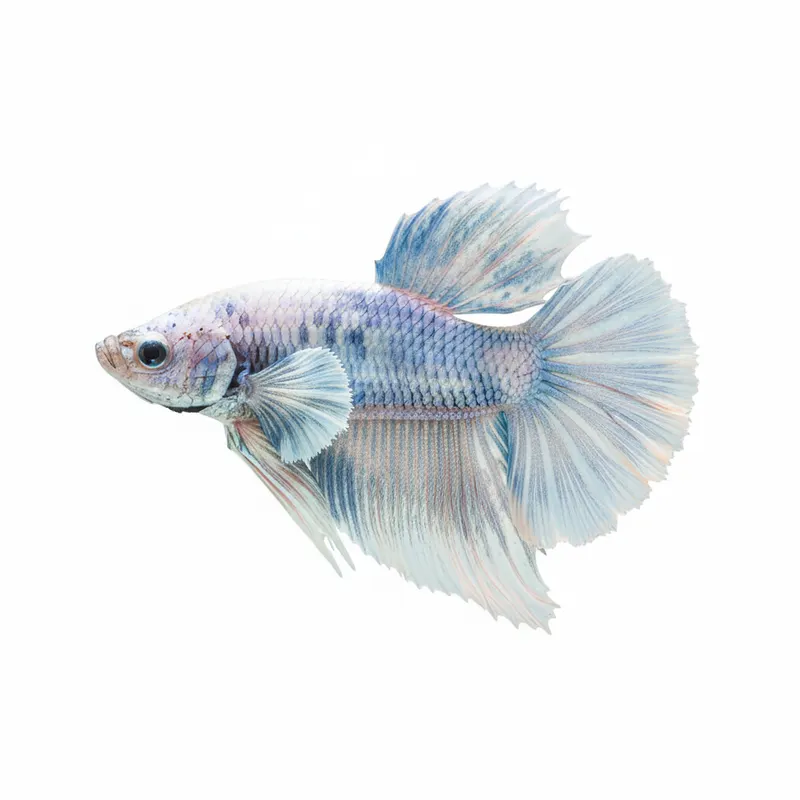
Halfmoon (HM) — the tail spreads to a 180-degree arc. Spectacular when displayed. Requires non-nippy tankmates and gentle flow to avoid damage. The benchmark of the show betta world.
Double tail (DT) — the caudal fin is split into two lobes. Often associated with a shorter body. More prone to swim bladder issues due to body compression in some lines.
Crown tail (CT) — the fin rays extend beyond the fin webbing, creating a spiky, crown-like appearance. Striking and popular.
Plakat (PK) — the short-finned form, closest to wild type. More active, stronger swimmer, less susceptible to fin damage and fin rot. Increasingly popular with keepers who want a more active, practical fish.
Rose tail / Feather tail — extreme ruffling of the caudal fin edges. Spectacular appearance but can impede swimming and is prone to fin damage.
Dumbo / Elephant ear — enlarged pectoral fins. Not a tail type but a fin type variant that appears across different tail types.
Giant betta — selectively bred for larger body size. Can reach 10–14cm rather than the standard 5–7cm. Needs larger tank space.
For new keepers: veil tails and plakats are the most practically manageable. Halfmoons and rose tails are stunning but more demanding in terms of flow, tankmate choice, and fin care.
Colour varieties
Betta splendens comes in essentially every colour, colour combination, and pattern that selective breeding has been able to produce over the past century of hobby work. The range goes from solid primary colours through complex multicolour patterns, metallic and iridescent effects, and even marble bettas whose colouration changes over their lifetime. For UK buyers, the practical colour considerations are:
Solid colours — red, blue, green, black, white, yellow. These are the most reliably "true" colours in that the fish largely stays that colour throughout its life.
Koi betta — multicolour pattern resembling koi fish colouration (white, red, and black). Very popular in the UK market currently.
Marble betta — carries a specific gene that causes pigmentation to shift over time. A marble betta you bought as white with red patches may look completely different a year later. Some keepers love this; others find it unpredictable.
Nemo / galaxy koi — specific pattern and colour combinations that have become very sought after. Prices for high-grade nemo bettas from established breeders are significantly higher than standard pet shop fish.
Tankmates — what works and what doesn't
Male bettas are famously territorial toward each other — two males in the same tank will fight, often seriously. Beyond that, betta tankmate compatibility is more nuanced than the "betta fish must live alone" guidance suggests.
Generally compatible
Corydoras — peaceful bottom feeders that occupy a different space to the betta and rarely interact directly. Pygmy corydoras, habrosus, and other small species work particularly well in 30–40 litre setups.
Small peaceful tetras — ember tetras, neon tetras, and similar species that are too fast to be caught by a betta and don't have long, flowing fins that trigger aggression. Avoid serpae tetras and tiger barbs — both are fin nippers.
Otocinclus — small algae-eating catfish that are completely ignored by bettas. Useful for planted setups.
Snails — mystery snails, nerites, and Malaysian trumpet snails are generally safe. Some bettas will attack snails; watch closely after introduction.
Neocaridina shrimp in larger tanks — some bettas ignore shrimp completely; others hunt them. Dense planting helps shrimp survive alongside bettas. Expensive shrimp are a risk.
Generally incompatible
Other male bettas — never. Serious injury or death results.
Fancy guppies — male guppies' colourful, flowing tails trigger betta aggression. Guppies are attacked and often killed.
Gouramis — same family as bettas, similar territory-and-display dynamics. Conflict is likely.
Fin nippers — tiger barbs, serpae tetras, black skirt tetras. They will shred betta fins.
Aggressive or large cichlids — they will bully or eat bettas.
Community tanks with bettas always require monitoring. Individual betta temperament varies — some are genuinely peaceful community fish; others are relentlessly aggressive. If a betta is attacking tankmates, the most humane outcome is a species-only betta tank, which is perfectly acceptable and many keepers prefer.
Female sororities
Multiple female bettas can be kept together in a "sorority" tank — but this requires planning and a sufficiently large setup. A minimum of 80 litres, at least five females (odd numbers of bettas are preferable to create a less defined hierarchy), dense planting to break lines of sight, multiple feeding spots, and close monitoring in the first weeks. Sororities can be stunning to watch, with females displaying and establishing hierarchy in a less fatal way than males. They can also be a constant management challenge if the group dynamic doesn't settle. They're not a beginner project.
Health and common problems
Fin rot
The most common betta health problem in the UK. Fraying, discolouration, or recession of fin edges — almost always caused by poor water quality, cold water, or fin damage from sharp décor or nippy tankmates. Improve water quality first. For established bacterial fin rot, Interpret Bacterypur or similar UK-available antibacterial treatment is effective. Fins regrow with the right conditions.
Ich (white spot)
Small white granules across fins and body, flashing behaviour, rapid gill movement. Usually triggered by temperature drops or new fish introduction. Standard heat treatment (raise to 28°C, increase aeration) combined with a proprietary ich treatment. Bettas tolerate most UK ich medications at standard doses.
Swim bladder disorder
Betta floating at an angle, unable to maintain position, or sinking to the bottom. Usually caused by overfeeding, constipation, or bacterial infection. Fast for 24–48 hours. Feed a blanched pea (minus the skin) as a laxative. If the issue persists beyond a week, bacterial infection may be involved and antibacterial treatment appropriate.
Velvet
Gold or rust-coloured dusty film on the body, visible in raking torch light. Oodinium parasite. Dimming tank lights slows the parasite's lifecycle. Treat with a copper-based medication — Interpret Anti-Parasite Slime and Velvet Control or similar. Velvet progresses rapidly; act immediately on suspicion.
Columnaris
White or grey lesions on mouth or body, sometimes with saddle-back discolouration behind the dorsal fin. Bacterial infection that can progress very rapidly. Treat promptly with antibacterial medication. Reduce temperature slightly — columnaris is more virulent at higher temperatures.
Where to buy bettas in the UK
Betta quality in UK pet shops varies enormously. The standard veil tails available in chain pet stores are generally healthy but often mass-produced and of no particular genetic distinction. For anything beyond the standard — specific tail types, high-grade colour varieties, show-quality lines, or the growing range of specialist varieties (koi, galaxy, nemo, elephant ear) — specialist breeders are the reliable source.
AquaLots lists betta fish from verified UK sellers and specialist breeders. The advantage of buying from a dedicated betta breeder through a marketplace is the same as in any other specialist fishkeeping purchase: you know the fish's history, the water parameters it's been kept in, what it's been fed, and you can ask the seller directly about temperament and tail condition. This matters for bettas specifically because tail quality, colour saturation, and overall condition deteriorate significantly in poor shop conditions — a betta from a specialist breeder who has kept it in appropriate conditions will look and behave very differently from the same genetic quality of fish kept in a 1-litre cup for three weeks in a pet shop.
Whatever the source, quarantine new bettas for two to three weeks before introducing them to established community tanks. Bettas can carry ich, velvet, and internal parasites without showing visible symptoms — quarantine protects your existing fish and gives you time to observe the betta's behaviour and eating in a controlled environment.