Search AquaLots
Find fish, plants, invertebrates and equipment
Bristlenose Pleco Care Guide: The Best Algae Eater for Any Tank
4 April 2026
The bristlenose pleco is one of the most useful and underappreciated fish in the hobby. It does what it says on the tin — eats algae, stays small, and minds its own business. Here's everything you need to know to keep one well.
In this guide
Species overview
The bristlenose pleco — genus Ancistrus — is the most widely kept pleco in the aquarium hobby and, for most purposes, the best one. In a hobby where "algae eater" is a label applied to dozens of fish that barely earn it, the bristlenose actually delivers. It grazes continuously, works through green algae and biofilm efficiently, and does so in a body that reaches four to five inches — small enough for a 30-gallon tank, light enough on bioload to actually help water quality rather than compromise it.
The genus Ancistrus contains many species, most of which look broadly similar and are sold interchangeably under the bristlenose label. The fish in the hobby are largely a mix of species and their hybrids, developed through decades of captive breeding. This isn't a problem — captive-bred bristlenoses are robust, adaptable, and well-suited to aquarium conditions precisely because they've been maintained and selected in captivity for generations.
The characteristic that gives the bristlenose its name — and its most recognisable feature — is the tentacle-like growth on the snout that males develop as they mature. These "bristles" or "tentacles" vary in length and density between individuals and are unique to males (females typically have much smaller bristles around the snout edges, or none at all). The development of bristles begins at around four months and continues as the fish matures, making it one of the few fish where sexing is genuinely straightforward for a beginner.
Variants and colour forms
Decades of selective breeding have produced numerous colour and fin variants of the bristlenose pleco. All share the same care requirements and temperament — the variants are purely cosmetic.
Standard (wild type)
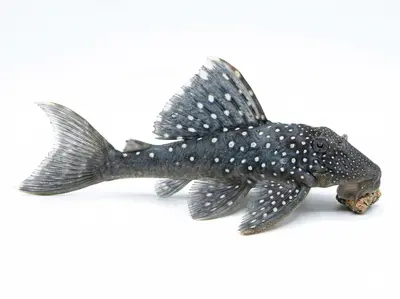
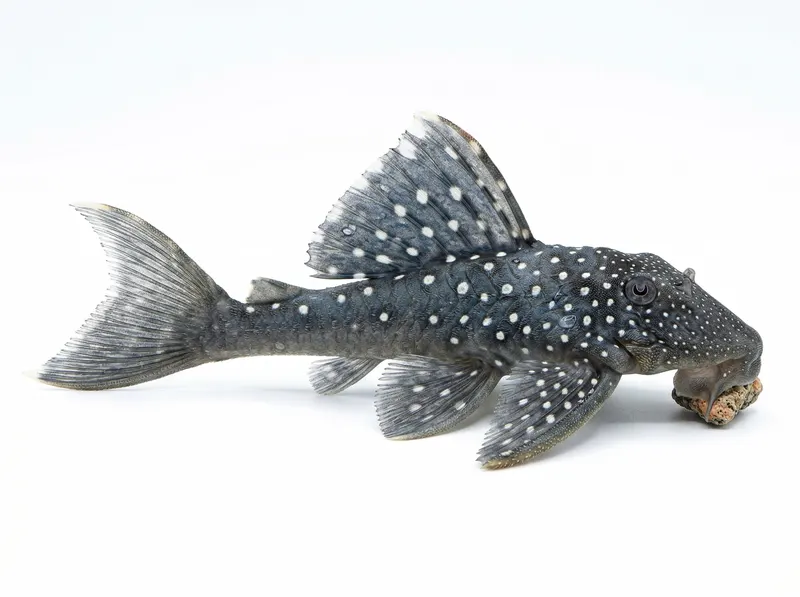
Dark brown to olive body with scattered pale spots. The original colouration. Still one of the most attractive forms and often hardier than more selectively bred variants. This is what you'll find most frequently in fish shops.
Albino
Pale yellow-orange body with red eyes. Extremely common in the hobby and one of the most popular variants. The pale colouration makes the fish more visible in the tank than the dark wild type — a genuine advantage if you actually want to see your pleco. Often listed in the hobby as L144, though technically that designation applies to specific albino species within Ancistrus.
Longfin
Extended, flowing fin rays on the dorsal, caudal, and pectoral fins. Available in both wild-type colouration and albino. The elongated fins are visually striking but require some additional care — long fins are more prone to damage and need the fish to be kept with non-aggressive tankmates. Longfin bristlenoses move somewhat more slowly than standard fin versions and can be outcompeted for food in busy tanks.
Super red
Selective breeding has produced a form with vivid orange-red colouration throughout the body. One of the more striking variants and increasingly popular. Care is identical to other variants.
Calico / peppermint
Irregular patterning of dark and light patches. Peppermint bristlenose is sometimes used specifically for Ancistrus dolichopterus, a distinct species with particularly prominent bristle development. Care requirements remain similar.
Tank setup
Tank size
A single bristlenose pleco can be kept in a 20-gallon tank, though 30 gallons is more practical — it gives more surface area for algae growth, more room for hiding spots, and a better bioload buffer. For a pair or for breeding purposes, 30–40 gallons is the sensible minimum. Larger tanks obviously accommodate bristlenoses easily alongside community fish.
Substrate
Bristlenoses spend most of their time on the glass, wood, and décor surfaces rather than on the substrate, so substrate type is less critical than for bottom-feeding fish. Fine sand or smooth gravel are both practical. Avoid very coarse, sharp-edged substrates that could damage the fish's undersides when they do rest on the bottom.
Hiding places
Essential. Bristlenoses are nocturnal and need somewhere dark and sheltered to retreat during the day. Without adequate hiding spots they'll spend the day visibly stressed, wedged into a corner or behind filter equipment. Caves (terracotta pots, commercial pleco caves, stacked slate, PVC pipe sections), dense plant areas, and driftwood overhang all work. Provide at least one cave per pleco and one spare — males particularly will defend a chosen cave from other plecos.
Driftwood
Not optional for long-term health. Bristlenoses rasp at wood surfaces constantly — it contributes to their digestion and provides behavioural enrichment. Bogwood and Malaysian driftwood are the most commonly used types. A piece of wood doesn't need to be large — even a small section gives the fish something to work on. The tannins released by wood also soften and slightly acidify water, which suits most bristlenose keeping conditions.
Plants
Compatible with planted tanks, which is one of the reasons bristlenoses are so popular — they graze algae from plant leaves without typically damaging the plants themselves. Delicate, very fine-leaved plants may be disturbed when a bristlenose clambers over them, but robust plants (Java fern, Anubias, Amazon swords, Vallisneria) coexist with bristlenoses easily.
Water parameters
ParameterTarget rangeTemperature73–82°FpH6.5–7.5Hardness (GH)6–15 dGHAmmonia0 ppmNitrite0 ppmNitrateBelow 30 ppm
The bristlenose is one of the most water-parameter tolerant plecos in the hobby. Its captive-bred status and long history in the trade have produced a fish that adapts well to a wide range of conditions. Standard UK or US tap water typically falls within the acceptable range for bristlenoses without requiring RO treatment or significant modification.
That said, consistently good water quality still matters. Elevated nitrates over time cause the same gradual decline in bristlenoses as in other plecos — reduced activity, appetite suppression, increased disease susceptibility. Regular water changes (25–30% weekly) keep nitrates in check and are the most important ongoing maintenance task.
Temperature flexibility is a genuine asset. The range of 73–82°F covers most community tank setups without requiring adjustment. The lower end suits cooler-running community tanks; the higher end accelerates metabolism, growth, and breeding activity.
Feeding
The feeding question that most new bristlenose keepers get wrong is this: they assume the fish is living on algae and don't supplement. Algae in the tank is helpful, but it's not a complete diet. A bristlenose fed only on whatever algae happens to grow in the tank will be undersupplied on protein and on certain micronutrients, and it will show it over time through slow growth, reduced vigour, and increased susceptibility to disease.
Vegetables
Blanched vegetables should be a regular part of the diet. Courgette (zucchini) is the standard recommendation and almost universally accepted — slice a coin-sized piece, blanch for thirty seconds, cool, and weight it to the bottom of the tank. Cucumber, sweet potato, squash, kale, spinach, and green beans all work. Offer vegetables two to three times per week. Remove uneaten pieces after 24 hours to avoid fouling the water.
Algae wafers and sinking pellets
Quality algae wafers should be a regular dietary staple. They're a more consistent nutrient source than tank algae and ensure the fish gets a balanced diet even in tanks with low algae growth. Offer a wafer or two every other day, or daily in tanks with low natural algae. High-quality options contain spirulina, kelp, and other algae components as primary ingredients.
Protein
Often overlooked but important. Bristlenoses benefit from occasional protein-rich foods — frozen bloodworm, brine shrimp, daphnia, or high-protein sinking pellets. Once or twice a week is sufficient. Protein feeds support the breeding condition of adults and the growth rate of juveniles. Don't overdo it — the diet should be primarily plant-based, but some protein is genuinely beneficial.
Wood
Not strictly feeding but relevant: bristlenoses rasp at wood as part of their normal feeding behaviour. The cellulose content of driftwood aids their digestion. Always have a piece of driftwood available.
Tankmates
Bristlenoses are among the most community-compatible catfish in the hobby. Their armoured body, non-aggressive temperament, and primarily bottom-and-surface dwelling habits make them compatible with an enormous range of fish.
Excellent companions
Tetras of all kinds, rasboras, danios, barbs (peaceful varieties), livebearers, corydoras, small to medium cichlids (with caveats below), other peaceful catfish. Most fish that occupy mid-to-upper water column are entirely compatible — they simply don't interact with the bristlenose in any meaningful way.
Cichlid companions
Bristlenoses coexist with many cichlid species because of their armoured plating — they're simply not worth attacking. Smaller, peaceful cichlids (kribensis, keyhole, rams, apistos) are fine. Larger, more aggressive cichlids may still harass bristlenoses particularly at feeding time or if the cichlid is breeding. In tanks with aggressive cichlids, make sure the bristlenose has somewhere it can retreat that the cichlid can't follow.
Multiple bristlenoses
You can keep multiple bristlenoses together — they're not aggressive toward each other as a rule — but males will defend caves from each other, particularly when breeding. Provide more caves than fish and ensure there's enough space that cave-defending doesn't cause persistent stress. Two females or a male and female pair in a 30-gallon tank is straightforward. Multiple males in a small tank with limited caves is more problematic.
Behaviour
Bristlenoses are primarily nocturnal — most of their activity occurs after the aquarium lights go off. During the day they typically rest in their chosen cave or in a shaded area beneath wood or dense planting. This is normal and healthy behaviour, not a sign that the fish is unwell.
Activity during the day varies by individual. Some bristlenoses — particularly well-settled fish in low-traffic environments — become quite bold and visible during daylight hours, particularly around feeding time. Others remain resolutely secretive. Age also plays a role: younger, recently introduced fish tend to hide more than settled adults.
At night, bristlenose activity is considerably more visible. They'll work systematically across glass surfaces, wood, and décor, rasping at algae and biofilm. The rasping movement — the fish pressing its mouth against a surface and moving it in a circular pattern — is one of the more distinctive behaviours in catfish keeping.
Territorial behaviour is relatively mild outside of breeding. Males defend their cave of choice from other plecos but don't usually bother other species. During breeding, the male becomes more actively defensive of the cave area but this rarely extends to serious aggression toward non-pleco tankmates.
Health and common problems
Ich (white spot)
Bristlenoses can contract ich under stress or temperature drops, though they're not particularly susceptible. Standard treatment — gradual temperature increase to 84°F combined with proprietary medication — is effective. Bristlenoses tolerate most ich treatments well at standard doses.
Hole in the head
Less common in bristlenoses than in larger cichlids but possible in conditions of chronic poor water quality. Presents as small erosions or pits around the head. Improving water quality is the primary treatment and prevention.
Skin flukes
Pleco species can be susceptible to skin and gill flukes, particularly fish from less-than-ideal sources. Signs include flicking against surfaces, rapid gill movement, and visible mucus on the skin. Praziquantel-based treatments are effective.
Digestive issues
A bristlenose that isn't eating or appears bloated may be constipated or have a digestive blockage. Ensure driftwood is always available, offer high-fibre vegetable foods, and fast the fish for 24–48 hours if bloating is observed. Persistent digestive problems may indicate internal parasites.
Fin damage
Longfin variants are more susceptible to fin damage. Fin nipping from aggressive tankmates, snagging on sharp décor, or bacterial infection can all damage fins. Remove the cause, improve water quality, and fins typically heal if the underlying issue is addressed.
Breeding
Bristlenose plecos are among the most reliably breeding fish in the hobby. A healthy pair in a tank with a suitable cave will spawn repeatedly, often every four to six weeks under good conditions.
Sexing
Males develop prominent tentacle-like bristles on the snout — this is clear and reliable from around four to six months of age. Females have smaller, less developed bristles around the snout edge, or none. Males also tend to be slightly larger at equivalent age and develop more pronounced odontodes (spiny growths) on the pectoral fin spines.
Cave selection and spawning
The male selects and defends a cave. He cleans the interior thoroughly before spawning. When the female enters and is accepted, spawning occurs over one to several hours — eggs are deposited on the cave ceiling and fertilised. The female is then expelled and the male guards the eggs exclusively. Clutch size is typically 30–100+ eggs depending on the age and size of the female.
Egg and fry care
The male fans the eggs continuously for four to seven days until they hatch. Newly hatched larvae carry a large yolk sac and remain in the cave for a further week. Free-swimming fry are already miniature versions of the adults and can immediately begin grazing algae and biofilm from tank surfaces. Feed baby brine shrimp, micro worms, and powdered algae wafers from the day they're free-swimming.
The male guards fry for several days after they become free-swimming. As fry disperse around the tank, they're increasingly independent. In a community tank, some fry predation by other fish should be expected — if you want to raise all the fry, move them to a dedicated rearing tank at the free-swimming stage.
Triggering spawning
If a pair isn't spawning, check: cave suitability (is the entrance the right size?), water temperature (increase slightly), water quality (perform more frequent water changes), and diet (increase live and frozen food frequency). The most common trigger for bristlenose spawning that had stalled is a significant water change with slightly cooler water — simulating a rainfall event.
What to look for when buying
Bristlenoses are widely available and relatively inexpensive, which means quality varies considerably across sources. What to look for:
Active and feeding. Bristlenoses should be moving and rasping at surfaces, not hiding in a corner.
Good body condition. The body should be full, not sunken or pinched. Ribs visible through the skin indicate poor nutrition.
Clear skin. No white spots, no visible parasites, no unusual lesions or erosions.
Intact fins. Particularly important for longfin variants — damaged fins indicate stress or aggression from tankmates.
Appropriate size. Very small juveniles (under an inch) are more fragile and harder to sex. Fish of 1.5–2 inches are a more practical purchase size.
For breeding purposes specifically, buying from a breeder who can accurately sex the fish and tell you the lineage is significantly better than buying from a general shop. The difference between a confirmed breeding pair and two unknown-sex shop fish can be months of waiting to discover you have two males.
The bristlenose pleco isn't a glamorous fish by L-number standards. It's not rare, it's not expensive, and it doesn't demand the careful sourcing conversations that a zebra pleco requires. But it's the most consistently useful fish on this list — the one that earns its keep every day, that beginners can keep successfully, that experienced hobbyists return to repeatedly. Start here, and the rest of the pleco world opens up from a position of solid understanding.