Search AquaLots
Find fish, plants, invertebrates and equipment
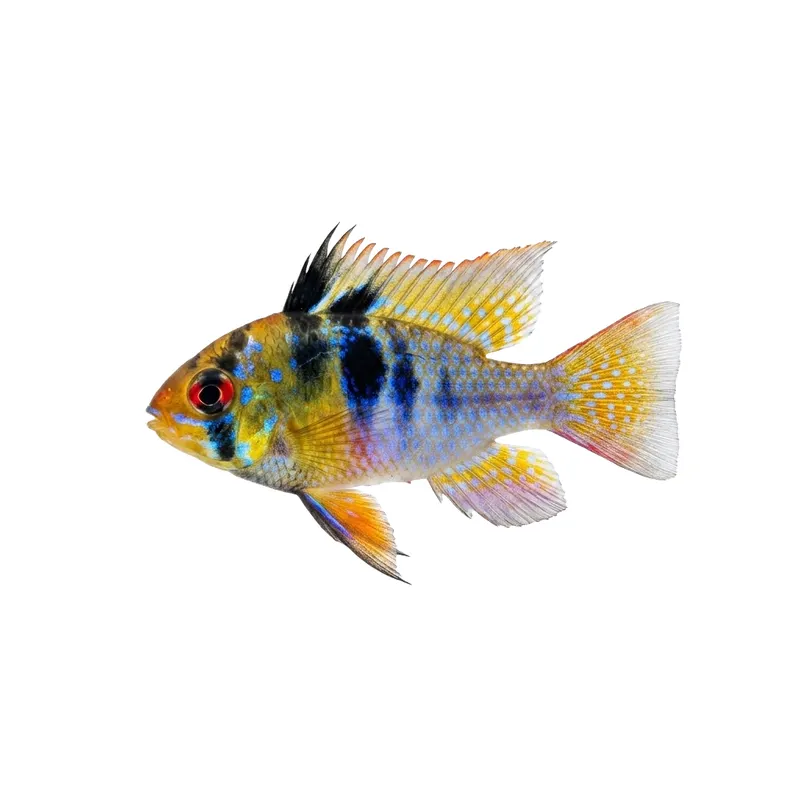
Dwarf Cichlid Guide: Dwarf Cichlid Guide: Best Apistogramma Species for Your Tank
6 April 2026
Apistogramma are some of the most beautiful and behaviourally complex fish available in the hobby. At two to three inches they deliver everything cichlids are known for — colour, personality, breeding behaviour — in a package that works in a 20-gallon tank.
In this guide
What is Apistogramma?
Apistogramma is a genus of small cichlids native to South America, distributed across the Amazon basin, the Orinoco drainage, and several coastal river systems. With over 90 formally described species — and potentially as many more awaiting formal description — it's one of the most diverse genera in the cichlid family and one of the most actively researched by both scientists and hobbyists.
The genus name translates roughly as "variable line" or "uncertain mark," a reference to the lateral line structure that varies significantly between species. More practically, Apistogramma are known for their dramatic sexual dimorphism — males are significantly larger (often twice the size of females), more brightly coloured, and display elaborate fin extensions during courtship and territorial behaviour. Females are smaller, more cryptically coloured in yellows and browns, and become intensely bright yellow-orange when guarding eggs or fry.
In the aquarium hobby, Apistogramma occupies a position somewhere between beginner and specialist fish. The most commonly kept species are accessible and well-documented, but the genus as a whole rewards deep engagement — there is an entire world of rarer species, geographic variants, and colour morphs that dedicated hobbyists spend years exploring.
Why keep Apistogramma?
Several reasons make Apistogramma stand out from the general tropical fish population.
Size. At two to three inches for males and barely more than an inch for many females, they can be kept in genuinely small tanks — 20 gallons for a pair or small harem. This makes the cichlid experience accessible in spaces where a larger cichlid simply isn't viable.
Colour. Male Apistogramma, particularly in breeding condition, display some of the most intense colours in freshwater fish. Blues, reds, yellows, and iridescent greens — often in complex, species-specific patterns. Some species have developed colour variants through selective breeding that amplify already vivid natural colouration.
Behaviour. They display the full range of cichlid behaviour — territory establishment, courtship, pair bonding, spawning, and parental care — in an observable way that larger cichlids in larger tanks sometimes don't provide. Watching an apisto female turn bright yellow and herd a cloud of fry around a well-planted tank is one of the hobby's genuine pleasures.
Community compatibility. Relative to most cichlids, Apistogramma are reasonably community-compatible. They occupy the lower tank levels and typically ignore fish in the middle and upper water column. Aggression is concentrated toward conspecifics and cave competitors rather than toward unrelated community fish.
A. cacatuoides — cockatoo dwarf cichlid
StatValueMale size3–3.5 inchesFemale size1.5–2 inchesTemperature75–82°FpH6.0–7.5DifficultyBeginner–Intermediate
The cockatoo is named for the male's spectacular elongated dorsal fin rays, which fan out like a cockatoo's crest during display. It's the most widely recommended entry point into the Apistogramma genus for good reason — it's more tolerant of water conditions than many other species, breeds readily, and is available from both specialist sellers and better-stocked general aquatic shops.
Multiple colour variants have been developed through selective breeding: double red (intense red on the tail and fins), triple red (extending the red pigmentation across more of the body and fins), orange flash, and others. All variants are equally straightforward to keep; the differences are purely cosmetic.
A cockatoo setup typically consists of one male and two to three females, each establishing a separate breeding territory within the male's larger range. The tank needs visual barriers — plants, wood, rocks — to allow females to establish distinct spaces. Without adequate territory division, the dominant female will persistently harass subordinates.
Males display constantly — especially when multiple females are present — which makes this one of the more visually dynamic Apistogramma to keep. The courtship displays, breeding dances, and territorial chases are excellent behavioural entertainment in a well-structured tank.
A. agassizii — Agassiz's dwarf cichlid
StatValueMale size3–3.5 inchesFemale size1.5–2 inchesTemperature75–82°FpH5.5–7.0DifficultyIntermediate
The agassizii is one of the classic Apistogramma species and has been in the hobby for decades. Males develop a distinctive pointed, spade-shaped caudal fin as they mature — an immediately recognisable feature that distinguishes this species from most other apistos. Colour varies considerably between geographic populations and selectively bred forms, with blue and red variants most commonly available.
It prefers slightly more acidic water than the cacatuoides — pH 6.0–6.8 is optimal, and in harder, more alkaline conditions colour can fade and breeding becomes sporadic. If your tap water is hard, this is a species that benefits from RO water blending to bring parameters into the preferred range.
Agassizii are more laterally compressed (deeper-bodied) than cacatuoides, giving them a different silhouette. They're also somewhat more assertive in their territorial behaviour, which means tank planning needs to account for adequate visual breaks between territories.
A. borellii — umbrella cichlid
StatValueMale size2.5–3 inchesFemale size1.5 inchesTemperature68–77°FpH6.0–7.5DifficultyBeginner–Intermediate
The borellii is unusual in the apisto world for its temperature preference — it's native to subtropical regions of southern Brazil, Paraguay, and Argentina, where water temperatures are considerably cooler than typical Amazon basin habitats. This makes it compatible with a different range of tankmates than most apistos, and it also makes it an option for keepers who run tanks slightly cooler than typical tropical temperatures.
Males display blue iridescence across the face and body in good condition — a striking look that's somewhat different from the more orange-red dominated colouration of many other species. The cooler temperature preference also means it can work alongside some goldfish varieties in appropriately large setups, though this is more of a novelty than a recommended approach.
It's one of the more peaceful apisto species and one of the more tolerant of water condition variation, making it a reasonable starting point for keepers who want something a bit different from the standard cacatuoides.
A. macmasteri — MacMaster's dwarf cichlid
StatValueMale size3–3.5 inchesFemale size1.5–2 inchesTemperature75–82°FpH5.5–7.5DifficultyIntermediate
The macmasteri is a Colombian species with a red-dominated colouration that makes males look particularly vivid in a well-planted tank. A prominent red patch on the abdomen, combined with yellow flanks and blue iridescence on the face, creates a striking combination. A selectively bred "red" colour form is also available with intensified red pigmentation.
It's adaptable across a wider pH range than some other species, which makes it slightly easier to keep in harder tap water. It's an active, assertive fish that displays frequently and is rarely shy once settled. Females in breeding condition develop the classic bright yellow colouration seen across the genus, making them highly visible and easy to monitor.
One consideration: macmasteri males can be persistent in their courtship, which places stress on females in small tanks. A tank of 30 gallons or larger with adequate cover gives females retreat options and reduces courtship stress.
A. trifasciata — three-striped dwarf cichlid
StatValueMale size2.5–3 inchesFemale size1.5 inchesTemperature75–82°FpH5.5–7.0DifficultyIntermediate
The trifasciata is named for the three horizontal stripes on the male's body — a more linear patterning than most apistos, which gives it a distinctive look among the genus. Males are also notable for their vivid red-orange fin colouration and the deep blue iridescence that develops across the flanks in optimal conditions.
It prefers softer, more acidic water than some other species and does best in the 6.0–6.8 pH range. It's a somewhat more specialist fish than cacatuoides in terms of water requirements, but the colouration reward for getting conditions right is significant — males in ideal conditions are extraordinary-looking fish.
Less commonly available than the top three species on this list, but specialist sellers and aquatics marketplace breeders working with this species are findable for those who seek them out.
Water requirements
Water chemistry is probably the most important husbandry factor for Apistogramma and the one most often overlooked. The genus as a whole originates from soft, acidic, blackwater environments in South America — river systems stained dark with tannins from decaying leaf litter, with very low mineral content and pH values that sometimes fall below 5.0 in the wild.
In the aquarium, the tolerance for higher pH and harder water varies considerably by species. The cacatuoides is broadly tolerant and will survive and breed in moderately hard water. The agassizii and trifasciata are considerably less forgiving — in hard, alkaline water they'll survive but won't thrive, won't colour up fully, and won't breed reliably.
What to do if your tap water is hard
RO water blending — Reverse osmosis water has zero dissolved minerals; blending it with tap water at the appropriate ratio (e.g. 50/50 for a 50% reduction in hardness) gives you control over the final parameters. This is the most precise and reliable method.
Driftwood and leaf litter — Bogwood and Indian almond leaves release tannins that soften water and reduce pH. For tanks with moderate hardness, this approach can shift parameters usefully; for very hard water, it's insufficient on its own.
Peat filtration — Running filter water through peat softens and acidifies it. Effective but changes the filter media maintenance routine and darkens the water significantly.
Temperature
Most Apistogramma are comfortable in the 75–82°F range. The borellii is an exception at 68–77°F. Slightly warmer temperatures at the upper end of the acceptable range accelerate breeding activity; slightly cooler temperatures slow it down but are generally not harmful for non-breeding maintenance.
Feeding
Apistogramma are micropredators in the wild, feeding primarily on small invertebrates, insects, and larvae. In the aquarium, this translates to a preference for small, protein-rich foods.
Staple foods
Small cichlid pellets or granules (1–1.5mm appropriate for the smaller females)
High-quality micro pellets
Supplements
Baby brine shrimp — universally accepted and excellent for conditioning
Frozen bloodworm (use small portions — large bloodworm can be difficult for smaller females to eat)
Frozen daphnia — good for digestive health and enthusiastically accepted
Micro worms and white worms — excellent conditioning foods for breeding preparation
Cyclops — excellent for smaller individuals including juveniles
Feeding notes
The size difference between males and females in Apistogramma means feeding management matters. Large males will outcompete small females for food if pellet size isn't appropriate for both. Use small-format foods, target feed females where necessary, and monitor condition of all individuals — a thin female is a common consequence of feeding management problems in apisto tanks.
Breeding
Apistogramma are cave spawners. Females lay eggs on the ceiling or walls of a small cave, guard them fiercely, and provide intensive parental care to the fry. The female is the primary guardian — she changes to vivid yellow as a warning signal and drives away anything that approaches the cave, including the male who may need to be separated in some setups to prevent fry predation.
Breeding setup
Provide multiple small caves — coconut shells, small terracotta caves, upturned pots with entrance holes. Dense plant cover gives females multiple retreat options and allows females to establish separate territories. A 20–30 gallon tank with one male and two females is a practical breeding setup for the more commonly kept species.
Triggering spawning
Increase live and frozen food frequency. Perform water changes with slightly cooler water. Ensure pH is in the species' preferred range — this is the most common cause of spawning failure in apistos with harder tap water. Raising temperature slightly (one to two degrees) also often triggers breeding activity.
Egg and fry care
Eggs hatch in two to three days. Fry carry a yolk sac for a further three to five days. Free-swimming fry are extremely small and need appropriately sized first foods — newly hatched baby brine shrimp and micro worms from day one. Feeding three to four times daily accelerates growth. The female continues to guard fry intensively for two to three weeks.
Raising fry
In a community tank, fry survival rates vary depending on tankmates. Many breeders move fry to a dedicated rearing tank at the free-swimming stage. A bare-bottom 10-gallon with a sponge filter, matched water parameters, and frequent small feedings is the standard rearing setup. Growth is slow — apistos take six to eight months to begin showing adult colouration.
Finding Apistogramma
Common species like cacatuoides are available from better-stocked general fish shops. For specific colour variants, rarer species, and wild-caught geographic populations, specialist sellers are the route to go.
The Apistogramma hobbyist community is engaged and generous — dedicated forums and social media groups are excellent resources for finding specific species and connecting with breeders. Aquatics marketplaces regularly list apisto species from specialist breeders who maintain multiple lines and can provide fish with known provenance.
Wild-caught apistos are available from importers and occasionally from specialist shops. These fish often have more intense natural colouration than tank-bred specimens but require more careful acclimatisation and may be less immediately forgiving of suboptimal conditions. For most purposes, captive-bred fish from established lines are the more practical starting point.
Whichever species you start with, the Apistogramma world is one of the most rewarding corners of the freshwater hobby. The combination of size, colour, personality, and behavioural complexity is genuinely unmatched among small fish — and the depth of the genus means there's always something new to explore, no matter how long you've been keeping them.