Search AquaLots
Find fish, plants, invertebrates and equipment
Fancy Goldfish Care Guide UK: Tank Setup, Varieties and Common Mistakes
29 March 2026
Fancy goldfish are one of the most misunderstood fish in the UK hobby. Kept properly they are intelligent, long-lived, and genuinely rewarding. Kept the way most are sold to beginners, they last months. This guide covers what actually works.
In this guide
What is a fancy goldfish?
Goldfish (Carassius auratus) are one of the oldest domesticated animals in the world, first bred in China over a thousand years ago and selectively developed for ornamental purposes over centuries. Through this long breeding history, an extraordinary range of body shapes, tail types, eye configurations, and colour patterns has emerged. Fancy goldfish is the hobbyist term for selectively bred varieties with modified body shapes, elaborate finnage, and distinctive features, as opposed to common goldfish, comets, and shubunkins that retain a streamlined body similar to wild carp.
The distinction matters practically. Fancy goldfish have compressed, shortened bodies that affect swimming ability, buoyancy, and susceptibility to health conditions. They are slower-moving and more demanding to keep well than streamlined relatives. At their best, they are among the most beautiful fish in freshwater fishkeeping. With proper care, fancy goldfish live 10 to 15 years, and many reach 20 years. The gap between potential and typical lifespan is almost entirely a function of husbandry.
Why bowls and small tanks kill fancy goldfish
Fancy goldfish are sold in the UK in conditions broadly incompatible with long-term survival. The standard retail presentation alongside a small bowl or decorative nano kit suggests these are low-maintenance pets requiring minimal space. This is wrong, and the consequences are fish that die within months.
The specific problems: goldfish are heavy waste producers and ammonia in a small unfiltered bowl becomes toxic within 24 to 48 hours. Goldfish have high oxygen demand, and small volumes with limited surface area leave them chronically oxygen-deprived. Small water volumes track ambient temperature rapidly, causing temperature swings that suppress immunity and trigger disease. And the persistent myth that goldfish grow to the size of their container has a basis in reality: not mystical growth hormones but chronic poor water quality that physiologically prevents normal development.
None of these problems are difficult or expensive to address. The solution is a properly sized, filtered tank. The cost difference between a 60-litre filtered setup and a 10-litre bowl is not large. The difference in fish survival is the difference between a fish that thrives for fifteen years and one that struggles through its first winter.
Tank setup
Size
The minimum tank size for a single fancy goldfish is 60 litres. For two fish, 100 to 120 litres is a practical minimum. Common fancy varieties like orandas and ryukins reach 15 to 20cm at adult size. Plan for adult size, not the juvenile size at point of purchase. A long, relatively shallow tank provides more swimming space and better gas exchange than a tall, narrow tank of the same volume. Aim for at least 60cm length for a single fish, 90cm or more for a small group.
Equipment checklist
Filter rated well above the tank volume
Heater set to 18 to 20 degrees C
Digital probe thermometer
Lid or cover
Siphon and bucket for water changes
Liquid water test kit
Filtration
Filtration is the single most important investment for fancy goldfish. Not decoration, not lighting, not specialist substrate. The biological colony in a cycled filter keeps ammonia and nitrite at zero, which is what keeps the fish alive long-term.
Goldfish require more filtration than their size suggests because they produce unusually large amounts of biological waste. Filter at four to six times the tank volume per hour minimum. A 100-litre goldfish tank needs a filter rated for at least 400 litres per hour, preferably 600. Most filters marketed for 100-litre tanks are underpowered for goldfish.
External canister filters are the most practical choice for tanks of 80 litres and above. The tank must be cycled before adding fish. Do not add goldfish to an uncycled tank. Weekly water changes of 25 to 30 percent are standard maintenance even with good filtration.
Water parameters and UK tap water
ParameterTarget rangeTemperature18 to 22 degrees C idealpH7.0 to 8.0GH8 to 20 dGHAmmonia0 ppmNitrite0 ppmNitrateBelow 40 ppm
UK tap water is generally well-suited to fancy goldfish. Most English tap water is moderately hard, neutral to slightly alkaline, and within the pH range goldfish prefer without any modification. Dechlorinate before use using any standard aquarium water conditioner. Very soft water areas (parts of Scotland, Wales, and the North West) can add a small amount of aquarium mineral supplement if GH is below 5 dGH. Very hard water is fine for goldfish with no modification needed.
Temperature and heating
Goldfish are cold-water fish tolerating a wide range. The optimal range for fancy goldfish in UK aquariums is 18 to 22 degrees C. UK rooms in winter regularly drop below 18 degrees C without heating assistance, and summer temperatures can reach 25 degrees C or above during heatwaves.
A heater set to 18 to 20 degrees C provides a stable temperature floor without overheating the fish. This is cooler than tropical heater settings and uses less energy. Turn it off in summer when room temperatures exceed 20 degrees C. Fancy goldfish are sensitive to heat at the upper extreme: sustained temperatures above 26 degrees C cause serious stress and should be addressed with a fan or water cooling.
Temperature stability matters as much as the specific number. Chronic fluctuations between 15 and 24 degrees C are more damaging to fancy goldfish health than a stable 20 degrees at either end of the acceptable range.
Fancy goldfish varieties
Oranda
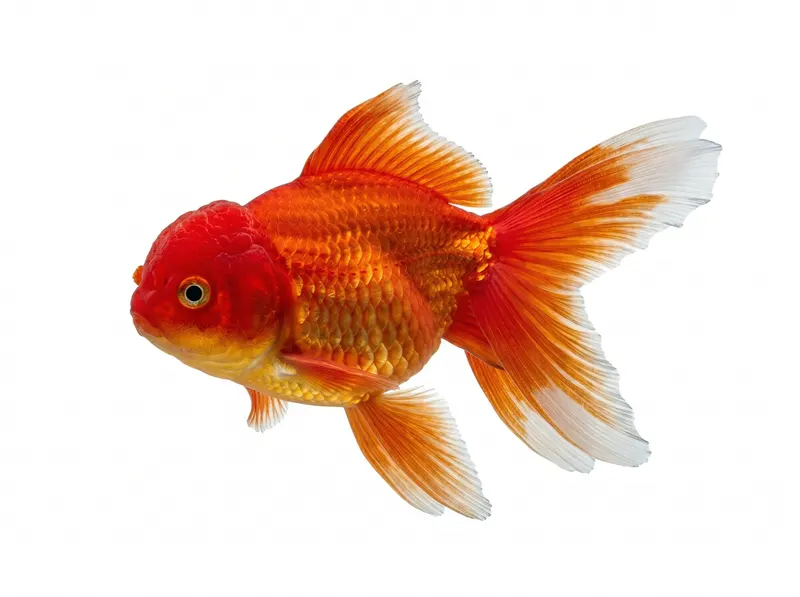
One of the most popular fancy varieties in the UK. The defining feature is the wen, a raspberry-textured hood growth covering the head and cheeks that develops as the fish matures. Available in red, red-and-white, black, calico, and combinations. The red-cap oranda, white body with vivid red wen, is a classic and widely available variety. Relatively hardy for a fancy type and a good starting point.
Ryukin
Deep, rounded body with a pronounced hump behind the head and a large double tail. Often vivid red and white or calico colouration. Stronger swimmers than many fancy types. Popular in UK shops and widely available from specialist breeders.
Ranchu
The Japanese variety considered by many enthusiasts to be the pinnacle of fancy goldfish breeding. Arched back, no dorsal fin, deep rounded body, and wen covering the head and cheeks. Slow swimmers, sensitive, and requiring more care than heartier varieties. Quality UK ranchu are available from specialist importers and breeders, and can be found on AquaLots from dedicated UK ranchu keepers.
Telescope eye and black moor
Large, protruding eyes on an extended stalk. The black moor is the most commonly available telescope in UK shops. Protruding eyes are vulnerable to injury from sharp decor. Vision is impaired, meaning telescope eyes should not be kept with faster varieties that outcompete them for food.
Bubble eye
Fluid-filled sacs beneath each eye, extremely fragile and easily burst. Requires completely smooth decor and very gentle water movement. One of the most demanding fancy varieties to keep safely. Not recommended as a first fancy goldfish.
Pearlscale
Round, dome-shaped body with distinctive raised, dome-shaped scales giving an unusual texture. Available in various colours and with or without head growth. Prone to swim bladder issues due to the very compressed body shape.
Butterfly tail
When viewed from above, the double tail opens symmetrically in a butterfly wing shape. Best appreciated from a top-down perspective. Increasingly available in the UK from specialist importers and breeders.
Feeding
Goldfish are omnivores and enthusiastic eaters that will beg continuously regardless of hunger. Overfeeding is one of the most common causes of goldfish health problems, including swim bladder issues, nitrate spikes, and digestive problems.
Use quality sinking goldfish pellets or granules as the staple food. Sinking rather than floating food reduces the air goldfish ingest at the surface, which contributes to swim bladder problems in fancy varieties with compressed bodies. Supplement with blanched vegetables (courgette, peas without skin, spinach) and occasional frozen daphnia or brine shrimp.
Feed twice daily, offering only what the fish consume in two to three minutes. Remove uneaten food promptly. Fast one day per week to reduce constipation and swim bladder issues that fancy goldfish are prone to.
Tankmates
Do not mix single-tailed goldfish (commons, comets, shubunkins) with double-tailed fancy varieties. Single-tailed fish are faster and more aggressive feeders that leave fancy varieties unable to compete for food even in apparently well-fed tanks.
Within fancy goldfish, match similar swim speeds and body types. Very slow swimmers like bubble eye should not be kept with faster fancy types. Orandas and ryukins of similar size coexist comfortably.
Other compatible species: white cloud mountain minnows (cold-water tolerant, peaceful), weather loaches (cold-water, active, generally ignored by goldfish), and rubber-lipped plecos (cold-water tolerant algae eaters). Avoid tropical fish, which require temperatures incompatible with fancy goldfish long-term health.
Health and common problems
Swim bladder disorder
The most common fancy goldfish health problem. Fish floating upright or upside down, tilting, or sinking to the bottom. Causes include overfeeding, swallowed air from surface feeding, constipation, or bacterial infection. Fast for 24 to 48 hours, then offer blanched peas without skin as a laxative. If issues persist beyond a week, antibacterial treatment for bacterial swim bladder infection may be appropriate.
Fin rot and bacterial infections
Fraying or discolouration of fins, ulcers on the body. Almost always caused by poor water quality. Improve water quality with a large water change and check ammonia and nitrite. Treat established bacterial infection with proprietary antibacterial treatments.
Ich (white spot)
More common at lower temperatures when immune function is suppressed. Standard treatment: raise temperature to 24 degrees C combined with proprietary ich medication. Do not exceed 24 degrees for fancy goldfish as they are more heat-sensitive than tropical fish.
Anchor worm and fish lice
Parasites visible to the naked eye. Anchor worm appears as thread-like white protrusions from the body. Fish lice are small flat parasites on the surface. Treat with proprietary treatments containing appropriate antiparasitic compounds. Manual removal of visible anchor worm with tweezers under brief salt bath can accompany chemical treatment.
Where to find quality fancy goldfish in the UK
The quality difference between fancy goldfish from a general pet shop and from a specialist breeder is dramatic. Pet shop fancy goldfish are typically mass-produced from poorly maintained stock, often undersized juveniles whose adult potential is unclear. Premium East Asian varieties such as ranchu, Thai oranda, and show pearlscales are a completely different category of fish available only through specialist sources.
AquaLots lists fancy goldfish from UK keepers and specialist breeders. The advantage of buying through a dedicated aquatics marketplace is seeing exactly what you are buying, asking about the fish's history and current water parameters, and buying with buyer protection in place. This is particularly valuable for fancy goldfish where condition, body shape, and fin quality matter significantly and are hard to assess from a shop tank photo.
When buying any fancy goldfish: look for active upright swimming, clear bright eyes, fins intact without fraying, full rounded body without emaciation, and no visible white spots or lesions. Ask what temperature the fish has been kept at and what it has been eating. A seller who can answer these questions clearly is a seller who understands their fish.