Search AquaLots
Find fish, plants, invertebrates and equipment
Guppy Fish Care and Breeding Guide
30 March 2026
Guppies are one of the most popular aquarium fish in the world — and consistently one of the most underestimated. The fancy strains available today are a long way from the plain guppies of a generation ago, and breeding them seriously is a genuinely rewarding and commercially viable hobby. This guide covers everything from choosing your first fish to producing sellable quality offspring.
In this guide
What is a guppy?
The guppy (Poecilia reticulata) is a small freshwater livebearer native to rivers and streams across northern South America — Trinidad, Venezuela, Guyana, Barbados, and adjacent regions. It's been introduced (both deliberately for mosquito control and accidentally) to waterways on almost every continent, which is testament to just how adaptable this species is.
In the wild, guppies are modestly coloured — males have some iridescent spotting and rudimentary fin extension, females are a plain olive-silver. Decades of selective breeding in the aquarium hobby have produced a fish that barely resembles its wild ancestor: males with elaborate finnage covering multiple times the body surface area, in colours ranging across the full visible spectrum, in dozens of named pattern and tail type combinations. The show guppy hobby has its own international associations, competitions, and grading standards that rival any other competitive animal breeding discipline.
For most hobbyists, the guppy sits somewhere between the basic pet shop fish and the serious show strain — fancy enough to be visually impressive, robust enough to breed readily, and interesting enough to build a genuine breeding project around.
Why keep guppies?
The practical case for guppies is straightforward: they are genuinely hardy, genuinely colourful, genuinely easy to breed, and they work in tanks as small as 15 litres for a small group. For a beginner, they're probably the most forgiving fish available that also offers genuine visual reward. For an experienced keeper, fancy strain guppies offer a breeding project with real depth — colour genetics, line breeding, tail type selection, and an active market for quality surplus fish.
Livebearing reproduction — giving birth to fully formed, free-swimming young rather than eggs — makes guppy breeding particularly accessible. No need for spawning triggers, egg incubation, or larvae management. The female gives birth to juvenile fish that eat immediately. The challenge is not triggering breeding (it happens without encouragement) but managing it, directing it toward quality, and deciding what to do with the surplus.
UK tap water — guppies love it
One of the least-discussed advantages of guppy keeping in the UK is that most UK tap water is essentially ideal for this species without modification. This is the opposite of the situation for many popular tropical fish, which require soft acidic water that UK hard water supplies don't provide naturally.
Guppies originate from hard, alkaline, often slightly brackish water in their native range. In the wild they've been found in everything from near-freshwater streams to water with significant salinity. They're adapted to dissolved minerals, moderate to high alkalinity, and neutral to slightly alkaline pH. The moderately hard, pH 7.2–7.8 water that most English tap supplies deliver is remarkably close to their optimal conditions.
Areas with softer water — parts of Scotland, Wales, and the North West — may need to add a small amount of mineral supplementation (a small amount of marine salt or a specifically formulated livebearer mineral supplement) to bring GH up to a level that supports healthy moulting and vigorous fry development. Guppies don't need extreme hardness, but they don't thrive in very soft water.
If you have very hard water (above 20 dGH) — some parts of London and the South East — guppies will still do well, though this is genuinely harder than ideal. Consider blending with a small proportion of RO or filtered water if hardness is very high.
Fancy guppy strains — a practical overview
The guppy world has a nomenclature for strains that's both useful and confusing in equal measure. Here's a practical guide to the main categories without the encyclopaedic detail that only matters to serious competitors.
Moscow guppies
A strain group originating from Russia, characterised by intense, uniform body colour that extends from head to tail. Moscow blue, Moscow green, Moscow purple — the defining characteristic is the solid, saturated colour across the full body rather than the patterned spots and half-tones of other strains. Moscow guppies are among the most visually impressive strains for body colouration and command strong prices from buyers who want a striking colony rather than elaborate fin displays.
Endler's livebearer and Endler guppy crosses
Poecilia wingei, the Endler's livebearer, is a close relative of the guppy that interbreeds with P. reticulata readily. Pure Endler's are smaller, bolder in pattern, and hardier than fancy guppies. Endler-guppy hybrids are popular because they combine the colour variety of guppies with some of the robustness of Endler's. Pure Endler's — specifically the naturally occurring wild strains — are separately collected and maintained by dedicated hobbyists who keep them from guppy hybridisation.
Snakeskin guppies
A pattern strain characterised by a scale-by-scale reticulated or chain-link pattern across the body, giving the fish the appearance of snakeskin. The pattern is genetic and breeds true in established snakeskin lines. Various colour variants of the snakeskin pattern exist — yellow snakeskin, red snakeskin, blue snakeskin.
Tuxedo guppies
A bicolour pattern where the posterior half of the body is distinctly darker than the anterior, creating a "tuxedo" effect. The demarcation line between the two colour zones and the specific colours involved vary between tuxedo lines.
Cobra guppies
Vertical banding on the body combined with rosette patterning, typically with metallic or iridescent scale expression. Cobra patterning is one of the more complex patterns in the guppy world and comes in multiple colour variants.
Albino strains
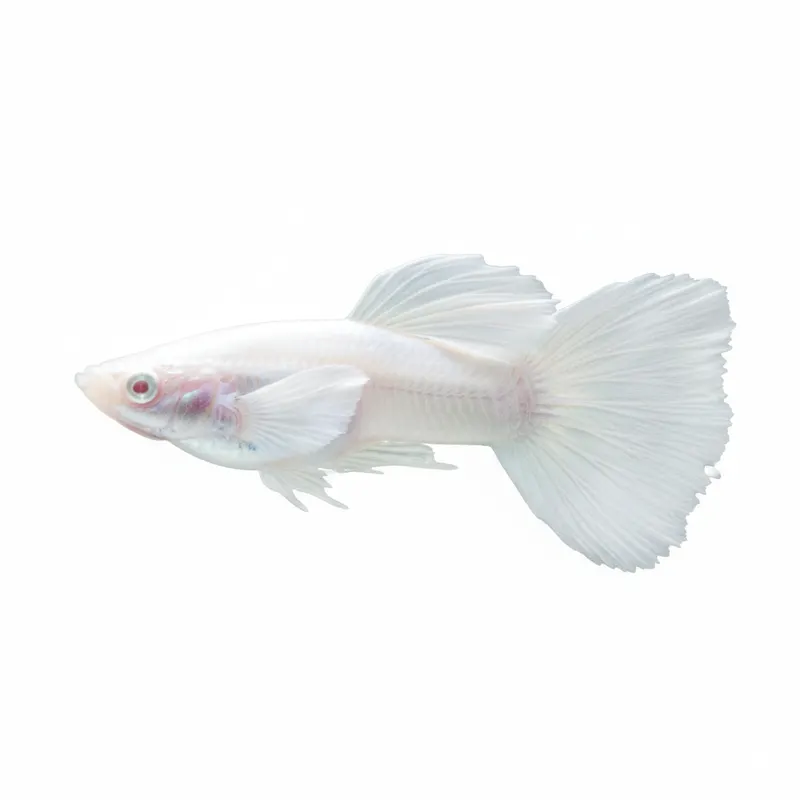
Albino guppies lack the dark melanin pigmentation present in standard fish. This results in a red-eyed, pale body — but the colour pigments (reds, yellows, oranges) that don't depend on melanin are often more vivid in albinos because there's no competing dark pigment to reduce their apparent intensity. Albino red guppies with flame-coloured tails are among the most striking varieties.
Tail types
Tail type is one of the most visible and most specifically classified characteristics in fancy guppies. The major types:
Delta / triangle — the broad, triangular tail that opens into a fan shape. The largest and most dramatic tail type. Delta tails with full spread can be as large as the rest of the fish's body. The most common fancy type in the trade.
Veil tail — flowing, drooping tail with a round or irregular lower edge. More graceful and less structured than the delta.
Sword tail — an extension of the upper or lower edge of the caudal fin into a spike. Top sword, bottom sword, and double sword are all distinct variants. The sword extension can be equal to or longer than the body.
Lyretail — extensions on both upper and lower edges, creating a lyre-shaped tail. Visually complex and distinctive.
Roundtail — a shorter, rounder tail without the dramatic extension of other types. More similar to wild-type tail shape, used in some specific strain programmes.
Pintail / spear — the central rays of the tail are elongated into a point. Elegant and unusual; less common in the UK trade than delta and sword types.
Flagtail — rectangular tail outline with straight upper and lower edges. Less commonly encountered.
Tail type is separately inherited from body colour in most cases, which means breeders can (with patience) develop any colour in any tail type. However, some combinations are harder to achieve than others, and maintaining both a specific colour and a specific tail type requires consistent selection pressure over multiple generations.
Tank setup
Tank size
A trio of guppies (one male, two females) can be kept in a 15-litre tank. In practice, a 40–60-litre tank is significantly more practical — it provides enough space for a small group, keeps water quality more stable, and allows enough plant cover for fry to hide if you want to raise some naturally. For a breeding project, 40–60 litres per active breeding trio or small group is a workable starting point.
Long, shallow tanks suit guppies better than tall, narrow ones — they're active mid-water swimmers that benefit from horizontal swimming space. Standard tropical tank dimensions (60–90cm long) work well.
Equipment
Filter — sponge filter for breeding tanks (no fry risk), hang-on-back or small canister for display tanks
Heater set to 24–26°C
Thermometer
Lighting — standard aquarium LED on a timer, 8–10 hours per day
Lid — guppies occasionally jump, especially when startled
Plants
Dense planting is beneficial for several reasons in a guppy tank. It provides cover for fry (which guppy parents will eat given the opportunity), breaks line of sight between males which reduces harassment of females, contributes to water quality through nutrient uptake, and creates a more natural, attractive environment. Java moss, floating plants (water sprite, frogbit), and hornwort are particularly useful — their fine structure provides excellent fry refuge. Vallisneria and Amazon sword add background density.
Bare bottom vs substrate
Serious guppy breeders often use bare-bottom tanks in breeding setups — it makes cleaning easier, allows waste to be siphoned completely, and removes the risk of detritus accumulating and degrading water quality. For display tanks, fine gravel or sand is more aesthetically practical. Either works.
Water parameters
ParameterTarget rangeTemperature23–27°CpH7.0–8.0GH (hardness)8–18 dGHKH (alkalinity)4–8 dKHAmmonia0 ppmNitrite0 ppmNitrateBelow 20 ppm
Temperature has a meaningful effect on guppy metabolism and lifespan. At the higher end of the range (26–27°C), guppies are more active, colour develops faster, and breeding is more frequent — but lifespan is shorter. At the lower end (22–24°C), they live longer but are less active and breed less frequently. Most hobbyists compromise at 24–25°C. For fry development, slightly higher temperatures (25–26°C) accelerate growth — keep fry tanks warmer than adult tanks if you want to raise juveniles to sale size quickly.
Feeding
Guppies are omnivores with small mouths and continuous appetites. Feeding little and often is more appropriate than one large daily feed.
Staple foods
Quality tropical micro-granules or fine flake food — the base of the diet. Look for formulations with high protein content and natural colour enhancers (astaxanthin, spirulina).
Spirulina flake or wafer — guppies benefit from plant-based foods as a regular supplement and spirulina notably enhances colour development.
Live and frozen supplements
Baby brine shrimp (BBS) — freshly hatched brine shrimp are the single best conditioning food for guppies and the best first food for fry. If you're breeding seriously, a brine shrimp hatchery running continuously is standard equipment.
Frozen daphnia — excellent for digestive health and conditioning. Guppies take it readily.
Frozen bloodworm — high protein, good conditioning food. Don't overfeed; large bloodworm can cause digestive issues if it's the primary protein source.
Micro worms and banana worms — excellent small live foods for both adults and growing fry.
Feeding frequency
Two to three small feeds per day produces better growth and colour than one large daily feed. Guppies are constantly active and benefit from a steady nutrient supply. Remove any uneaten food after a few minutes — guppies should consume everything offered within two to three minutes at each feeding. Leftover food accumulates rapidly and degrades water quality.
Tankmates
Guppies are peaceful community fish with one significant vulnerability: their long, elaborate fins invite fin-nipping from fast-moving or aggressive tankmates. A male delta-tail guppy with a torn, nipped tail is not a happy or healthy fish.
Good companions
Corydoras — peaceful bottom feeders, different water level, no fin nipping
Small peaceful tetras — ember tetras, neon tetras (at appropriate temperature). Avoid tiger barbs, serpae tetras, and other fin-nippers.
Small rasboras — peaceful, appropriate size, no fin nipping tendency
Bristlenose pleco — algae grazer, not interested in guppies
Otocinclus — small, peaceful, algae-focused
Snails — mystery snails, nerites, ramshorn snails are all compatible
Neocaridina shrimp — compatible in most guppy setups, though guppies will eat shrimplets
What to avoid
Tiger barbs — notorious fin nippers
Bettas — will attack male guppies and frequently vice versa
Most cichlids — too aggressive and often large enough to eat guppies
Large catfish that consume fish
Serpae tetras and other known fin-nippers
For breeding setups, guppies-only tanks are strongly recommended. It simplifies management and removes any risk of tankmate predation on fry.
Sexing guppies
Sexing guppies is one of the easier tasks in fishkeeping and can be done reliably from around three to four weeks of age — earlier than most other fish.
Males are smaller and slimmer than females. They develop colourful, elaborate finnage — particularly the caudal (tail) fin and the dorsal fin — as they mature. Most importantly, males develop the gonopodium: a modified anal fin that is rod-shaped rather than fan-shaped. The gonopodium is used for internal fertilisation and is the definitive sexing criterion — once it's visible, there's no ambiguity.
Females are larger, rounder-bodied, and considerably plainer than males. The anal fin is the normal fan shape. A gravid (pregnant) female will develop a "gravid spot" — a dark patch at the base of the abdomen that becomes more prominent as the pregnancy progresses. In the final stages of pregnancy, the gravid spot is large and dark and the female's abdomen is noticeably swollen. At this stage, birth is typically imminent within a few days.
Breeding
Guppies breed without any deliberate intervention in a healthy, mixed-sex tank. The challenge is not triggering breeding but managing it. Understanding the reproductive biology helps you do this more effectively.
Livebearer reproduction
Guppies are livebearers — females carry developing young internally rather than laying eggs. Fertilisation is internal. A single mating fertilises multiple broods — females store sperm and can produce several broods from a single mating event. This makes separating sexes to control breeding less straightforward than it sounds: a recently mated female who is placed in a male-free environment may continue to produce broods for months.
Gestation and brood size
Gestation lasts 21–30 days depending on temperature — shorter at higher temperatures, longer at cooler ones. At 26°C expect roughly 21–23 days; at 23°C more like 28–30 days. Brood sizes range from 10–20 fry in young, small females to 30–60+ in large, mature females. Record brood sizes exceed 100, but these are exceptional.
Managing breeding pairs and trios
The standard approach for controlled breeding is a trio — one male to two females. Multiple females share the male's attention, which reduces harassment stress on individual females. Males mate relentlessly and can stress or injure a single female through continuous pursuit. Two to three females per male distributes this pressure.
For line breeding with specific genetic objectives, a single pair is sometimes used to control parentage exactly — this allows tracking which male produced which offspring, essential for serious selection work.
Breeding tanks
A dedicated breeding tank — even a small 20–30-litre bare-bottom setup with a sponge filter and heavy java moss or floating plants — separates breeding activity from any community tank risks and makes fry management straightforward. Set up the breeding tank two weeks before introducing the female so it's fully cycled.
Birth and fry management
Female guppies will eat their own fry immediately after birth. This isn't unusual or dysfunctional — it's normal livebearer behaviour. To raise fry successfully you need to either remove the female immediately after birth, use a breeding box or divider during birth, or provide dense enough plant cover that fry can hide and survive despite the predation risk.
Breeding boxes — small perforated containers that hang inside the main tank — allow the female to give birth through gaps too small for her to pass, with fry falling into a protected lower compartment. They work but should not be used for extended periods as they're stressful for the female. Move the female in only when birth appears imminent and remove her immediately afterwards.
Raising fry
Guppy fry are relatively robust compared to the larvae or fry of egg-laying species. They're miniature fish from birth, capable of immediate independent feeding, and reasonably tolerant of water conditions within the normal guppy range.
First foods
Newly hatched baby brine shrimp (BBS) — the best first food. Guppy fry take BBS immediately after birth and it provides excellent nutrition for growth and colour development. Set up a brine shrimp hatchery before the female gives birth — 24-hour-hatched nauplii are the right size for newborn guppy fry.
Finely crushed quality flake — a practical fallback if BBS aren't available. Crush flake to a fine powder before feeding.
Micro worms and banana worms — small live foods well-suited to guppy fry size.
Commercial fry foods — powdered fry foods (Sera Micron, Hikari First Bites) are convenient and adequately nutritious.
Feeding frequency for fry
Feed fry three to five times per day in small amounts. Growth rate is significantly affected by feeding frequency — fry fed more often reach juvenile size noticeably faster than those fed once daily. In a commercial breeding context, continuous feeding through an automatic feeder is used; for hobbyists, as many feedings per day as your schedule allows, with a minimum of three.
Water quality for fry
Fry are more sensitive to water quality than adults. In a small fry tank with high feeding frequency, ammonia and nitrite can spike quickly. Sponge filters provide safe biological filtration (no risk of fry being sucked in), and small daily water changes (10–20%) maintain quality without the parameter shock of large infrequent changes. Test ammonia and nitrite weekly in fry tanks and be prepared to increase water change frequency if levels rise.
Growth timeline
Week 1–2: Newborn fry feeding on BBS and micro foods, growing rapidly
Week 3–4: Sexing becomes possible; males beginning to develop gonopodium
Week 4–6: Separate males and females to prevent premature breeding — females can become pregnant as young as four weeks
Month 2–3: Juvenile colouration and finnage developing in males; growing toward adult size
Month 4–6: Approaching adult size; full colour and finnage expressed in males; females at or near breeding size
Line breeding for quality
Random breeding produces random-looking guppies. Line breeding — selecting breeding pairs based on specific desired traits across multiple generations — is how quality strains are maintained and improved.
The basics
Choose a specific goal — a colour, a tail type, or a combination. Select the best male and female specimens showing that trait most strongly from each generation's offspring. Breed only these selected individuals, not the whole group. Repeat across each generation. Over five to ten generations of consistent selection, the trait becomes reliably fixed in the line.
Inbreeding and outcrossing
Continuous inbreeding within a small closed population eventually reduces genetic diversity, causing weakened immune systems, reduced fry survival, and fertility problems. This is one of the main reasons fancy guppies purchased from mass-market shops are often weaker than those from specialist breeders — they've been intensively inbred for colour at the expense of overall health.
The solution is periodic outcrossing — introducing unrelated individuals carrying the same desired trait from a different line. Split your colony into two parallel lines (Line A and Line B), breed each separately for two to three generations, then cross Line A males with Line B females and vice versa. The resulting offspring have improved genetic diversity while retaining the selected traits. This is the approach used by serious guppy breeders worldwide.
Record keeping
Line breeding without records is guesswork. Tag breeding tanks with the strain, line, and generation number. Record which male was paired with which female and when. Note brood sizes, survival rates, and the grade of offspring. Records allow you to trace problems to their source and make rational decisions about which pairings to use in future generations.
Health and common problems
Fin rot
The most common guppy health problem — particularly in fancy males with large, delicate finnage. Presents as fraying, discolouration, or recession of fin edges. Usually a consequence of poor water quality, fin-nipping injury, or stress. Improve water quality first; if bacterial infection is established, treat with an appropriate antibacterial. The elaborate fins of fancy guppies are particularly susceptible — any source of stress or physical damage opens the door to secondary bacterial infection.
Wasting disease / guppy disease
A poorly understood condition — sometimes attributed to Microsporidia, sometimes to other internal parasites — characterised by progressive wasting, curved spine (fish-tuberculosis appearance), loss of colour, and death. It's more common in commercially mass-produced fancy guppies (particularly those imported from Southeast Asian fish farms) than in quality line-bred stock from specialist breeders. There's no reliable treatment. The prevention is buying from reputable sources with clean stock history and quarantining all new fish.
Velvet
Gold or rust-coloured dusty coating visible in raking light. Caused by Oodinium parasite. Treat promptly with copper-based medication or proprietary velvet treatment. Reduce lighting and raise temperature slightly. Guppies are not particularly sensitive to standard velvet medications at normal doses.
Swim bladder problems
Guppies with compressed, selectively bred body shapes are prone to swim bladder issues — particularly the "fancy" compressed body shapes bred for competition. Affected fish struggle to maintain position in the water column. Often incurable if structural. Improve water quality and feeding variety as supportive measures.
Bacterial infections post-birth
Females can develop bacterial infections following birth, particularly if they were stressed during pregnancy or birth occurred in poor water conditions. A female that appears lethargic, swollen, or loses colour after giving birth should be moved to a clean, quiet hospital tank and treated with a broad-spectrum antibacterial.
Selling surplus guppies
A productive guppy breeding setup produces more fish than most tanks can hold. Surplus guppies are among the easiest fish to sell in the hobby — the market is broad, demand is consistent, and shipping is relatively straightforward for a robust, adaptable species.
What sells
Fancy strain males with well-developed colour and finnage. Full-colour adult males photograph well and sell well — they're the face of the listing.
Trios and pairs from established lines — buyers who want to breed themselves pay more for a confirmed male-female breeding unit from a named strain than for random individuals.
Specific tail types — moscow guppies, double sword, lyretail, and less common varieties command better prices than generic delta tails.
Juveniles at 4–6 weeks — young fish are easier to ship safely and buyers often prefer to raise the last stage of development themselves.
What the market pays
Basic pet shop quality / common fancy variants: £1–3 per fish
Intermediate quality from named strains: £3–6 per fish
Quality line-bred fancy strains (moscow, snakeskin, sword types): £5–15 per fish
Show-quality or rare strains from verified lines: £15–40+ per fish
Basic quality guppies are very hard to sell profitably given shipping costs and competition from cheap imports. The economics improve substantially at the mid and upper end. Investing in quality founding stock from specialist breeders — rather than starting from pet shop fish — gives you a much better commercial starting point.
Where to sell
AquaLots is a natural home for fancy guppy listings — the platform connects buyers specifically looking for quality aquarium livestock with verified sellers, which is a very different audience from general classified sites. Listing with clear photos of males showing their finnage and colour, a description of the strain and line history, and your water parameters reaches buyers who understand what they're looking at and will pay accordingly. This is a much more effective route than Facebook groups where negotiation culture drives prices down, or general classified sites where the audience isn't specifically aquarium-focused.
Build feedback on the platform, respond to buyer questions about strain history, and photograph your best males in good lighting — guppy photos live and die on the quality of the tail display visible in the image.