Search AquaLots
Find fish, plants, invertebrates and equipment
Kribensis Cichlid Care Guide: The Perfect Community Cichlid
3 April 2026
The kribensis is everything a community cichlid should be — small, colourful, behaviorally fascinating, and manageable for a keeper who does their homework. Here's how to keep them properly.
In this guide
Species overview
The kribensis — Pelvicachromis pulcher — is a West African dwarf cichlid from the rivers of southern Nigeria and adjacent parts of Cameroon. It's been kept in the aquarium hobby for decades and remains one of the most reliably good choices for anyone who wants a cichlid that will work in a community setting without constant aggression management.
The name "kribensis" is a holdover from an older scientific classification — Pelmatochromis kribensis — and while the taxonomy has changed, the name has stuck in the hobby to the point where most people don't know the current scientific name without looking it up. In shops you'll also sometimes see it sold as "krib," "purple cichlid," or occasionally by its current name.
Part of what makes the kribensis stand out in the cichlid world is its size. At three to four inches for males and slightly smaller for females, it's genuinely compact — manageable in a 30-gallon tank, compatible with a wide range of community fish, and able to be kept as a single pair rather than requiring the harem dynamics of some other species. This combination of small size and genuine cichlid personality makes it one of the best introductions to cichlid keeping available.
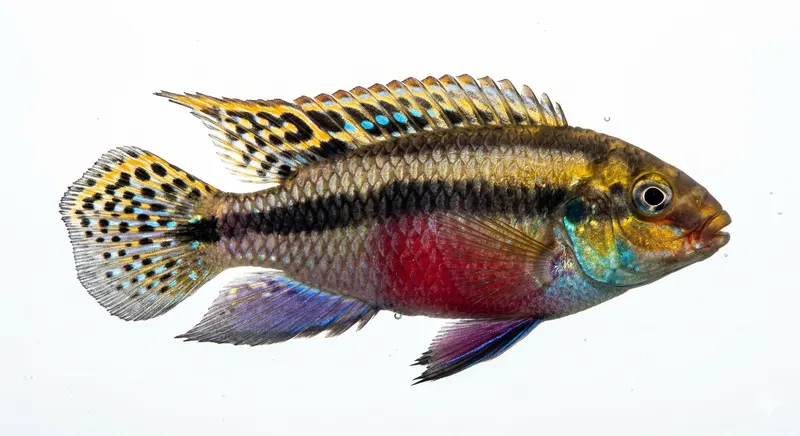
The species is also notable for its reversed sexual size dimorphism in colouration — while the male is larger, the female is often more vividly coloured, particularly when in breeding condition. The cherry-red belly patch that females develop is one of the most striking colour signals in small cichlids, and watching it intensify as a female comes into breeding condition is one of the pleasures of keeping this species.
Appearance and variants
The standard kribensis has a base colouration of olive to beige on the upper body, transitioning to a pale belly. The lateral stripe — a dark horizontal band running from the snout through the eye to the tail — is a defining feature. Males develop iridescent blue and green scales along the flanks and have distinctively pointed dorsal and caudal fin tips. Females are shorter and rounder in body profile, with the vivid cherry-red or pink belly that becomes most intense during breeding condition.
Several geographic colour variants exist, collected from different river systems within the species' range. Nigerian red kribensis tend to have more intense red pigmentation. Cameroon variants sometimes show different patterning along the lateral stripe. These variants are not always clearly labelled in the trade, but experienced sellers can often distinguish them.
Albino kribensis are also available — a selectively bred variant with pale body colouration and red eyes. The albino form lacks the dramatic contrast of the wild type but retains the characteristic body shape and behaviour, and the females still develop the pink belly patch during breeding condition.
Tank requirements
Tank size
A pair of kribensis can be kept in a 30-gallon tank. If you're keeping them in a community setting with other fish, 40 gallons gives more space for territorial division and provides retreat space for tankmates during breeding periods. Larger tanks are always better with cichlids — the extra space reduces conflict and makes the inevitable territorial behaviour during breeding less disruptive to other inhabitants.
Substrate
Fine sand is ideal. Kribensis are diggers — not excessively so, but they will move sand around particularly during breeding preparation. Sand is easy to siphon, allows natural digging behaviour, and doesn't trap waste between particles in the way that gravel does. Dark sand tends to show off the fish's colours better than light-coloured substrate.
Caves and hiding places
Caves are essential for kribensis — they're cave spawners and the female in particular needs secure hiding spots during and after breeding. Half-flower pots, coconut shells with entrance holes, ceramic caves, and stacked slate all work well. Provide at least two or three hiding spots even for a single pair, so the female has options and so other fish can retreat if needed. Dense planting around the cave provides additional cover.
Plants
Kribensis are relatively plant-friendly for cichlids. They don't typically eat plants and while they dig around cave sites, established plants in other areas of the tank are usually left alone. Java fern, Anubias, and cryptocorynes are all practical choices — sturdy enough to survive the occasional disruption and appropriate for the water conditions kribensis prefer. Dense plant growth also provides the visual breaks that reduce aggression and give smaller tankmates places to retreat.
Lighting
Moderate lighting suits kribensis. Bright, high-intensity lighting can cause stress and makes the fish more likely to hide. The vivid colours show better in moderate lighting with dark substrate than under intense illumination.
Water parameters
ParameterTarget rangeTemperature75–81°FpH6.0–7.5Hardness (GH)5–12 dGHAmmonia0 ppmNitrite0 ppmNitrateBelow 20 ppm
Kribensis are more adaptable than many cichlids in terms of water chemistry. They originate from rivers with variable water conditions — some populations come from soft, slightly acidic water while others are found in harder, more alkaline conditions — which has given the species a degree of flexibility that makes it suitable for a range of tap water qualities.
For optimal colouration, health, and breeding, slightly soft and acidic to neutral water is preferable — pH 6.5–7.2 and moderate hardness. In harder, more alkaline water they will survive but colouration may be less vivid and breeding more sporadic. If your tap water is very hard, consider blending with RO water to bring parameters into the preferred range.
Temperature is flexible within the stated range. 77–79°F is a comfortable middle ground that suits kribensis and a wide range of community tankmates. Higher temperatures can trigger more frequent breeding activity but also accelerate metabolism and increase waste production.
Feeding
Kribensis are undemanding feeders and one of the easiest cichlids to feed well. They accept a wide variety of foods with enthusiasm and are rarely picky once settled.
Base diet
A quality cichlid pellet or granule sized appropriately for their small mouths (1–2mm granules are suitable) forms a good dietary base. Look for formulations with high protein content and natural colour enhancers. Feed twice daily, offering what they'll consume in two to three minutes.
Supplements
Frozen bloodworm — accepted with enthusiasm and excellent for conditioning breeding fish
Frozen or live brine shrimp — good variety food and conditioning supplement
Daphnia — useful for digestive health and variety
Blanched spinach, peas, courgette — occasional vegetable supplements are beneficial
Cyclops and Mysis shrimp — excellent occasional foods
Feeding behaviour
Kribensis are mid-to-bottom feeders. They'll come to the surface for floating food but prefer to feed from the substrate or at mid-water level. Sinking granules or pellets are more effective than flake for ensuring they consistently access their food in a community tank where faster-moving fish might compete at the surface.
Tankmates
Kribensis are one of the more community-compatible cichlid species, but tankmate selection still requires thought — particularly around breeding periods when territorial behaviour intensifies.
Good tankmates
Tetras — most tetra species work well; they occupy the upper water column and don't compete for the same space
Rasboras — peaceful, upper-water fish that ignore cichlid territorial behaviour at the bottom
Corydoras — generally left alone as they're bottom dwellers but not cave competitors; avoid during active breeding periods
Bristlenose plecos — typically ignored by kribensis; armoured and not interesting to attack
Danios — fast-moving and robust enough to avoid cichlid attention
Livebearers (guppies, mollies, platies) — generally compatible in larger tanks; guppies with long fins can occasionally attract nipping
Avoid
Very small, delicate fish (nano fish, small killifish) — may be targeted during breeding
Other cave-dwelling fish that will compete for the same hiding spots
Larger, aggressive cichlids that will intimidate or injure the kribensis
Fish with very long, trailing fins — occasional fin-nipping during territorial periods
Multiple pairs
Keeping multiple pairs of kribensis in the same tank is possible in a sufficiently large setup (60+ gallons) with clearly delineated cave territories. In smaller tanks, a second pair will be driven out or harassed continuously by the dominant pair. If you want to keep multiple pairs, plan the space and cave placement carefully before stocking.
Behaviour
Kribensis behaviour is one of the main reasons experienced fishkeepers keep coming back to this species. They're complex, observable, and genuinely interesting to watch — more so than most small community fish.
Pair bonding
Kribensis form genuine pair bonds that persist over multiple breeding cycles. Pair selection is mutual — the fish choose each other through a courtship process involving colour displays, fin spreading, and side-by-side swimming. Forcing two fish together without allowing courtship to occur sometimes results in a pair that doesn't spawn or a female that's persistently harassed.
Colour communication
Colour changes in kribensis — particularly in the female — communicate social and reproductive status. The cherry-red belly intensifying signals breeding readiness. Darkening of the body indicates stress or aggression. Fading colour often signals subordinate status or poor health. Once you learn to read these signals, you have a real-time window into the fish's wellbeing.
Territorial behaviour
Outside of breeding periods, kribensis are relatively tolerant of other fish. During breeding — particularly while guarding eggs and fry — territorial behaviour escalates significantly. The pair will defend a larger area around the cave, chasing fish considerably larger than themselves with apparent fearlessness. This is entirely normal and typically subsides once the breeding cycle completes.
Health and common problems
Ich (white spot)
Relatively common in kribensis kept in suboptimal temperature conditions. Standard heat treatment (raising temperature to 84°F) combined with proprietary ich medication is effective. Kribensis aren't particularly sensitive to most ich treatments at standard doses.
Bloat
Abdominal swelling can indicate bacterial infection, constipation, or internal parasites. Fasting for two to three days addresses mild constipation. Persistent bloat with other symptoms (lethargy, clamped fins, loss of appetite) may need antibiotic or antiparasitic treatment.
Fin rot
Typically related to poor water quality. The classic presentation is fraying or discolouration of the fin edges. Improving water quality usually resolves mild cases; more severe infections need antibiotic treatment.
Hole in the head
Less common in kribensis than in larger cichlids but can occur in conditions of chronic poor water quality or dietary deficiency. Presents as small pits or erosions around the head area. Improving water quality and adding vitamin supplementation to the diet typically resolves early-stage HITH.
Breeding
Kribensis are one of the most reliably spawning dwarf cichlids in the hobby and an excellent species for anyone who wants to observe cichlid breeding behaviour for the first time.
Pair formation
If buying specifically for breeding, purchasing a group of four to six juveniles and allowing them to pair naturally produces the most compatible pairs. The fish will sort themselves into bonded pairs as they mature, and the pair bonds formed this way are typically stronger than those between fish introduced as adults. Alternatively, buy a confirmed pair from a breeder.
Triggering spawning
In a well-maintained tank with appropriate water conditions, kribensis often spawn without deliberate intervention. If fish are in condition but not spawning, try: a 20% water change with slightly cooler water, increasing live or frozen food frequency, adding or repositioning caves, and slightly increasing temperature (one degree can make a difference).
Spawning process
The female initiates breeding by displaying to the male — spreading her fins, intensifying colour, and eventually leading the male to the chosen cave. Spawning occurs inside the cave over one to several hours. Egg counts range from 50 to 200+, deposited on the cave ceiling or walls. The male fertilises the eggs, and both parents typically guard the cave entrance, though the female does most of the immediate egg care.
Egg and fry care
Eggs hatch in two to three days at 78–80°F. Wriggling larvae remain in the cave for a further three to five days before becoming free-swimming fry. Both parents continue to guard the fry actively, herding them around the tank floor and defending against perceived threats. This parental care phase — a week to ten days of intense family activity — is one of the most engaging behaviours in small cichlid keeping.
Fry feeding
Free-swimming kribensis fry are larger than many other cichlid fry and can usually take baby brine shrimp and micro worms from the start. They also graze on biofilm and fine algae from the tank surfaces. High-frequency feeding (three to four small feeds daily) accelerates growth. Parents continue to guard fry for two to three weeks after they become free-swimming.
Buying kribensis
Kribensis are widely available and not expensive. However, the quality of stock in general pet shops is variable — fish are often juveniles that are difficult to sex, occasionally stressed from transport, and sometimes maintained in hard alkaline water that doesn't suit them well long-term.
For breeding purposes specifically, buying from a specialist breeder or an experienced hobbyist who can accurately sex the fish and confirm their water parameters gives a much better starting point. The fish will be adapted to conditions closer to optimal, will have a known history, and will be accurately sexed — eliminating the common frustration of discovering a "pair" consists of two males after months of waiting for them to spawn.
If buying from a general shop, look for fish that are active, eating, and showing good colour — particularly females with at least some pink belly development, which indicates good condition. Avoid fish that are hiding, showing clamped fins, or that have any visible signs of disease. Quarantine new acquisitions for four to six weeks before introducing them to established tanks.