Search AquaLots
Find fish, plants, invertebrates and equipment
Livebearer Fish Guide: Guppies, Mollies, Platies and Swordtails
5 April 2026
Livebearers are the fish most people start with — and for good reason. They're hardy, colourful, and give birth to live young without any special intervention. Here's the complete guide to keeping them properly.
In this guide
What are livebearers?
The term "livebearer" refers to fish that give birth to free-swimming young rather than laying eggs. In the aquarium hobby, the most commonly kept livebearers are members of the family Poeciliidae — a group of small to medium fish from Central America, the Caribbean, and parts of South America. Guppies, mollies, platies, swordtails, and Endlers are the main representatives, all sharing the defining characteristic of live birth and all being among the most widely kept fish in the world.
What makes livebearers so successful in the hobby is a combination of factors: they're hardy, adaptable to a wide range of water conditions, easy to feed, visually appealing, and they reproduce so readily that fry management often becomes the primary challenge rather than getting them to breed at all. They're the fish most new hobbyists encounter first, and they're also fish that serious hobbyists work with for decades — the fancy guppy and platy breeding communities have developed extraordinary colour forms and fin variants that bear little resemblance to their wild ancestors.
The other defining characteristic of Poeciliidae relevant to fish keeping is sperm storage. Female livebearers can store sperm from a single mating for months, producing multiple broods from one encounter. This means a single female purchased from a shop — even if she appears to be the only fish in the tank — may already be pregnant. It also means that isolating a female from males doesn't immediately stop her producing fry.
Guppies
Poecilia reticulata
StatValueMale size1–1.5 inchesFemale size1.5–2.5 inchesTemperature72–82°FpH7.0–8.0Lifespan1.5–3 yearsDifficultyBeginner
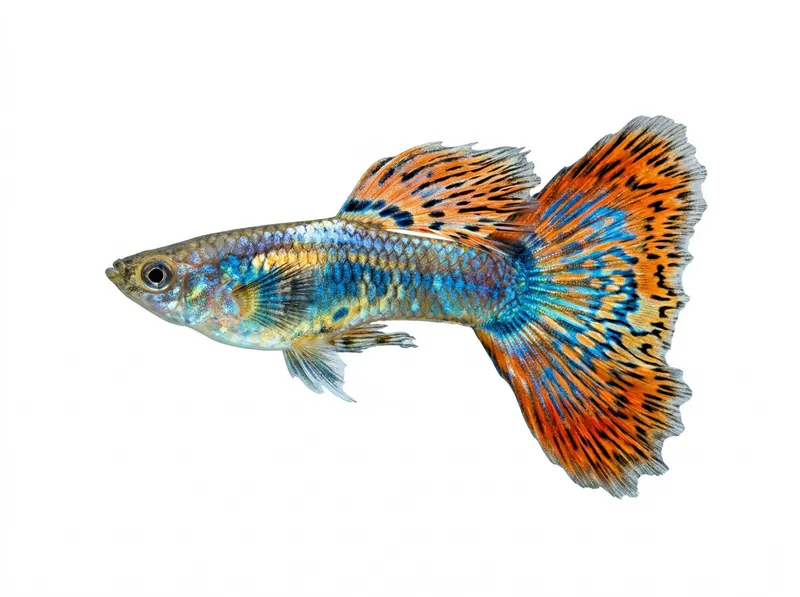
The guppy is the world's most widely kept freshwater fish. It's been in the hobby since the early twentieth century, introduced to fishkeepers through its scientific collector Robert John Lechmere Guppy, and has since been developed through selective breeding into hundreds of distinct colour forms and fin varieties. Mosaic, cobra, tuxedo, delta tail, ribbon tail, lyre tail — the terminology for guppy variants alone could fill a glossary.
Wild-type guppies are relatively small and drab by hobby standards, but the variety available in the aquarium trade is extraordinary. Show-quality fancy guppies from dedicated breeders represent decades of selective work and are genuinely impressive animals. Commercial guppies in general shops are often less carefully bred — show quality versus shop quality is a significant difference in this species.
Males are smaller and brilliantly coloured; females are larger, plainer, with a gravid spot (dark patch near the anal fin) visible when pregnant. The sex ratio should be maintained at more females than males — one male to two or three females is often recommended to distribute the male's courtship attention and reduce stress on individual females.
Guppies prefer slightly hard, alkaline water — a small amount of aquarium salt (1 tablespoon per 5 gallons) is sometimes used in guppy tanks, though it's not essential and limits tankmate options. They're active, surface-oriented fish that compete well for food and work in community setups with peaceful tankmates of similar size.
Endler's livebearers
Poecilia wingei
StatValueMale size0.75–1 inchFemale size1–1.5 inchesTemperature72–82°FpH7.0–8.5Lifespan2–3 yearsDifficultyBeginner
Endler's livebearers are closely related to guppies and visually similar — small, with brightly coloured males and larger, plainer females. They were described as a species relatively recently (2005) and had been kept in the hobby under the informal name "Endler's" before their formal description. They remain less common than guppies in general shops but are actively kept by specialist breeders who maintain distinct wild-collected lines.
Pure Endler's livebearers should not be mixed with guppies — the species hybridise readily, and the resulting hybrids undermine the genetic integrity of both pure lines. Hobbyists working with pure Endler's lines take this seriously. Hybrids are common in the trade and are sold as "hybrid Endlers" or simply as fancy guppies — fine for general community keeping but not appropriate if maintaining a pure line matters to you.
Males are vivid — metallic green, orange, and black markings in various combinations depending on the line. Their small size and active behaviour makes them excellent nano tank fish, and a colony in a small, well-planted tank is a genuinely attractive display.
Mollies
Poecilia sphenops, P. latipinna, P. velifera
StatValueAdult size3–5 inches depending on speciesTemperature75–82°FpH7.5–8.5Lifespan3–5 yearsDifficultyBeginner–Intermediate
Mollies are the largest of the commonly kept livebearers and the most demanding in terms of water quality. They're native to coastal habitats — some populations are found in brackish or even fully marine conditions — and they're intolerant of poor water quality in a way that guppies and platies are not. Elevated nitrates, acidic water, and soft water all cause mollies to show "the shimmies" — a characteristic side-to-side swaying or rocking behaviour that indicates the fish is stressed and unwell.
Keeping mollies well means hard, alkaline water (pH 7.5–8.5, moderate to high hardness), excellent filtration, and regular water changes. Many molly keepers add aquarium salt to their tanks — mollies genuinely benefit from it in a way that most freshwater fish don't. The addition of salt (1–2 tablespoons per 5 gallons) reduces the incidence of the shimmies and improves overall condition.
The common molly varieties available in the hobby include black molly (P. sphenops), dalmatian molly (black and white spotted), lyretail molly, balloon molly (a selectively bred short-bodied form), and the spectacular sailfin molly (P. latipinna and P. velifera) — males of which develop enormous dorsal fins that they fan dramatically during courtship. Sailfin mollies grow larger than short-fin varieties and are even more demanding of water quality.
Platies
Xiphophorus maculatus, X. variatus
StatValueAdult size1.5–2.5 inchesTemperature70–80°FpH7.0–8.0Lifespan3–5 yearsDifficultyBeginner
Platies are arguably the most beginner-friendly livebearer in the hobby. They're hardier than mollies, less demanding about water quality, more colourful and larger than guppies, and have a calmer, less frenetic energy than swordtails. A mixed-sex group of platies in a community tank just works — they're peaceful, attractive, and productive without requiring any special attention.
The colour variety in platies is extensive: sunset platy, red wag, blue mirror, gold twinbar, rainbow — the range of commercially available forms is almost as broad as guppies. They're among the most extensively hybridised fish in the hobby — the "platy" in shops is typically a hybrid between X. maculatus and X. variatus, but the resulting fish are robust and breed reliably.
Variable platies (X. variatus) are somewhat different from the common platy — more elongated in body shape, with a slightly different fin structure, and available in some striking colour forms including the parrot platy and marigold. They're worth seeking out if you're interested in the species beyond the standard shop forms.
Platies are omnivores with a notable fondness for algae — they'll graze plant surfaces and glass just as a bristlenose would. This algae-grazing habit makes them useful in planted tanks and adds a natural behaviour dimension that distinguishes them from purely carnivorous community fish.
Swordtails
Xiphophorus hellerii
StatValueMale size4–5 inches including swordFemale size3–4 inchesTemperature72–82°FpH7.0–8.0Lifespan3–5 yearsDifficultyBeginner
The swordtail is named for the elongated lower extension of the male's caudal fin — the "sword" — which can equal or exceed the body length in well-developed specimens. It's the most active and outgoing of the common livebearers, with a higher energy level than platies and a tendency to chase and display that can become problematic in small tanks or with timid tankmates.
Males are aggressive toward each other. Two males in a small tank will fight persistently — dominance chasing, fin nipping, and occasional physical damage. Keep one male per tank or maintain a large enough group (three or more males) in a sufficiently large tank that aggression is distributed. The classic advice is to keep one male to three or more females, which directs the male's energy toward courtship rather than male combat.
An interesting biological quirk: some female swordtails spontaneously change sex to functional males later in life, developing the sword and male colouration. This sex reversal is more likely in tanks with few or no males and represents a fascinating example of environmental sex determination.
Colour forms include red swordtail (the classic), green, black, pineapple, and various hybrid forms. The wild-type green swordtail is occasionally available from specialist breeders and is a genuinely beautiful fish — more subtle than the commercial forms but with excellent body proportions and natural behaviour.
Water requirements
All four main livebearer species prefer hard, slightly alkaline water. This reflects their natural habitat in Central American rivers and lakes, many of which have significant mineral content from limestone geology. The practical implication is that livebearers are often easier to keep in areas with hard tap water than areas with soft water.
SpeciespHHardnessSalt beneficial?Guppy7.0–8.0Moderate to hardOptionalEndler's7.0–8.5Moderate to hardOptionalMolly7.5–8.5HardBeneficialPlaty7.0–8.0Moderate to hardOptionalSwordtail7.0–8.0Moderate to hardOptional
In soft water areas, adding crushed coral to the filter or using a small amount of mineral buffer raises both pH and hardness toward the preferred range. Aquarium salt contributes chloride ions but doesn't significantly affect hardness — it's beneficial specifically for mollies but not a replacement for appropriate GH for any of the species.
Feeding
All livebearers are omnivores and uncomplicated feeders. They accept virtually any food offered and are rarely picky. Quality flake food is the standard diet for most community livebearer setups, supplemented with:
Frozen bloodworm — excellent conditioning food particularly for breeding fish
Frozen brine shrimp — universally accepted and nutritious
Daphnia — good for digestive health
Blanched vegetables — particularly for mollies and platies, which have stronger herbivorous tendencies
Spirulina flake or wafer — algae-based food that benefits mollies particularly
Feed twice daily, offering what the fish consume in two to three minutes. Livebearers have small stomachs relative to their apparent appetite — they appear perpetually hungry. Overfeeding is common and leads to elevated nitrates and associated problems. Fast once per week.
Breeding and fry management
Livebearer breeding requires essentially no deliberate intervention — it happens in any mixed-sex tank. The practical challenge is what to do with the fry, which arrive in numbers (10–50+ per brood) on a regular cycle (every four to six weeks at typical aquarium temperatures).
Pregnancy identification
A pregnant female's gravid spot — the dark area near the anal fin where the developing fry are visible — enlarges as pregnancy progresses. In the final days before birth, the spot may become very dark or even show the eyes of the fry through the female's body wall. A noticeably squared-off abdomen is another indicator that birth is imminent.
Fry survival
Livebearer fry are born fully formed and immediately capable of swimming and feeding. They're also immediately at risk of being eaten — by other fish and sometimes by their own mother. In a densely planted tank with good cover, some fry will survive without intervention. In a sparse tank, survival rates may be very low.
For deliberate fry rearing: move heavily pregnant females to a separate breeding or nursery tank shortly before birth. A small tank with dense floating plants, a gentle sponge filter, and appropriate water parameters provides a safe birth environment. Return the female to the main tank after birth (she will not consistently protect fry and may eat them).
Managing numbers
With productive livebearer pairs, managing fry numbers becomes the primary challenge. Options include: allowing natural predation in the main tank (reduces numbers to sustainable levels without intervention), raising fry in a grow-out tank for sale or trade, or maintaining a male-only or female-only tank to halt reproduction.
Tankmates
Livebearers are generally easy to combine with other community fish. The main considerations are:
Guppy males and fin-nipping fish — guppy tails are irresistible to some fin-nipping species (tiger barbs, some tetras). Either avoid combining them or keep tiger barbs in large enough groups that their nipping behaviour is directed internally.
Molly salt requirements — if you salt a molly tank, this restricts tankmate options considerably. Most community fish don't benefit from salt and some are harmed by it.
Swordtail male aggression — male swordtails can be aggressive to other male fish of similar appearance. Monitor for harassment in mixed cichlid or livebearer setups.
Good universal livebearer companions include most tetras (except tiger barbs), rasboras, corydoras, bristlenose plecos, peaceful small to medium cichlids (kribensis, keyhole), and other livebearers of similar size.
Health and common problems
Velvet (Oodinium)
Gold dust or rust-coloured sheen over the body, often easier to see under a torchlight held at an angle. More common in livebearers than ich. Treat with copper-based medication (remove shrimp and invertebrates first), raise temperature, and reduce lighting.
Ich (white spot)
Small white granules across the body and fins. Standard heat and medication treatment is effective. Livebearers tolerate most ich treatments well.
The shimmies
Specifically in mollies — side-to-side rocking or swaying behaviour at the surface. Almost always indicates poor water quality (too soft, too acidic, elevated nitrates) or salt deficiency. Improve water parameters and add salt. Not contagious and not a specific disease — it's a stress response to inadequate water conditions.
Fin rot
Fraying or discolouration of fins, particularly noticeable in long-finned varieties like fancy guppies and lyretail mollies. Typically secondary to poor water quality or fin nipping. Improve water quality, remove fin-nipping tankmates, and treat with antibacterial medication if infection has progressed.
Wasting disease
Fish that eat normally but continue to lose weight despite good water quality may have internal parasites — particularly Camallanus worms, which are visible as small red threads protruding from the anal vent in more advanced cases. Treatment with levamisole or fenbendazole is effective; both are available through specialist aquatic suppliers.