Search AquaLots
Find fish, plants, invertebrates and equipment
Malawi Cichlid Care Guide UK: Mbuna, Peacocks, Haps and Tank Setup
28 March 2026
Malawi cichlids are the freshwater hobby's best-kept secret — extraordinary colour, intelligence, and breeding behaviour at a fraction of the cost and complexity of a marine reef. If you're in a hard water area of the UK, you actually have a natural advantage most fishkeepers around the world don't. Here's the full guide.
In this guide
Lake Malawi — understanding the habitat
Lake Malawi sits in the East African Rift Valley — a geological tear in the continent that created a series of deep, ancient freshwater lakes. Lake Malawi is massive: 560 kilometres long, up to 75 kilometres wide, and nearly 700 metres at its deepest. It's been isolated long enough that the cichlid species within it have undergone extraordinary speciation — there are estimated to be between 700 and 1,000 cichlid species in Lake Malawi alone, the majority of which exist nowhere else on earth. This level of biodiversity in a single lake is one of the most remarkable examples of evolutionary radiation in the vertebrate world.
What makes Lake Malawi distinctive as a fishkeeping habitat is its water chemistry. Unlike most freshwater habitats in the fishkeeping world — Amazon basin soft and acidic water, Southeast Asian soft jungle streams — Lake Malawi is alkaline, hard, and mineral-rich. The water is effectively freshwater that behaves almost like dilute ocean water in terms of its mineral content and stability. pH runs between 7.8 and 8.5. General hardness is typically 8–16 dGH. Carbonate hardness is high, providing strong pH buffering. This chemistry is what most UK tap water more closely resembles than anything else in the freshwater hobby.
The UK hard water advantage
Most UK fishkeepers are taught, rightly, that their tap water is too hard and alkaline for many popular tropical species. Soft water Amazonian species — discus, apistogramma, cardinal tetras — require water modification or RO treatment in hard water areas of England. This creates a perception that UK tap water is a problem to be managed.
For Malawi cichlids, UK tap water is not a problem. It is very nearly ideal. The moderately to heavily hard, neutral-to-alkaline water that comes out of taps in most of England — particularly the Midlands, South East, East Anglia, and London — is almost exactly what Lake Malawi delivers naturally. In some hard water areas you're adding specific Malawi mineral salts to soften the water just slightly; in others you can simply use tap water directly after dechlorination.
This means Malawi cichlid keeping has a genuinely lower setup cost in the UK than many other specialist fishkeeping pursuits. No RO unit, no remineralisation products, no ongoing water chemistry management. Dechlorinate, monitor pH and hardness quarterly to ensure your tap water hasn't changed significantly, and you're done with water chemistry.
If your water is very soft (GH below 8 dGH) — more common in Wales, Scotland, and parts of the North West — you'll want to add a Malawi-specific mineral salt or buffer to raise hardness and stabilise pH in the high 7s to 8.0 range. Crushed coral in the filter or as a substrate additive also raises carbonate hardness naturally and is inexpensive.
The three groups: mbuna, peacocks and haps
Malawi cichlids are broadly divided into three groups that reflect their ecological niches and behavioural differences. Understanding this division is the most important step before buying fish, because mixing groups incorrectly is the most common cause of aggression problems and hybridisation.
Mbuna
Rock-dwelling cichlids from the rocky shoreline habitat of the lake. Predominantly herbivores that rasp algae from rock surfaces. Highly territorial, aggressive, and active. Brilliant colours — the electric yellows, deep blues, and vivid patterns that draw most people to Malawi cichlids initially. Most mbuna are between 8–15cm at full adult size. They need rocky structure to establish territories and should be crowded (more on this below).
Peacock cichlids (Aulonocara)
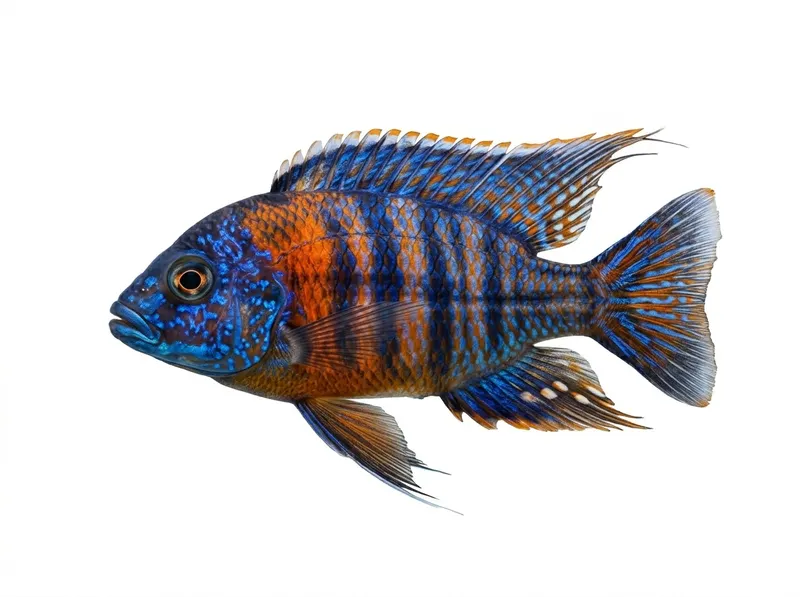
A single genus containing around 25 species, all from deeper, sandy-bottomed areas of the lake. Less aggressive than mbuna. Males display extraordinary colours — blues, yellows, reds, and metallic combinations — while females are generally silvery-brown. They feed primarily by sifting through sand for small invertebrates. Slightly more peaceful and a good starting point for Malawi keeping if you want colour without the intensity of mbuna aggression.
Haplochromine cichlids (Haps)
A broadly applied term for the open-water cichlids of the lake that don't fit the mbuna or Aulonocara classifications. Haps range from small-to-medium species compatible with peacock setups to large, predatory fish that need their own tanks. They are generally less aggressive than mbuna but more predatory, and many will eat smaller fish. Males of many hap species are among the most spectacularly coloured fish in freshwater fishkeeping.
The mixing rule
Keep Malawi cichlids with other Malawi cichlids. Do not mix them with cichlids from other lake systems (Tanganyika, Victoria) or from other geographical regions (South American cichlids) without very careful research. Mixing groups within Malawi requires understanding which species are compatible — mbuna and peacocks can coexist in large tanks with careful planning, but mbuna aggression can stress peacocks significantly in smaller setups. Haps and peacocks mix well. Research each species before stocking.
Mbuna species guide
Mbuna means "rock fish" in the Tonga language of northern Malawi. These are the most commonly kept Malawi cichlids in the UK, primarily because of their extraordinary colours and their suitability for mixed community mbuna setups in tanks starting from 120 litres.
Labidochromis caeruleus — Electric yellow cichlid
The most popular Malawi cichlid in the UK hobby. Vivid lemon-yellow body with black fin markings. Less aggressive than most other mbuna, making it a good starting species and a compatible companion for other mbuna. Reaches around 10cm. Easy to find in shops and from specialist breeders.
Pseudotropheus demasoni
Striking dark blue and light blue stripes. One of the smaller mbuna at 7–8cm but among the most aggressive. In a correctly stocked, crowded tank they work well; in an understocked tank a single dominant male can be lethal to others. Follow the overcrowding principle strictly with demasoni.
Metriaclima estherae — Red zebra cichlid
Males are blue; females are vivid orange-red — one of the few mbuna where females are as intensely coloured as males. Hardy and active. A staple of UK Malawi setups.
Melanochromis auratus — Auratus cichlid
Dramatic colour reversal between sexes and juveniles — juveniles and females are yellow and black, males are dark with gold/white stripes. One of the more aggressive mbuna. Needs careful management in community setups; tends to dominate.
Iodotropheus sprengerae — Rusty cichlid
Muted purple-brown colouration with a subtle iridescence. One of the less aggressive mbuna options — better for mixed setups than many other species. Underrated in the hobby.
Labeotropheus trewavasae and L. fuelleborni — Fuelleborn's cichlid
Robust, blue-bodied cichlids with rounded snouts adapted for scraping algae. Heavy-bodied and aggressive. Multiple colour morphs exist. Large for mbuna at 12–15cm.
Peacock cichlids (Aulonocara)
Aulonocara species are among the most spectacularly coloured fish available in freshwater fishkeeping. The males of most species display electric blues, vivid yellows, and metallic combinations that legitimately rival marine fish for visual impact. They're also significantly more peaceful than mbuna, which makes peacock-only or peacock-hap setups more forgiving for beginners.
Aulonocara stuartgranti — Flavescent peacock
The most commonly available peacock in the UK, with multiple geographic colour variants. Males display blue and yellow colouration that intensifies dramatically in breeding condition. The "OB" (orange blotch) variant — where females develop mottled orange colouration through a specific gene expression — is particularly striking.
Aulonocara jacobfreibergi — Mamelela peacock / Fairy cichlid
One of the larger Aulonocara species at 15cm+. Males develop vivid blue, orange, and yellow colouration. More territorial than smaller peacock species; needs a larger tank to manage properly.
Aulonocara hansbaenschi — Red shoulder peacock
Blue body with vivid red-orange shoulder colouration on males. One of the most popular peacock species in the UK hobby. Widely available from specialist breeders.
Aulonocara nyassae — Emperor cichlid
The original peacock species. Deep royal blue with subtle yellow highlights. Considered the benchmark for Aulonocara colour quality.
Haplochromine cichlids
Copadichromis borleyi — Kadango cichlid
One of the most visually impressive hap species — males develop stunning blue-green-red colouration in breeding condition. A mid-sized hap at around 15cm that works well in peacock-hap community setups.
Sciaenochromis fryeri — Electric blue ahli
Solid electric blue colouration on males — one of the most intense solid blues in freshwater fishkeeping. Peaceful for its size, pairs well with peacocks. A staple of UK Malawi setups.
Nimbochromis livingstonii — Livingstonii cichlid
A large predatory hap (up to 25cm) notable for its behaviour of lying motionless on the substrate to ambush smaller fish. Not suitable for mixed setups with smaller cichlids. Spectacular when kept appropriately.
Protomelas taeniolatus — Red empress cichlid
Males develop vivid red and orange colouration across the head and flanks, contrasting with blue scaling. Peaceful and large at 15–18cm. One of the most popular hap species in UK fishkeeping.
Tank setup
Tank size
The minimum tank size for a Malawi cichlid setup is 120 litres for a modest mbuna community, but 180–240 litres gives you the space to stock correctly and manage aggression effectively. Bigger tanks are not just more comfortable — they are functionally better for Malawi keeping because the overcrowding principle (see below) requires sufficient space for territories to be split between enough fish that no single fish dominates completely.
A long, shallow tank suits Malawi cichlids better than a tall, narrow one. They occupy rock structure and the lower and middle water column primarily, and horizontal swimming space matters more than depth.
Substrate
Fine sand is standard for Malawi cichlid tanks. Peacocks and haps need sand to sift through as natural feeding behaviour. Sand is also easier to clean than gravel in high-bioload setups, and its pale colour shows off the fish's colours effectively. Cichlid-specific sand like Caribsea Sahara is popular; fine play sand works equally well at lower cost. Some keepers use crushed coral mixed into the sand to boost carbonate hardness — beneficial if your tap water is soft.
Rockwork
Rock structure is the defining feature of a Malawi mbuna setup. The rocks serve multiple functions: they create territories that break line of sight between fish, provide caves for subordinate fish to shelter in, and replicate the natural rocky shoreline habitat. Caves, overhangs, and crevices are all used by the fish.
Common rock choices in UK setups include slate (widely available and stackable to create complex structures), tufa rock (porous, lightweight, creates complex surface texture), limestone (raises pH and hardness slightly — beneficial for Malawi), and artificial rock structures. Avoid driftwood — it leaches tannins that lower pH, counteracting the high-pH environment Malawi cichlids need.
Stack rock to the back and sides of the tank, leaving an open sand area in the centre. This gives fish both territory (in the rock structure) and open swimming space.
No plants
Live plants don't work in mbuna tanks — they're eaten. The high pH and active digging also make most aquatic plants impractical. Algae growth on the rocks is actually beneficial for mbuna as a grazing surface. Artificial plants are occasionally used for visual effect but aren't necessary.
Lighting
Blue-spectrum LED lighting enhances the colours of Malawi cichlids significantly, particularly the iridescent blues and greens. Standard white LED lighting works but full-spectrum or blue-heavy reef-style lighting makes a dramatic visual difference. This is one area where a modest investment in lighting repays immediately in how the tank looks.
Water parameters
ParameterTarget rangeTemperature24–28°CpH7.8–8.5GH (hardness)10–20 dGHKH (carbonate hardness)8–15 dKHAmmonia0 ppmNitrite0 ppmNitrateBelow 40 ppm (below 20 ppm preferred)
The elevated nitrate tolerance compared to sensitive tropical species reflects the lake's large, dilute water chemistry — Malawi cichlids are somewhat more tolerant of nitrate accumulation than many other fish. That said, chronic elevated nitrates still cause health problems over time, and weekly or fortnightly water changes of 25–30% should be standard maintenance.
Filtration
Malawi cichlids are heavy waste producers. A tank stocked with a proper mbuna community requires filtration rated for significantly more than the actual tank volume — a 200-litre Malawi setup should have filtration capacity of at least 400–600 litres per hour. Overcrowding the tank (necessary for aggression management) increases the bioload further.
External canister filters are the standard for Malawi setups at this volume. Two canister filters running simultaneously provides redundancy and additional biological capacity. Add an internal filter or powerhead to increase water movement — Malawi cichlids benefit from moderate to strong circulation that replicates the wind-driven, wave-affected shallows of the lake.
Strong circulation also helps prevent the dead water zones behind rockwork where detritus accumulates and water quality deteriorates. Direct flow to reach behind rock structures where possible.
Managing aggression — the overcrowding principle
This is the most counterintuitive aspect of Malawi cichlid keeping and the one that most surprises keepers coming from community fishkeeping backgrounds. In most community tanks, you stock lightly to reduce competition. In a Malawi mbuna setup, you stock densely — and this actually reduces aggression.
The mechanism: in a tank with few fish, a dominant male establishes territory over the entire tank and pursues each other fish relentlessly. With nowhere to escape to and no other fish to deflect aggression onto, subordinate fish are killed or stressed to death. In a densely stocked tank, the dominant male cannot maintain attention on any single target — aggression is spread across many fish, no individual fish receives a lethal concentration of harassment, and subordinate fish can shelter in the rock structure while the dominant male is busy displaying to someone else.
Practical guidance for mbuna overcrowding:
Stock multiple species (4–6 in a 180+ litre tank) to prevent any species being systematically targeted
Maintain a ratio of one male to multiple females per species where possible — this dilutes male-to-male aggression
Add most fish at the same time to prevent an established fish dominating new arrivals in a territory it's already claimed
Rearrange rock structure when adding new fish — this resets territory claims and reduces the advantage of established fish over newcomers
Remove any fish that is being targeted persistently — overcrowding reduces but does not eliminate the possibility of one fish becoming a chronic victim
This principle applies most strongly to mbuna. Peacock and hap setups are less densely stocked and can be managed with more conventional stocking approaches.
Feeding — the mbuna diet mistake
The most common health-related mistake in mbuna keeping is the diet. Mbuna are primarily herbivores — they evolved to rasp algae from rock surfaces, not to hunt and eat meat. Feeding them high-protein foods causes a specific and serious condition called Malawi bloat.
Malawi bloat is abdominal swelling caused by bacterial proliferation in the digestive tract triggered by inappropriate feeding — specifically, excessive protein from bloodworm, beef heart, and other animal-based foods. It can be fatal within days of onset and is very difficult to treat once established. Prevention through appropriate feeding is far preferable to treatment.
Feed mbuna:
Quality spirulina flake as the primary staple — this is what they're designed to eat
Algae wafers and spirulina-based cichlid pellets
Occasional blanched vegetables — spinach, kale, peas, cucumber
Small amounts of krill or Mysis shrimp occasionally for variety and colour enhancement
Do not feed bloodworm, beef heart, or other high-protein animal matter as regular foods for mbuna. Peacocks and haps are more carnivorous and can handle more protein — but even for mixed peacock-hap setups, a spirulina-based staple with protein supplements is safer than a protein-heavy diet.
Mouthbrooding and breeding
Most Malawi cichlids are maternal mouthbrooders — after spawning, the female picks up the fertilised eggs in her mouth and carries them through incubation (typically 21–28 days) and the early fry stage. During this period, the female stops eating entirely.
Breeding happens readily in correctly maintained Malawi tanks without any deliberate intervention. You will simply notice a female with a swollen lower jaw who has stopped eating — this is a holding female. Options at this point:
Leave her in the main tank. She will eventually release the fry, most of which will be eaten immediately. Some will survive if there is sufficient rock structure to hide in. This works passively and requires nothing from you.
Move her to a separate holding tank. A quiet 40-litre bare-bottom tank with a sponge filter lets her complete brooding without the stress of the main tank. She can be returned after releasing fry. This improves fry survival significantly.
Strip the eggs. An experienced technique where the eggs are removed from the female's mouth and artificially incubated. Requires practice and is not necessary for casual keeping.
Fry released from a mouthbrooder are surprisingly large and capable — they can eat baby brine shrimp immediately and grow quickly. Malawi cichlid fry are relatively easy to raise compared to egg-scattering species.
Health and Malawi bloat
Malawi bloat — abdominal swelling with possible pinecone-scaling, lethargy, and loss of appetite — requires immediate action. Move the affected fish to a hospital tank immediately. Treat with metronidazole (available in proprietary treatments including API General Cure). Withhold all food. Reduce protein content of the diet permanently for the affected tank. Early treatment can save fish; advanced bloat with raised scales usually cannot be reversed.
Other health concerns in Malawi tanks: bacterial infections from physical aggression injuries (treat wounds with antibacterials, address the aggression cause), ich from temperature drops (standard treatment), and hole-in-the-head from chronic poor water quality and dietary deficiency (improve conditions, feed varied diet, treat with metronidazole for Hexamita component).
Sourcing quality Malawi cichlids in the UK
The Malawi cichlid community in the UK is one of the most active specialist communities in the hobby. There are dedicated breeders working with specific species, line-bred colour strains, and wild-caught geographic variants. General pet shops stock the common mbuna species — electric yellows, red zebras — but for less common species and quality specimens, specialist sources are worth seeking.
AquaLots connects buyers with UK Malawi cichlid breeders and specialist sellers directly. The advantage of buying from a dedicated Malawi breeder is the same as in any other specialist purchase: known water parameters, feeding history, confirmed species identification (hybridisation is a genuine problem in the Malawi hobby — buying from reputable sources reduces the risk), and sellers who understand the fish they're selling well enough to advise on compatible tankmates and setup.
When buying, ask about the fish's origin — captive bred or wild caught, and if captive bred, how many generations. Ask about water parameters, feeding, and current tank companions. A seller who can answer these questions clearly is a reliable source. One who can't identify the species precisely beyond "African cichlid" is not.
Quarantine all new Malawi cichlids for two to four weeks before introducing them to an established tank. Even healthy-looking fish can carry pathogens that their immune systems manage until the stress of introduction to a new tank allows an outbreak. Quarantine protects your existing collection.