Search AquaLots
Find fish, plants, invertebrates and equipment
Neocaridina Shrimp Colour Morphs, Grades and Colony Building
31 March 2026
You've read the basics. Now this is the guide for anyone who wants to go further — understanding what separates a painted fire red from a sakura, why UK tap water is quietly one of the best in the world for Neocaridina, how moulting works and when it goes wrong, and how to build a colony that produces sellable shrimp rather than just more shrimp.
In this guide
Why Neocaridina dominates UK shrimp keeping
The freshwater shrimp hobby in the UK has two main branches — Neocaridina and Caridina — and they're not equivalent in terms of accessibility. Caridina shrimp (crystal reds, bee shrimp, Taiwan bees) are specialist animals requiring soft, acidic water that most UK tap supplies don't provide naturally. Setting up a proper Caridina tank means RO units, remineralisation, active buffering substrate, and significantly more careful monitoring. The payoff is extraordinary, but the barrier to entry is real.
Neocaridina davidi is different. It evolved in waterways with a broad range of conditions, was selectively bred in captivity for decades, and the captive strain has adapted further to aquarium life. The result is a shrimp that thrives in moderately hard, neutral to slightly alkaline water — which happens to describe most UK tap water almost exactly. This isn't a coincidence that makes UK keeping easier; it's genuinely optimal. Many of the most productive Neocaridina breeding operations in the world are in countries with similar water chemistry to the UK.
The diversity of colour forms now available within a single species is remarkable. Everything from the original translucent wild form to near-black, deep blue, vivid yellow, and dozens of named and graded colour lines — all of which breed true, hybridise readily with each other, and require identical care. The collector market that has developed around high-grade colour forms is active, international, and continuously producing new varieties.
UK tap water — the hidden advantage
One of the most consistent pieces of misinformation in UK shrimp keeping is the idea that tap water needs to be heavily modified for Neocaridina. For the vast majority of UK water supplies, this isn't true — and understanding why helps you keep shrimp better.
What Neocaridina actually needs
ParameterIdeal rangeTemperature18–26°CpH7.0–7.8GH (general hardness)6–10 dGHKH (carbonate hardness)2–6 dKHTDS150–250 ppmAmmonia0 ppmNitrite0 ppmNitrateBelow 20 ppm
Now look at typical UK tap water. Most of England has moderately hard to hard water with pH in the 7.2–7.8 range and GH of 8–14 dGH. The East Midlands, South East, and most of the South are on the harder side; the North West, Wales, Scotland, and parts of the South West are softer. Virtually all of this falls within or very close to the Neocaridina sweet spot without any modification beyond dechlorination.
Dechlorination — the one thing you must do
UK tap water contains chlorine and often chloramine, both of which are toxic to the beneficial bacteria in your filter and harmful to shrimp directly. Always treat tap water with a dechlorinator before adding it to the tank. Use a product confirmed to neutralise chloramine — not just chlorine — as chloramine (used by many UK water suppliers) is more stable and requires specific chemistry to break down. Seachem Prime is widely used in the UK shrimp community and handles both effectively.
One critical note: avoid dechlorinators containing aloe vera. Products marketed as containing "natural extracts," "slime coat protection," or "herbal ingredients" often contain aloe — which is irritating to invertebrates. Check ingredients. Several widely sold aquarium conditioners contain aloe and should not be used in shrimp tanks.
When you do need to modify water
If your water is very hard (above 15 dGH) — common in parts of London, the South East, and Lincolnshire — Neocaridina will still survive but the elevated mineral content can cause problems long-term. Blending your tap water with a proportion of RO water or collected rainwater (if tested clean) brings hardness down to the optimal range. You don't need to go full RO — even a 30–50% RO blend typically corrects very hard tap water sufficiently.
If your water is very soft (below 5 dGH) — more common in Scotland, Wales, and parts of the North — shrimp will struggle to moult successfully without adequate minerals. Add a Neocaridina-specific remineraliser to bring GH into the 6–8 dGH range. Do not use Caridina remineralisers for this — they're formulated for a completely different water profile.
Copper — the invisible killer
Copper is acutely toxic to all invertebrates at concentrations that don't affect fish at all. Sources of copper contamination in shrimp tanks include: copper pipework in older homes (test your tap water if you have copper pipes, especially from hot water run through a mixer tap — never use hot tap water for water changes), liquid fertilisers containing copper micronutrients, and some medications. Test your tap water for copper if you have unexplained shrimp deaths in an otherwise well-maintained tank. A basic copper test kit costs a few pounds and rules out the most common invisible cause of shrimp mortality.
The red line — cherry, sakura, fire red, painted fire red
The red variants of Neocaridina davidi are the most widely kept and most thoroughly graded colour line in shrimp keeping. Understanding the grades is important both for buying and for breeding — the grading system describes what you're actually selecting for when you breed shrimp.
Cherry shrimp (basic grade)
The entry-level red Neocaridina. Partial red colouration, with significant translucency — you can see through the body, the organs are visible. Males typically have very pale red or are nearly transparent. Females have more colour but it's patchy and inconsistent. These are the shrimp sold in general pet shops at £1–2 each, and while they're perfectly healthy and will breed, the colony they produce will be a mix of grades rather than consistently high colour.
Sakura
A step up from cherry. Females have solid red colouration across most of the body, with some translucency remaining in the abdomen. Males are still lighter but show more colour than basic grade. Sakura grade is where the red line starts looking genuinely impressive in a colony. Expect to pay £3–5 per shrimp from a reputable seller.
Fire red / high red
Deep, opaque red colouration across the full body including legs. Minimal translucency. Even males show significant red colour. The colony produced from fire red parents will be predominantly high-grade with some variation. Fire red is the practical sweet spot for most hobbyists who want impressive-looking shrimp without paying top prices for painted fire red. Typically £4–8 per shrimp.
Painted fire red
The top grade. Full, opaque, vivid red across the entire body including the underside and all appendages. No translucency visible. Males at this grade are also noticeably coloured rather than the near-transparent males typical of lower grades. A tank of painted fire reds is visually extraordinary — the uniform, intense colour across a colony is unlike anything below this grade. Prices range from £8–20+ per shrimp for verified, true-breeding painted fire red lines from established breeders.
Bloody mary
Sometimes classified as a separate morph, sometimes as a variant within the red line. Bloody mary shrimp have a particularly deep, dark red colouration with a quality that looks almost internally lit — the pigment penetrates the muscle tissue rather than just the exoskeleton, giving a unique visual depth. They don't interbreed cleanly with standard red lines without colour degradation, so serious breeders maintain them separately.
The blue line — blue velvet, blue dream, blue diamond
Blue Neocaridina morphs are among the most visually striking variants and among the most actively collected by dedicated hobbyists. The blue colouration ranges from pale grey-blue at lower grades to deep, vivid cobalt at the top of the market.
Blue velvet
The entry-level blue morph. Semi-transparent blue-grey body with variable coverage. The "velvet" name refers to the soft, matte quality of the blue tint in good lighting. Against dark substrate with planted backdrop they're attractive even at lower grades; in poor conditions or on light substrate, the colour appears washed out. Widely available, typically £2–4 per shrimp.
Blue dream
Higher-grade blue with better body coverage and more consistent colouration. Solid mid-blue across the body with some translucency. Blue dream shrimp are the most commonly traded "quality" blue Neocaridina and the price point most hobbyists encounter when looking for a step up from basic blue velvet. £4–8 per shrimp from reputable sellers.
Blue diamond
Deep, opaque, full-body blue with minimal translucency. The benchmark for the blue colour line — equivalent to painted fire red in the red line. True blue diamond lines from established breeders produce consistently high-grade offspring. These are collector-tier shrimp, typically £10–25+ each from verified sources.
Carbon rili
A pattern morph rather than a solid colour — a transparent midsection with deep blue (or sometimes red) colouration at the head and tail, creating a striking two-tone effect. Rili patterning is distinctive and unusual, and high-grade rili shrimp with clear contrast between the coloured sections and the transparent centre are actively sought by collectors.
Yellow and orange morphs
Yellow neon / lemon shrimp
Bright lemon-yellow colouration that shows particularly well against dark substrate and under LED lighting. Underrated in the hobby relative to the reds and blues — the vivid yellow colouration is genuinely striking in a well-planted tank. Grades follow similar logic to the red line: cherry-equivalent (partial colour, translucent), through to high-grade solid yellow with full body coverage. Very hardy, same care as all Neocaridina.
Orange sunkist
Warm orange colouration, positioned between the yellow and red lines in hue. Sunkist shrimp are popular with hobbyists who want something different from the standard red and blue offerings. The orange is most vivid in high-grade females; males are typically lighter orange to near-translucent.
Orange rili
The rili patterning applied to the orange line — transparent midsection with orange head and tail. Similar collector appeal to carbon rili.
Dark morphs — black rose, carbon rili, bloody mary
Black rose
Near-black body colouration, achieved through selective breeding for maximum melanin expression. High-grade black rose shrimp are genuinely very dark — almost opaque black across the full body. Against a light substrate they're extremely striking; against dark substrate the colouration can be harder to appreciate. Less common than red or blue variants, and correspondingly more sought after by collectors.
Chocolate shrimp
A rich, deep brown colouration — distinct from the near-black of black rose. Less commonly available than other dark morphs. The "chocolate" name describes the warm, dark brown tone accurately.
Rarer and newer morphs
The Neocaridina colour hobby is active and creative, and new morphs and varieties are introduced regularly. Some notable examples in the current (2025–2026) market:
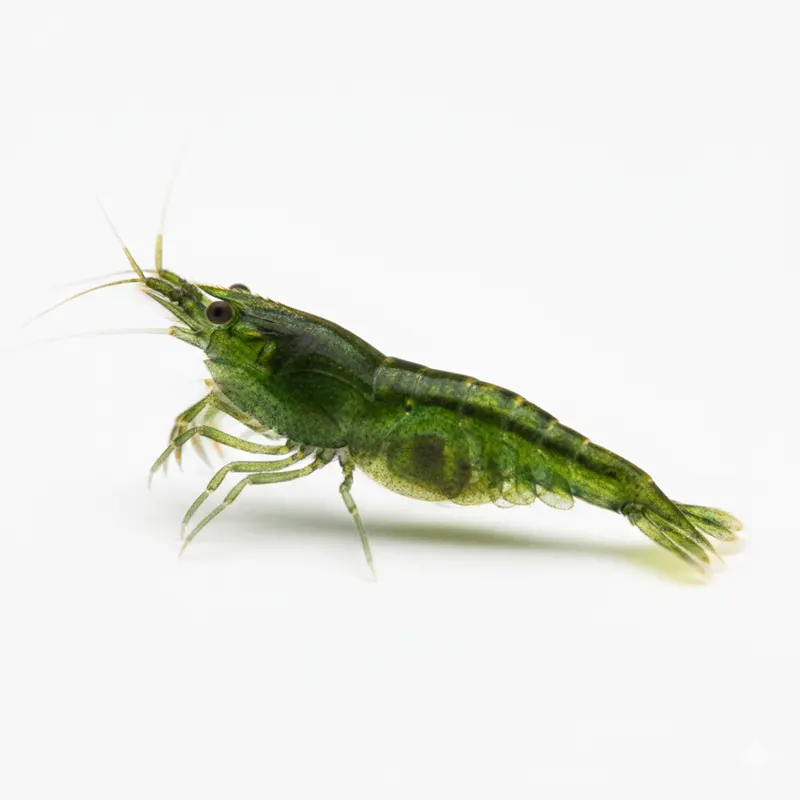
Green jade — olive to vivid green colouration, variable by grade. Genuinely green shrimp are unusual in the hobby and green jade lines command attention from collectors.
Hulk / extreme green — selectively bred for intensified green pigmentation, distinct from green jade. Rare and actively collected.
Snowball / white pearl — white to cream colouration. Snowball shrimp are recognisable for their white egg clusters (which gives the morph its name — females carrying eggs look like they're carrying a snowball). More challenging to maintain high grade than the red line.
Panda — black and white patterning. A collector morph requiring careful line breeding to maintain the pattern consistency.
Skittles mixes — combinations of multiple colour morphs sold together as visual variety rather than for line breeding. Popular for display tanks where colour consistency across a colony isn't the goal.
The grading system explained
The grading system in Neocaridina describes colour intensity, opacity, and coverage across the body. The same framework applies across colour lines — what makes a "high grade" red shrimp makes a "high grade" blue shrimp, just in different colour.
Key grading criteria:
Opacity — can you see through the body? Lower grades are translucent (organs visible); higher grades are opaque (solid colour throughout).
Coverage — does the colour extend across the full body including the underside, legs, and appendages? Low-grade shrimp have colour primarily on the dorsal surface; high-grade shrimp have uniform colour top to bottom.
Intensity — is the colour vivid or pale? Even with full coverage, the saturation of the colour varies — high-grade shrimp have intense, saturated colour rather than a pale wash.
Consistency of males — in lower grades, males are nearly colourless. In the highest grades, males show meaningful colour themselves. A colony where both sexes are visibly coloured is at the upper end of the grading scale.
When buying, ask sellers what grade their shrimp are and look at photos carefully. Male-female photos showing both sexes together give a much better indication of grade than female-only photos. A high-grade female next to a translucent male is still a mid-grade line — the male's colour (or lack of it) tells you where the line actually sits.
Colour genetics — the basics
You don't need to understand genetics to keep Neocaridina, but understanding the basics makes you a better breeder and helps you predict what will happen when you mix morphs.
Why mixing colours produces brown shrimp
The wild-type Neocaridina davidi is a mottled brown. Every colour morph in the hobby was developed by selectively breeding away from the wild type, suppressing certain pigments while amplifying others. Red shrimp have been bred to express red pigment strongly and suppress the brown. Blue shrimp express blue. Yellow shrimp express yellow.
When you mix two colour lines — say, blue velvet and cherry red — the offspring's genetics now contain instructions for both colour expressions and the wild-type background. The wild-type brown is dominant, and most mixed offspring revert toward it. A tank of mixed Neocaridina colours doesn't stay mixed — within two to three generations, most offspring are brownish or translucent regardless of what you started with.
Maintaining a colour line
To maintain a colour line, keep that colour isolated. One colour per tank, with no cross-contamination. This is why even shrimp from the same species but different colour lines are kept in separate setups — a single blue velvet shrimp in a cherry red colony will degrade the red line's colour quality within a few generations.
Line breeding for improvement
Once you have a single colour line isolated, you can select for higher grade over time. At each generation, cull (remove or rehome, not necessarily euthanise) lower-grade individuals and use only your highest-grade males and females for the next generation. Over five to ten generations of selection pressure, a cherry-grade line can be improved to fire red or better. This is how the high-grade lines sold by specialist breeders were developed — years of patient selection rather than any single genetic discovery.
The practical implication: when you buy a colony of "mixed grade" shrimp at a lower price, you're starting from a lower base and will need more generations of culling to reach high grade. When you pay more for high-grade, true-breeding stock from an established breeder, you're buying the results of that breeding work already done.
Moulting — the mechanics and what goes wrong
Moulting is the process by which shrimp shed their exoskeleton to grow. It's one of the most critical biological processes in shrimp keeping and one of the most common sources of mortality when things go wrong. Understanding it properly is essential for any keeper beyond the basics.
How moulting works
Shrimp have no internal skeleton. Their body is supported by an external exoskeleton — essentially a shell made of chitin — which doesn't grow with the animal. As the shrimp grows, it periodically sheds the old exoskeleton, expands its soft body quickly while it can, and then hardens the new, larger exoskeleton. This process takes hours to complete, and the window between shedding the old shell and hardening the new one is when the shrimp is completely vulnerable — soft, unable to defend itself, and sensitive to physical and chemical stress.
Adult shrimp moult roughly every three to six weeks. Juveniles moult more frequently. Females moult immediately before and after breeding. You'll see discarded exoskeletons in the tank — they look like ghost shrimp and cause alarm in new keepers who think their shrimp have died. Leave them in the tank: they contain minerals that shrimp will graze and recycle.
What goes wrong — the white ring of death
A failed moult occurs when the shrimp cannot fully emerge from the old exoskeleton. The most distinctive presentation is the "white ring of death" — a white band or gap visible around the shrimp at the joint between the head shield and the abdomen, indicating the exoskeleton has cracked at this point but the shrimp hasn't been able to pull free. A shrimp showing this is almost certainly going to die; there's no reliable treatment at this stage.
Causes of failed moults
GH too low — the most common cause. The minerals in GH (primarily calcium and magnesium) are used to build the new exoskeleton. If GH is too low, the shrimp can't manufacture sufficient exoskeleton material, and the new shell may be too soft to support the animal after moulting. Keep GH at 6 dGH minimum for Neocaridina — 7–8 dGH is optimal.
Parameter instability — sudden changes in any parameter can trigger premature or unsuccessful moulting. This is why large water changes (more than 30–40% at once) are risky in shrimp tanks — the sudden shift in pH, temperature, or TDS can force a moult at the wrong time. Do smaller, more frequent water changes rather than infrequent large ones.
Copper toxicity — copper interferes with the moulting process and chitin formation. Even low-level copper exposure can cause moulting failures.
Iodine deficiency — iodine plays a role in crustacean moulting chemistry. Some shrimp-specific foods include iodine supplementation; in heavily planted, well-fed tanks this is rarely a problem, but in sparse, minimally fed setups it can be a contributing factor.
What to do after a mass moult
Occasionally a tank of shrimp will all moult within a short period simultaneously — triggered by a water change, temperature shift, or new moon cycle (shrimp are sensitive to lunar cycles in ways that are not fully understood but are well-documented by breeders). A mass moult is not inherently a problem, but it means your whole colony is vulnerable at the same time. Minimise disturbance during and immediately after a mass moult, and don't clean the tank or perform water changes for 24–48 hours until the exoskeletons have hardened.
Building a productive colony
There's a difference between having shrimp and having a productive shrimp colony. A tank with ten shrimp and no shrimplets isn't working. Here's how to build a colony that grows reliably and produces surplus stock.
Starting population
Start with at least ten to fifteen shrimp, ideally from a single colour line with a good male-to-female ratio (one male to two to three females is ideal). Starting with fewer shrimp means the founding population may be too small to find mates reliably, and genetic diversity is limited. Ten to fifteen gives you a meaningful starting colony with realistic odds of multiple breeding pairs.
The role of biofilm
Shrimplets — newly hatched shrimp, which are tiny (1–2mm) — cannot eat the same foods as adults. Their primary food is biofilm: the thin, invisible coating of bacteria, algae, protozoa, and organic matter that develops on all surfaces in a mature tank. Without adequate biofilm, shrimplet survival is very poor even if adult shrimp are thriving.
Building and maintaining biofilm requires: a mature tank (at least six to eight weeks old before adding shrimp), surfaces for biofilm to colonise (rocks, wood, plant leaves, sponge filter surfaces, leaf litter), and restraint in cleaning — over-cleaning removes the biofilm shrimplets depend on. This is one of the main reasons a clean, bare-bottom, heavily maintained tank produces poor shrimplet survival rates, while a mature planted tank with leaf litter and a sponge filter produces excellent survival.
Nitrogen management
Nitrate is the long-term water quality issue in established shrimp tanks. Shrimp can tolerate moderate nitrate for short periods but chronically elevated nitrate (above 20 ppm for Neocaridina, above 10 ppm for Caridina) suppresses breeding, increases susceptibility to disease, and eventually causes population decline even when all other parameters look correct. Weekly partial water changes of 10–20% keep nitrate in check without the parameter shock risk of larger infrequent changes. Test nitrate monthly and adjust water change volume based on what you find.
Don't over-stock competing species
Shrimp breed slowly relative to fish. Even in ideal conditions, a colony grows modestly — a few shrimplets per female per month under good conditions. If your tank has too many fish or other organisms competing for the biofilm and space that shrimplets need, colony growth is suppressed. Either run shrimp-only or keep only the most shrimp-compatible companions in breeding tanks.
Breeding for sale — what sells and at what price
A productive Neocaridina colony eventually produces more shrimp than the tank can hold, and selling surplus stock is one of the most natural income streams in the hobby. Understanding what the market actually pays for helps you target your breeding appropriately.
What sells
High-grade, true-breeding colour lines — particularly painted fire red, blue diamond, and top-grade morphs. These command genuine prices from collectors who want to start or improve their own lines. The key word is "true-breeding" — buyers want offspring that will look like the parents, not a colony that grades down after a generation.
Rarer morphs — green jade, black rose, carbon rili, and newer colour forms sell faster than common red cherry because demand consistently outpaces supply from the smaller number of breeders working with them.
Juveniles vs adults — young shrimp at 0.5–1cm sell well because buyers can raise them and feel part of the process. Don't wait until they're fully adult — sell younger.
Berried females — females visibly carrying eggs sell at a premium because buyers are getting the colony jump-start of a breeding-ready female.
Realistic pricing
Basic cherry / low-grade Neocaridina: £0.50–2 each — hard to sell profitably given shipping costs
Sakura / mid-grade red: £2–4 each
Fire red / high red: £4–8 each
Painted fire red / top grade: £8–20 each
Blue velvet: £2–4 each
Blue dream: £4–8 each
Blue diamond: £10–25 each
Rarer morphs (green jade, black rose, carbon rili): £5–15 each depending on grade and availability
The economics work best at mid-to-high grade. Basic grade shrimp face too much price competition from bulk importers. High-grade shrimp from verified lines have a collector market willing to pay appropriately. Investing in quality founding stock and maintaining line purity is the financially rational approach.
Sourcing quality stock in the UK
The quality difference between shrimp from a general pet shop and shrimp from a specialist UK breeder is significant. General shops typically stock low-grade red cherry shrimp maintained in suboptimal conditions — sometimes in tropical fish tanks with incompatible water parameters, sometimes with fish that eat them, rarely with the attention to water chemistry that serious shrimp keeping demands.
For anything above basic grade — and certainly for any Caridina variety — specialist breeders are the right source. AquaLots lists verified UK shrimp sellers including hobbyist breeders who maintain specific grades and colour lines. You can see what grades and morphs are available, message sellers directly about their water parameters and breeding history, and buy with buyer protection in place. This is the difference between buying ten shrimp that might breed and starting a true-breeding line that produces high-grade offspring consistently.
When buying any shrimp for a breeding project, ask: what grade are they? Are they true-breeding (will offspring look like the parents)? What water parameters have they been kept in? How long has the seller maintained this line? A seller who can answer all of these clearly is someone who understands their stock.
Drip acclimate all new shrimp, particularly if the seller's water parameters differ from yours. A two-hour drip acclimation for Caridina, and at least one hour for Neocaridina from significantly different water, minimises the parameter shock that causes losses in the first 24 hours after purchase — the window when most shipping-related losses occur.